

Official websites use .gov
A .gov website belongs to an official government organization in the United States.

Secure .gov websites use HTTPS
A lock (
) or https:// means you’ve safely connected to the .gov website. Share sensitive information only on official, secure websites.


Data Infrastructure for Critical Material Recovery
Summary
The Data Infrastructure for Critical Material Recovery project aims to strengthen critical materials recovery data infrastructure via the development of suitable data sets, metrics, indicators, models and technical standards to define critical materials and information pathways and catalyze the adoption of critical material reliant emerging technologies (AI, Quantum, cloud computing, e-commerce etc.) while supporting the development of regenerative manufacturing systems that maximize product value chains and mitigate critical materials supply risks.
Critical materials are essential to addressing the ‘AI paradox’ associated with manufacturing emerging technologies and products that require the critical material reliant physical infrastructure associated with the widespread adoption of these technologies. In short, critical material shortages can impact the nation’s ability to be a leader in AI, Quantum and digital manufacturing. Regenerative manufacturing systems aim to maximize product value along the entire product life cycle and across multiple dimensions via the implementation and seamless integration of efficient processes, logistics and distribution, and end of use (EoU) product/ resource management to mitigate supply chain risks. This project explores two fundamental research thrusts. The first strengthens systems-level data requirements (e.g., market dynamics and stakeholder actions) that enable increased economic opportunities and better resource utilization. The second research thrust directly supports the first by addressing data needs to strengthen critical material supply chains in the context of new and emerging technologies and products.
This work will support U.S. manufacturers and change-makers in strategizing future business plans by addressing current manufacturing data inconsistencies and strengthening overall predictive capabilities. The research carried out will facilitate identifying standards requirements. Methods, frameworks, metrics, and indicators developed will foster standards development with ISO Technical Committee 323, the ASTM E60 Committee, and the IEEE PV3513 Committee.
Description
Objective
The objective of this project is to strengthen critical materials recovery data infrastructure via the development of suitable data sets, metrics, indicators, models and technical standards to help define critical materials and information pathways across entire product life cycles and catalyze adoption of critical material reliant emerging technologies (AI, Quantum and cloud computing) and support the development of regenerative manufacturing systems that maximize product value chains and mitigate critical material supply risks.
Technical Idea
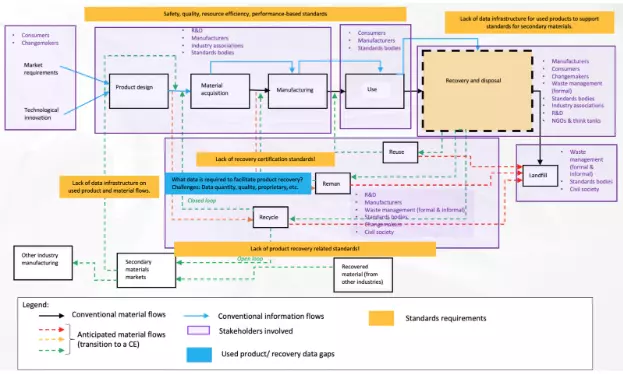
There is currently a lack of consistent and high-quality data to develop technical standards associated maximizing product value via recovery (e.g., reuse, remanufacture, recycle). This lack of consistent and high-quality data also impedes the development of technical standards that support systems-level considerations that have the potential to enhance stakeholder engagement and collaboration, to facilitate secondary materials trade/ exchanges (e.g. Industrial Symbiosis).
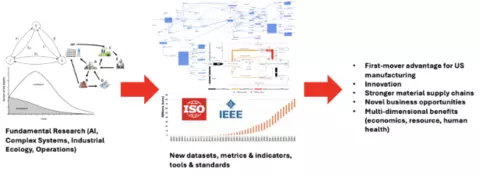
This project aims to advance measurement science in the context of data infrastructure for recovered materials, particularly critical materials via the development of systems-level considerations. This involves the development of data sets, metrics, indicators, and technical standards. These outputs collectively will be used to develop predictive models using methods rooted in Artificial Intelligence (AI), Industrial Ecology, Complex Systems Science, and Operations Research.
The identified outputs/ products aim to support U.S. manufacturing (OEMs, SMEs, and other change-makers) by helping anticipate possible future market dynamics that could potentially impact U.S. firms’ medium to long-term business strategies. The results and insights gained as a result of the fundamental research carried out will also be instrumental in identifying standards gaps to provide U.S. manufacturing firms the opportunity to maintain competitiveness in a global market by enabling first mover advantage that could help grow U.S. business abroad. Current focus areas include the critical materials, electronics and plastics sectors.
Research Plan
The implementation of material-centric data infrastructure to enable regenerative manufacturing economies requires careful systems-wide considerations that endeavor to balance multiple objectives and trade-offs concomitantly. In the case of manufacturing, product development, use, recovery and the associated supply chains are influenced by several exogenous and endogenous factors. The interactions between these parameters are characterized by nonlinearities and other complexities. Consequently, product manufacturing gives rise to numerous complex systems and sub-systems that are constantly evolving and are characterized by numerous materials as well as informational feedback loops that make material recovery challenging.
This project will carry out work in the areas of fundamental research, standards development, and through collaborations support the overall project plan.
Two foundational R&D thrusts to advance measurement science to facilitate robust data infrastructures will be explored interpedently and subsequently also in unison with one another. The first R&D thrust explores how to develop regenerative manufacturing systems for maximizing product value across the entire product life cycle. Specifically, this project investigates factors that will enable product recovery at the end of its first life to support regenerative manufacturing systems. This is vital, particularly in the context of the growing use of high value and/or critical materials in manufactured products. Recovering embedded high value/ critical materials can reduce materials and acquisition costs. One vital characteristic of regenerative manufacturing systems is that they are essentially complex systems that aspire to be highly adaptable and resilient to perturbations. Products that rely on a steady supply of critical materials are particularly vulnerable to the growing geopolitical uncertainties associated with the acquisition of critical materials. The second R&D thrust investigates factors that support the development of robust critical material supply chains. Specifically, the impacts of scaling up, diversifying supply sources and the potential use of substitute materials is explored.
Fundamental Research:
Fundamental research rooted in Artificial Intelligence (AI), Industrial Ecology, Complex Systems Science, and Operations Research to develop suitable metrics and indicators will be developed. Data sets to specifically support predictive capabilities will be developed. Collectively the development of data sets, metrics and indicators will facilitate the development of dynamic, integrated decision-making models and tools that will enable manufacturers and other stakeholders to model varying technical and market scenarios. By strengthening predictive capabilities, we aim to put U.S. manufacturers in a position where they will be able to make informed decisions pertaining to current and future business strategies.
Standards Development:
To maximize the impact of the fundamental research, efforts to standardize the developed metrics, indicators, methods and data sets will be undertaken. Fundamental research carried out will contribute directly towards the technical rigor to new and existing standards. Continued U.S. participation in developing technical standards ensures first-mover advantage and helps U.S. manufacturers maintain a position of competitiveness, continued engagement and leadership in the global market. Influencing global product standards directly impacts U.S. manufacturers’ ability to strategize future business plans and identify strong trade links. Currently, this project contributes to the following standards committees:
- ISO TC/323 Circular Economy
- IEEE PV3513 Standard for Supply Chain and Asset Traceability for Photovoltaic Solar Module Recycling and Reuse
Going forward, the project will continue to contribute to ASTM E.60 standards for establishing consistent terminology, driving efficiency and supporting innovation to facilitate trade for U.S. manufacturers.
Collaborations:
External engagements will be undertaken to support efforts related to fundamental research and tech transfer including standards development. These collaborations occur with partners in academia (Purdue University, University of Michigan and University of Maryland), industry (EarthShift Global and Siemens), other government agencies (DoE Critical Materials Advisory Committee), with standards development (ISO, IEEE, ASTM) organizations and other nonprofits (ASME).
Highlights
- Chatterjee A., Minsk, O., Hapuwatte, B. M., Triebe, M. J., Kietzer, D., Kittali-Weidner, S., Morris, K.C., & Mathur, N. (2024). Development Strategies for Industrial Byproduct Exchange Projects: Insights from Network Analysis – in review
- Mathur, N., Maani, T., Rong, C., & Sutherland, J. W. (2024) Forecasting Rare Earth Element Demands for Clean Energy Technologies with the Bass Diffusion Model, Procedia CIRP LCE – accepted
- Chatterjee, A., Mathur, N., Figola, D., Triebe, M. J., Hapuwatte, B., Hartwell, A., & Morris, K.C. (2024) Quantifying High Density Polyethylene Flows in the United States using Material Flow Analysis, MSEC – accepted
- Kim, Y., Deng, S., Maani, T., Mathur, N., Triebe, M. J., & Sutherland, J. W. (2024) Developing manufacturing-relevant indicators for assessing circularity of a product’s life cycle in the long-run behavior, SME NAMRC – accepted
- Hapuwatte, B. M., Mathur, N., Morris, K.C. (2023) Emissions avoidance quantification and allocation framework for secondary materials marketplaces supporting the circular economy. Proceedings of the ASME 2023 18th International Manufacturing Science and Engineering Conference (MSEC) 2023.
References
Chatterjee, A., Mathur, N., Figola, D., Triebe, M. J., Hapuwatte, B., Hartwell, A., & Morris, K.C. (2024) Quantifying High Density Polyethylene Flows in the United States using Material Flow Analysis, MSEC – accepted
Hapuwatte, B. M., Mathur, N., & Morris, K. C. (2023, June). Emissions avoidance quantification and allocation framework for secondary materials marketplaces supporting the circular economy. In International Manufacturing Science and Engineering Conference (Vol. 87233, p. V001T04A004). American Society of Mechanical Engineers.
Mathur, N., Last, N., & Morris, K. C. (2023a). A process model representation of the end-of-life phase of a product in a circular economy to identify standards needs. Frontiers in Manufacturing Technology, 3, 988073.
Mathur, N., Hapuwatte, B., & Morris, K. C. (2023b). A proposed integrated model to assess product recovery pathways: The case of solar photovoltaics. Procedia CIRP, 116, 83-88.
Mathur, N., Maani, T., Rong, C., & Sutherland, J. W. (2024) Forecasting Rare Earth Element Demands for Clean Energy Technologies with the Bass Diffusion Model, Procedia CIRP LCE – accepted
Mathur, N., Singh, S., & Sutherland, J. W. (2020). Promoting a circular economy in the solar photovoltaic industry using life cycle symbiosis. Resources, Conservation and Recycling, 155(August 2019), 104649
OECD (2022), Global Plastics Outlook: Policy Scenarios to 2060, OECD Publishing, Paris, https://doi.org/10.1787/aa1edf33-en.