

Official websites use .gov
A .gov website belongs to an official government organization in the United States.

Secure .gov websites use HTTPS
A lock (
) or https:// means you’ve safely connected to the .gov website. Share sensitive information only on official, secure websites.


Augmented Intelligence for Manufacturing Systems (AIMS)
Summary
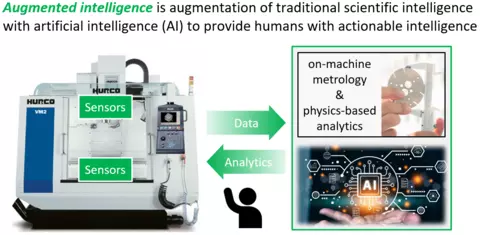
The U.S. economy depends on manufacturing and the ~500,000 U.S. machine tools that make parts. However, a major problem with these machines is that their performance is typically not monitored, resulting in unplanned downtime and the loss of revenue as machines fail or machined parts exceed their specifications without warning. Smart manufacturing paradigms seek to improve manufacturing processes by analyzing data with artificial intelligence (AI). However, major challenges inhibit the realization of smart manufacturing for the U.S.’s $2.65+ trillion of machinery. First, many machine tools lack the data required for AI models. For example, cutting tool forces and vibrations contain vital process information but cannot be practically measured in production. Second, existing AI tools rely on pre-trained generic models that may not be accurate for a specific machine. For example, thermal distortion is a major source of machining inaccuracies, but NIST measurements show that thermal compensation algorithms on some modern machines can have errors exceeding 80 µm (60 % of typical part tolerances). Thus, versatile AI-enhanced metrology systems are required to monitor and optimize the performance of ~500,000 U.S. machine tools. Manufacturers need augmented intelligence, the augmentation of traditional scientific intelligence with AI, for optimized production based on health tracking and asset management. Augmented intelligence is both accurate and trustworthy via on-machine measurements with periodic verification and updating of machine learning (ML) models.
The Augmented Intelligence for Manufacturing Systems (AIMS) project develops augmented intelligent solutions for manufacturing systems via methods, testbeds, deployable systems, reference datasets, uncertainty quantification, guidelines, and standards. The AIMS project includes proof-of-concept deployable solutions that enable reference datasets, demonstration with industry, technology transfer, and eventual standardization. Stakeholders and collaborators include part manufacturers, machine tool manufacturers, technology developers and integrators, AI researchers, and manufacturing software developers. Through reference datasets, technology transfer, and incorporation into standards, augmented intelligence will be adopted to advance U.S. manufacturing.
Description
Objective
Develop augmented intelligent solutions that combine integrated metrology, physics-based models, and artificial intelligence to monitor and predict the performance of manufacturing machines and their processes in real time for the optimization of production quality and yield.
Technical Idea
A research direction that fulfills NIST’s mission and leverages EL’s expertise is to research new methods for manufacturing that fuse traceable techniques (metrology) and physics-based models with non-traceable techniques (artificial intelligence). This fusion is called “augmented intelligence” since traditional intelligence (measurement science and physics) is augmented by artificial intelligence (AI). Physics-based models approximate physical reality, while AI models can find complex structures and relationships but lack the explainability and reliability of physical models. As the physical relationships among sensor data become more complex, and as the amount of data increases, AI can be leveraged to “fill in the gaps” of simple physical models. Augmented intelligence will enable real-time monitoring, diagnostics, and prognostics of production machines and processes and hence will enable machine-specific digital twins that are both accurate and trustworthy via on-machine measurements with periodic verification and updating of ML models.
Manufacturers need augmented intelligence, the augmentation of traditional scientific intelligence with AI. Specifically, smart production machines are needed that rely on augmented intelligence based on the fusion of integrated metrology, physics-based models, and artificial intelligence to optimize production quality and yield. Augmented intelligent methods will be developed that are broadly deployable with a low barrier to entry and can be integrated within new machine tools or packaged into plug-and-play solutions for existing and new machine tools. Thus, augmented intelligence is envisioned as a disruptive catalyst for factory-wide performance optimization.
Research Plan
The AIMS project seeks to develop and deploy augmented intelligent solutions for manufacturing systems and their processes, to help advance national priorities of smart manufacturing and AI. The goal is to help the ~500,000 U.S. machine tools to become smart machine tools that monitor and predict their health and the performance of their processes in real time to optimize production quality and yield. Generally, there are five main steps employed to meet this goal:
- Identify a production issue based on input from industrial stakeholders and identify gaps in the academic knowledge for addressing those issues
- Develop and test novel integrated metrology methods using NIST-owned machine tools and equipment, focusing on scalable and cost-effective approaches
- Develop and deploy prototype systems out to industrial and academic partners to evaluate their performance in real-world scenarios
- Create augmented intelligence models which combine on-machine measurements and machine control data to continuously update ML models that monitor and optimize manufacturing processes
- Publish academic works, datasets, and standards to facilitate further industrial deployment, academic research, and commercialization
Various tasks are planned towards augmented intelligent solutions for monitoring and prediction of thermal drift, cutting forces, and tool-tip displacements on milling machines and in-situ diameters on turning machines:
- Demonstration of vision-based thermal drift monitoring for machine tools at U.S. manufacturer
- Development of affordable tool-tip force and vibration monitoring for broad technology transfer with U.S. manufacturers
- Development of new data-driven method for real-time displacement monitoring with instrumented tool holder and metrology suite
- Development of on-machine metrology for large turned diameters
Highlights
- ASME B5.64 (“Methods for the Performance Evaluation of Single-Axis Linear Positioning Systems”) was first published in 2023 under the leadership of Dr. Vogl
- Gregory W. Vogl, Ainsley Rexford, Zongze Li, Robert G. Landers, Edward C. Kinzel, M. Alkan Donmez, and Joe Chalfoun. 2023. “Vision-based thermal drift monitoring method for machine tools.” CIRP Annals – Manufacturing Technology. 72(1): 301-304. https://doi.org/10.1016/j.cirp.2023.04.053
- Gregory W. Vogl, Dominique A. Regli, and Gregory M. Corson. 2022. “Real-time estimation of cutting forces via physics-inspired data-driven model.” CIRP Annals – Manufacturing Technology. 71(1):317-320. https://doi.org/10.1016/j.cirp.2022.04.071
- Gregory W. Vogl, Kyle F. Shreve, and M. Alkan Donmez. 2021. “Influence of bearing ball recirculation on error motions of linear axes.” CIRP Annals – Manufacturing Technology. 70(1): 345-348. https://doi.org/10.1016/j.cirp.2021.04.07
- Patent (U.S. Patent Number: 11,085,793) issued for “Inertial Measurement Unit and Diagnostic System” on August 10, 2021: https://www.nist.gov/document/11085793-patent-image