

Official websites use .gov
A .gov website belongs to an official government organization in the United States.

Secure .gov websites use HTTPS
A lock (
) or https:// means you’ve safely connected to the .gov website. Share sensitive information only on official, secure websites.


Data Infrastructure for Biomanufacturing
Summary
In September 2025, the Executive Office of the President released the report Fiscal Year 2027 Administration Research and Development (R&D) Budget Priorities and Cross-cutting Actions1. One of its budget priorities is “Strengthening and safeguarding American Health and Biotechnology.” Biomanufacturing is an R&D area that supports this priority. It can secure America’s supply chain, address major health challenges, counter biological threats, and create jobs. The administration noted the need to invest in innovations that will create modular and scalable biomanufacturing capabilities. Related industry roadmaps highlight two critical enabling technologies: fully automated factories and knowledge management2. Achieving these technologies will require new data standards and new methods for developing and using those standards. They are needed to connect factory equipment and software in a flexible and cost-effective way. They also make it easier to share knowledge across systems and organizations3. Together, these capabilities will support the development of factories that are fully automated, modular, scalable, and intelligent. This project will work with industry consortia and public-private innovation institutes. It will create a new type of data standard and develop related methods, tools, and guidance. These innovations can help the biomanufacturing industry achieve the two critical enabling technologies.
Description
Objective
Develop measurement science for new, computationally more precise, and AI-understandable data standards that would allow for quick and easy 1) configuration of integrated equipment and software components within the production system and 2) knowledge discovery, visualization, and intelligence extraction leading to a more modular, scalable, efficient, and cost-effective biomanufacturing.
Technical Idea
NIST has played a leading role in the Industrial Ontology Foundry (IOF) consortium, which is developing an ontology-based manufacturing data standard. This type of standard uses a computer language grounded in logic theory, allowing the meaning of the standard and its data to be interpreted and checked by computers. With this approach, computers can verify whether interpretations and refinements of the standard are logically consistent. Traditional data standards, by contrast, can only check whether data follow the expected structure and allowed values.
NIST has led the IOF community in publishing the IOF Core ontology4, which serves as the foundational ontology standard for the industrial manufacturing domain. The IOF Core ontology is based on the Basic Formal Ontology (BFO), a top-level ontology grounded in realist philosophy and in Edmund Husserl’s theories of parts and wholes, dependence, boundaries, and continuity.
Beyond the IOF Core, NIST also guides the development of several mid-level ontologies within IOF, including those for materials science, quality, and supply chain. These mid-level ontologies are important because they support the creation of subdomain reference ontologies for specific industries, such as biopharmaceutical manufacturing.
Working with NIIMBL5 and its Big Data program, NIST led the release of the first subdomain reference ontology—the Biopharmaceutical Manufacturing Core ontology—in July 20256. The team also published a three-year roadmap for more reference ontologies in the biopharmaceutical manufacturing domain7. The project will continue to develop these reference ontologies and related mid-level ontologies, which companies will need to build more specialized application ontologies in their respective fields.
While the ontological approach improves the clarity and meaning of data standards, it does not provide explicit data structures (also known as data models) that industry needs for easy data integration and knowledge-base development. To address this gap, the project has begun using ontology patterns to provide abstract structural templates. A draft set of these patterns is already available online8. We also plan to explore other technologies, such as SHACL9and the Allotrope Data Model (ADM) and Allotrope Simple Model (ASM)10, to help industry adopt IOF’s ontology-based standards more quickly and consistently.
Ontology-based data integration is in its infancy compared to current technologies, such as data schema-based integration. Because of this, the project will collaborate with industry to develop best practices and guidelines on topics such as version management and implementation architecture.
Another challenge is improving computing infrastructure for working with ontologies and ontology-compliant data. Current consistency-checking methods, such as the Tableau algorithm used in commercial tools, do not scale well for large ontologies and corresponding data (known as knowledge graphs or KG). Faster heuristic algorithms exist, but they can fail in certain cases. New strategies—such as data partitioning, GPU-based parallel processing, and AI-supported reasoning—may offer better performance. For this reason, the project will study emerging neuro-symbolic AI and collaborate with industry and academic partners to test advanced, ontology-driven engineering applications.
NIST has also developed advanced methods and tools that help develop and implement schema-based data standards more efficiently. The industry is looking to NIST for guidance on whether to use the schema-based and ontology-based technologies together or if they should plan a transition to the ontology-based technology. And if so, what is the path? Because organizations still work with multiple technologies and standards. The project will develop 1) metrics to help industry evaluate technologies, 2) guidelines for using them to their best advantage, and 3) tools that improve overall data integration efficiency.
Research Plan
The project will work with stakeholders from manufacturing institutes such as NIIMBL, as well as partners in industry, academia, and other research groups. Together, they will develop reference ontologies for data standards along with use cases, measurements, datasets, methods, algorithms, tools, and guidance. These efforts will enable the manufacturing industry to create and deploy subdomain and application ontologies in a more consistent and verifiable manner. The project will focus mainly on biomanufacturing but will also support work that improves interoperability across different sectors.
The research plan includes the following efforts:
Mid-level reference ontologies for the broad manufacturing domain:
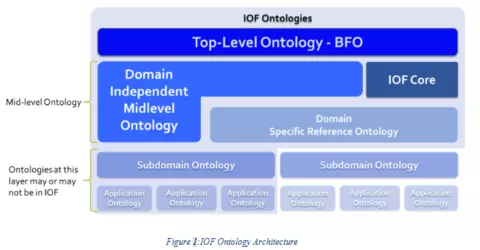
The project will continue working with IOF partners in industry and academia to build comprehensive mid-level ontologies. These ontologies form the foundation for deriving reliable subdomain and application ontologies as shown in the IOF Ontology Architecture below. In the architecture, lower-level ontologies are derived from higher-level ones. In the next phase, the team will develop ontologies for manufacturing operations management, quality (including quantities and units), materials science, and analytical methods such as statistics and AI.
Subdomain ontologies for the biopharmaceutical manufacturing subdomain:
NIST’s earlier work with NIIMBL produced a three-year roadmap for ontologies in this subdomain. The focus areas include process, manufacturing quality, materials, and analytics. The project will deliver these reference ontologies to industry and work with stakeholders to demonstrate key use cases. As part of this effort, the team will also create supporting standards, guidance, and software tools.
Advanced computing infrastructure and methods for utilizing ontologies and ontology-compliant data:
The project will study neuro-symbolic AI and document the current state of the field. As a starting point, the project will develop the Machine Learning Lifecycle Ontology (MLLO) within IOF to demonstrate Type 2 neuro-symbolic AI. MLLO will show how ontologies can help engineers speed up AI model development, compare and select models, track model provenance, support regulatory review, and manage model export controls—key parts of the current administration’s AI Action Plan11. The project will demonstrate applications in NIIMBL’s adaptive control project and in MLOps12 workflows used by industry partners.
Strategies, methods, and tools for managing multiple data standards:
Ontology-based data standards already exist in some areas. For example, the Allotrope Foundation develops ontology-based standards for analytical instruments in the pharmaceutical industry, and the Open Biomedical Ontology (OBO) library has long supported biological and chemical research. Although these ontologies do not aim for the same level of fidelity as IOF ontologies, they remain important. The project will create methods and strategies for reusing these resources.
At the same time, legacy data standards are still widely used, so complex data-mapping tasks will continue to be necessary. The project will develop strategies, metrics for measuring data-integration efficiency, and advanced tools for improving data mapping across different standards and technologies. Four data-mapping use cases have already been formalized by our prior project13. This project will build software prototypes to test these cases and measure improvements in mapping efficiency.
Highlights:
- NIST Developed, Score Tool, deployed as OAGi connectCenter.
- Paper about the initial vision of the Score tool to revolutionize the standard development and use.
- Paper about advanced vision of the Score tool to help increase the supply chain resilience.
- Paper about the vision to apply AI to the standard lifecycle management.
- Supply chain integration standard resources for the Real-Time Release of Raw Materials in Biopharmaceutical Industry, produced using the Score tool in collaboration with OAGi and a biopharma supplier.
- Video of the presentation by Mr. Scott Nieman, Lead Enterprise Architect at Land O’Lakes, describing how Score can help digitalize supply chain with small and medium size enterprises.
- AgGateway, an agricultural industry association, 2023 Q3 update – To use Score to produce its ADAPT standard.
- Draft biopharmaceutical ontology available at the IOF GitHub Repo. Select the ‘biopharma’ branch or similar.
- IOF Ontology releases.
- Publication about the state of the art in continuous biopharmaceutical manufacturing.
- Publication about the IOF Core Ontology.
- Publication about an example utilization of the IOF Core ontology for a biomanufacturing application.