

Official websites use .gov
A .gov website belongs to an official government organization in the United States.

Secure .gov websites use HTTPS
A lock (
) or https:// means you’ve safely connected to the .gov website. Share sensitive information only on official, secure websites.


Super Intelligence (SI) for Manufacturing
Summary
Super Intelligence (SI) for Manufacturing is a research initiative focused on the measurement science and standards needed to move machine learning and agentic intelligence in manufacturing from piecemeal, ad hoc pilots to engineered, trustworthy systems. Built on the “AI for Manufacturing Workshop” in 2026 and use cases collected, the research is organized under five research threads: (1) trustworthy manufacturing intelligence fundamentals, including a reference function architecture for super intelligence in manufacturing; (2) human-machine teaming; (3) super intelligence-ready manufacturing data and contextualization; (4) Super intelligence integration, supported by an integration test bench and benchmark studies; and (5) digital twin (DT) assured manufacturing intelligence, including verification, validation, and uncertainty quantification (VVUQ). The project closes the gap between today’s systems engineering methods and the needs of super intelligence applications in manufacturing by developing evaluation methods, metrics, datasets, tools, and benchmark studies, and by contributing the results to SDO’s standards development for reliable, interoperable, and cost-effective industrial adoptions.
Note:
On Sept. 29, 2026, Executive Order 14434: Inaugurating the Era of Super Intelligence directed executive agencies to update its use of “artificial intelligence” to “super intelligence”.
Description
Objective
To develop the methods, metrics, models, tools, and consensus-based standards necessary to empower next-generation manufacturing systems with trustworthy and interoperable digital infrastructure and super intelligence technologies. More specifically, the project explores innovative machine learning and agentic intelligence applications in manufacturing and develops methodologies, metrics, datasets, tools, and benchmark studies that enable trustworthy super intelligence for manufacturing system design, operation, and automation through digital twins and teaming with human.
Technical Idea
This project closes the gap between today’s systems engineering methods and principles and the needs of super intelligence applications in manufacturing. We treat industrial intelligence, human and digital twin as key components of a closed-loop manufacturing system, and develop the reference architecture, measurement science, evaluation methods, benchmark studies, and standards needed to engineer, verify, and integrate those components with confidence.
The organizing concept for trustworthy super intelligence in manufacturing is Teamed, Integrated, DT-assured and Layered Intelligence (TIDAL). In a TIDAL manufacturing system, intelligence functions are layered across the ISA-95 hierarchy, from root cause analysis, real-time monitoring, and quality inspection at the asset level; through production scheduling, line optimization, and predictive alerts at the site and area level; to generative design, cross-site benchmarking, centralized model management, and agentic orchestration at the enterprise level. These intelligence functions are teamed with the people who own each decision and are supported by vertically and horizontally integrated data and digital twin foundations. In the closed loop, sensed data flows from the industrial automation system and the manufacturing operations management (MOM) layer to super intelligence models and skills, which draw on knowledge graphs, digital twins, and microservices and return decisions through human-machine interfaces to MOM and control.
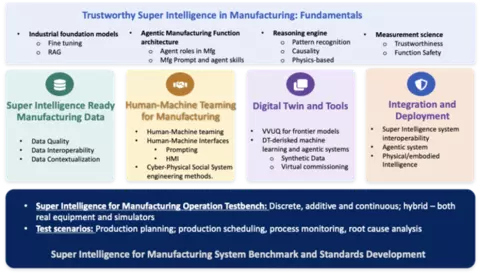
Each research thread addresses one part of this loop (Figure 1). Trustworthy Super Intelligence fundamentals provide the function architecture, reasoning approaches, and measurement science that the other threads build on. Human-machine Teaming, Super Intelligence-ready Data, Digital Twins and Tools, and Integration and Deployment address the four industry challenges identified at the workshop. A shared Super Intelligence for Manufacturing operation test bench, spanning discrete, additive, and continuous processes with both real equipment and simulators, provides the common basis for benchmark studies in production planning, scheduling, process monitoring, and root cause analysis, and for the standards contributions that follow.
Research Plan
The research plan is organized into five research threads and a cross-cutting standards and engagement activity.
Thread 1: Trustworthy Super Intelligence in Manufacturing – Fundamentals
Based on TIDAL (Teamed, Integrated, Digital twin-assured, Layered Intelligence) framework, we will develop a reference function architecture for super intelligence in manufacturing that defines super intelligence functionality at the asset, site/area, and enterprise levels, their interactions with human roles and with MOM and control systems, and the data and digital twin foundations they depend on. The architecture will be grounded in the open super intelligence for manufacturing use case repository, which is being populated in collaboration with SDOs. Use cases will be mapped to the architecture to identify gaps and to support a super intelligence in manufacturing standards roadmap. The same use cases will feed the normative use case for standards on multi-agent systems for industrial automation. In FY28 we will extend this work toward an agent skill taxonomy and open manufacturing agent prompt templates.
Thread 2: Human-Machine Teaming for Manufacturing
A survey of human-machine standards suggests the lack of rigorous human-machine teaming, role and interaction models for manufacturing collaboration. Standards for human-machine teaming predate the use of LLMs in human interaction and are ineffective in relationships that underpin Industry 5.0, such as mentoring, coaching, and supervising. A new human-machine teaming model builds on a theory-revision (“flexecution”) view in which the human and intelligent machines jointly pursue goals while refining the underlying problem formulation, and on a constructionist learning framework that relates human and machine characteristics and learning environment quality to cognitive and behavioral outcomes, such as the production of a sharable, inspectable artifact. The model will be studied in two cases: production scheduling and digital twins. We will publish a human-machine teaming standards landscape and literature review and draft best practice guidance for human-machine teaming in manufacturing with SDOs. As a stretch goal, we will develop a teaming approach to tool deployment and stewardship, piloted in production scheduling.
In parallel, methods will be explored for reliable industrial knowledge graphs through Human-machine teaming. Most human oversight of retrieval-augmented generation focuses on querying, while the indexing step that creates the knowledge graph is automated and validated after the fact, an approach that is difficult to scale. We will develop “Centaur Indexing,” a validation-by-design approach in which domain experts steer and correct entity and relation extraction as the graph is built. Products include the Nestor v2 workspace for human-steered knowledge indexing and vocabulary normalization, and the proposed GRABBLE open specification for multi-layered textual annotations aligned with ISO 24617. Pending human subjects approval, an experimental study will compare automated GraphRAG indexing with Centaur Indexing on a downstream root cause analysis task.
Thread 3: Super Intelligence-Ready Manufacturing Data
Guidelines and specifications are needed to define how manufacturing data context should be managed, represented, and validated for reliable super intelligence consumption. We will study semantic enrichment of heterogeneous data sources (SCADA, MES, ERP, streaming sensor data, and external data) through ontology-based modeling, and the instantiation of contextualized data as knowledge graphs and serialized formats for intelligent agents and large language models. We will evaluate the effect of contextualization on reasoning performance, token usage, and selective information extraction. Two complementary sources of context will be examined: measurement context from metrology metadata, and operational context organized by the ISA-95 equipment hierarchy and operational data relationships captured in Manufacturing Operation Management Ontology (MOMO). Products include an impact study of metrology context on manufacturing intelligence performance, a publication on manufacturing data contextualization methods, and contributions to MOMO.
Thread 4: Manufacturing Intelligence Empowered by Digital Twins
Digital twin integration for de-risking manufacturing Intelligence.
Following the ISO/IEC 23053 “AI system life cycle”, we will identify the risks at each stage, from data acquisition through operation, and the ways a digital twin can mitigate them, including synthetic data generation, physics-consistency checks, physics-informed training, edge case generation, shadow-mode deployment, and drift detection against a synchronized twin. The first focus is measurement science for super intelligence systems trained on synthetic data when real training data are limited: what synthetic data are needed, what requirements they must satisfy beyond the ISO/IEC 5259 data quality metrics, and how uncertainty propagates from the data-generating model to the deployed SI model’s performance. The approach will be demonstrated with computer vision for printed circuit board defect inspection using synthetic data, and with surface roughness estimation from sparse measurements combined with simulation. Sensitivity analysis will be conducted, and a specification will be defined on how synthetic data can be used for super intelligence model training. A second focus is the credibility of super intelligence systems validated through virtual commissioning compared with physical testing. Related efforts include guardrail guidelines for physical intelligence systems.
VVUQ of manufacturing digital twins and industrial Intelligence.
Foundational work will apply a risk-informed credibility approach to digital twin and super intelligence applications in manufacturing and coordinate with ASME VVUQ standards. We will examine VVUQ for frontier models and agentic intelligence, whose nondeterministic behavior is not addressed by existing practice, drawing on the ASME V&V 40, 50, 70, and 80 series and on frontier model risk management work in ISO. For digital twin life cycle VVUQ, we will advance ISO 23247-8 and develop agentic intelligence tools for continuous VVUQ monitoring and management of physics-based digital twins.
Thread 5: Manufacturing Super Intelligence Integration and Deployment, Test Bench and Benchmark Study
Modern data pipeline tools and knowledge graphs are emerging as leading approaches for organizing shop floor data for super intelligence but implementations remain ad hoc and lack systems engineering rigor, standards, and interoperability. We will develop a super intelligence for manufacturing integration test bench that implements alternative industrial information architectures with open-source tools, including unified namespace (UNS) over MQTT combined with knowledge graphs and type models, and I3X and OPC UA profiles. The initial test case is the Tennessee Eastman Process, with planned extension to the NIST Digital Twin and the Additive Manufacturing Data Integration Lab for physical equipment and additive manufacturing. Test tasks include fault detection, and diagnosis, preventive maintenance, VVUQ in support of ISO 23247-8, and other agentic decision making.
Benchmark studies will evaluate how context and contextualization methods affect an intelligent agent’s ability to reason about manufacturing processes, including locating the right OT data and structuring shop floor context. Metrics include accuracy, latency, cost, and grounding; for fault diagnosis, detection recall will be weighted ahead of precision, consistent with alarm management practice. An ablation study will quantify how progressively richer context affects agent performance, reliability, and grounding. The software products are a benchmark environment, an agent benchmark harness, and an evaluation toolkit in FY28. In parallel, super intelligence-enabled system integration for additive manufacturing will continue the FY26 comparative study of standards-based, foundation-model-generated, and hybrid integration.
Synthesis, Standards Advancement, and Stakeholder Engagement
Results from all threads will be synthesized into NIST AMS reports, journal papers, guidance, and standards contributions, including:
- Use cases, the standards roadmap, and human-machine teaming guidance;
- Data quality, human-machine teaming, and super intelligence risk contributions;
- Publication of the FY26 workshop report and continued convening of industry, standards, and academic stakeholders, including MEP centers and manufacturing institutes.
- Release of open test bench software, benchmark harnesses, and tools to support reproducible evaluation of SI for manufacturing.