Official websites use .gov
A .gov website belongs to an official government organization in the United States.

Secure .gov websites use HTTPS
A lock (
) or https:// means you’ve safely connected to the .gov website. Share sensitive information only on official, secure websites.


Advanced Measurements for Material Property Calibration
Summary
The NIST Material Flammability Characterization project calibrates, maintains, and uses a variety of experimental apparatus that allow for the determination of material properties relevant to pyrolysis modeling. Unique application of standard testing tools (e.g., custom sample preparation and/or test procedures) and design/development of custom apparatus enable state-of-the-art quantification of the material properties that control flammability behavior.
Description

DEVICES AND APPLICATIONS
Smoldering and Flaming Heats of Combustion (∆Hc,char and ∆Hc,gas):
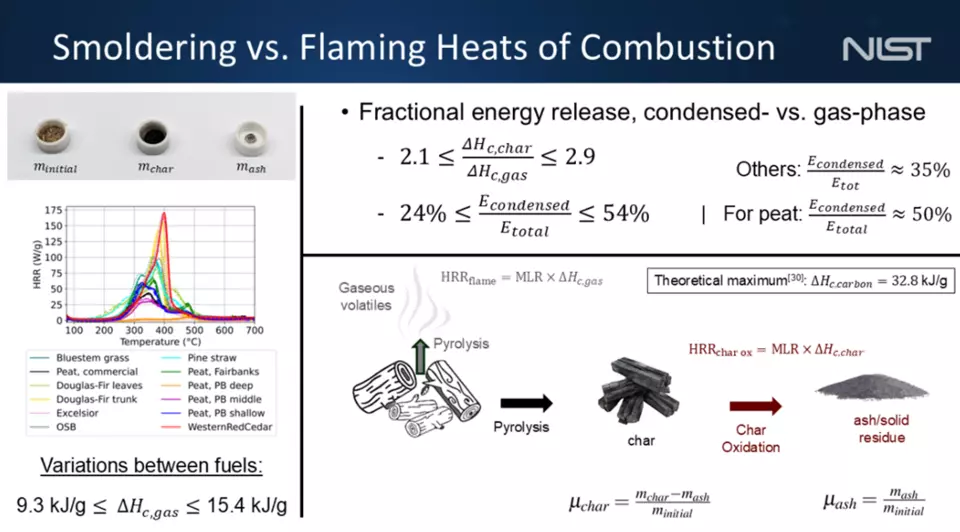
Repeated tests were performed using a microscale combustion calorimeter (MCC) to independently measure the heat of combustion of flaming combustion (∆Hc,gas) and the heat of combustion of char oxidation (∆Hc,char) of vegetative fuels: (a) sticks, stems, and/or leaves of grasses and trees, (b) peat (commercial and natural samples, obtained from multiple sources), and (c) solid and engineered wood samples (i.e., western red cedar and oriented strand board, OSB).
IInitial results demonstrate up to 65 % variations in ∆Hc,gas measured for these fuels (consistent with values reported in the literature) and a factor of 2.1x to 2.9x increase in ∆Hc,char versus ∆Hc,gas for a given fuel. The relative amounts of energy released (per gram initial sample mass) in the gas-phase and the condensed-phase can be calculated based on measured ∆Hc,gas, ∆Hc,char, and residue yields. The fraction of total fuel energy content released in the condensed-phase due to char oxidation varied substantially: between 24 % and 58 % for all fuels tested here.
Credit:
NIST
|
Credit:
NIST
|
Average molecular formula of gaseous pyrolyzates:
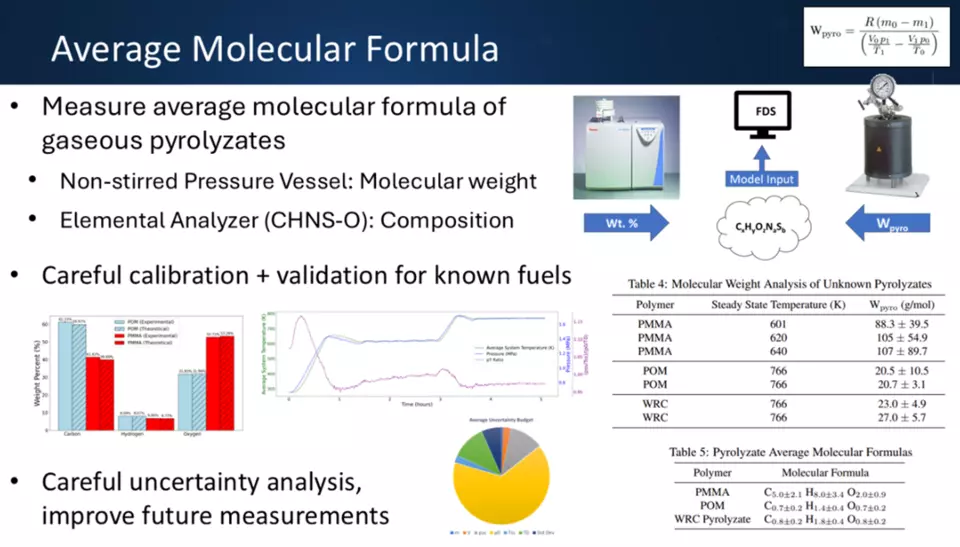
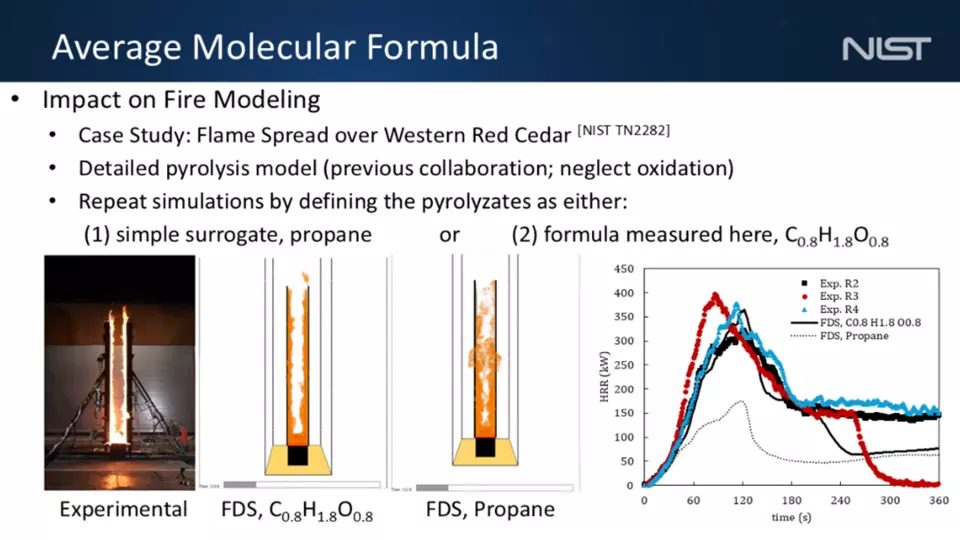
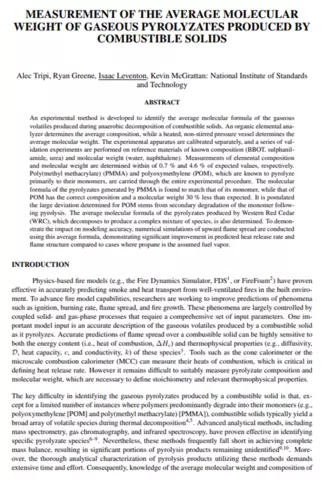
An experimental method is developed to identify the average molecular formula of the gaseous volatiles produced during anaerobic decomposition of combustible solids. This approach uses two test apparatus: an organic elemental analyzer, which determines their average composition, and a heated, non-stirred pressure vessel that determines their average molecular weight. In a preliminary analysis, numerical simulations of upward flame spread were conducted in the Fire Dynamics Simulator, FDS. Simulations that used this average formula demonstrated improvement in predicted heat release rate and flame structure compared to cases where propane is the assumed fuel vapor.
Credit:
NIST
|
Credit:
NIST
|
Credit:
NIST
|
NIST Gasification Apparatus:
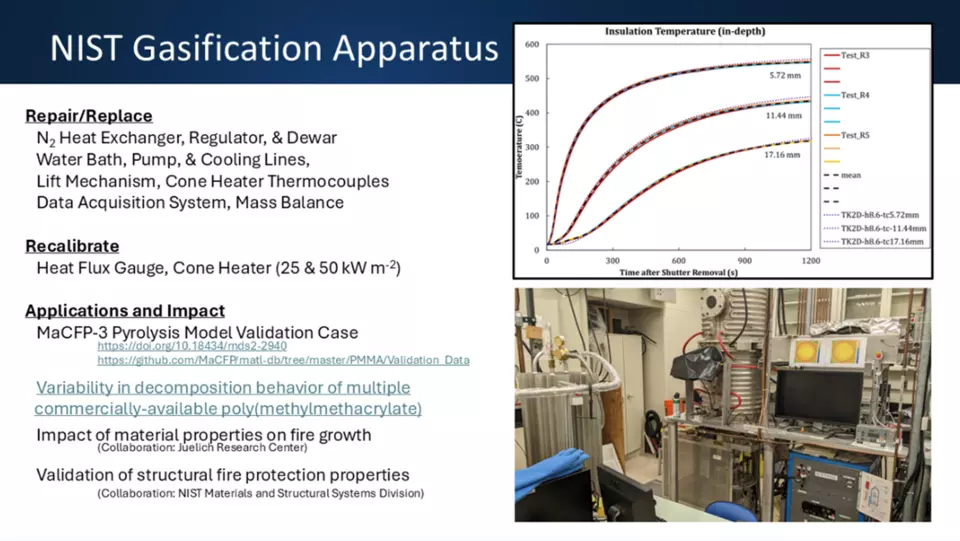
The NIST Gasification Apparatus was originally designed and built in the late 1990s to expose solid or liquid samples to a uniform heat flux in a non-oxidizing or partially oxidizing atmosphere. It offers a stable, well-characterized environment for the study of heat transfer through materials and the anaerobic decomposition of pyrolyzable solids. In the 2020s, the NIST Gasification Apparatus was refurbished (multiple system components were upgraded or replaced), recalibrated, and brought back online
to enable the study of:
- Decomposition behavior of ‘MaCFP-PMMA’ (validation dataset provided in support of the Measurement and Computation of Fire Phenomena Working Group, MaCFP)
- Variability in decomposition behavior of multiple commercially-available poly(methylmethacrylate) (PMMA) samples and identification of potential replacement candidates for MaCFP-PMMA
- Heat transfer through materials relevant to structural fire protection applications