

Official websites use .gov
A .gov website belongs to an official government organization in the United States.

Secure .gov websites use HTTPS
A lock (
) or https:// means you’ve safely connected to the .gov website. Share sensitive information only on official, secure websites.


Vegetative Fuels (Wildfire Research)
Summary
Since 2019, experimental and analytical tools maintained by the Material Flammability Characterization project have been applied to characterize the burning behavior of vegetative fuels and materials/products relevant to wildland urban interface (WUI) fires. Applications include (1) quantifying the energy content of woods, peat samples, and other vegetative fuels fuels as well as where this energy is released during burning (i.e., in the gas-or solid-phase due to flaming or smoldering combustion), (2) assessing the impact of these measured variations on simulations of wildfire spread and burning behavior of wood samples, and (3) quantifying firebrand yield (i.e., generation of fire brands from full-scale vegetation per kg burned) and its dependence on tree species and moisture content. Summary presentations and/or reports for each of these tools are provided below.
Description
Firebrand Yield
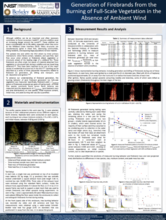
Between December 2019 and January 2020, 14 full-scale experiments were conducted at the University of Maryland in collaboration with NIST to measure variations in burning behavior and firebrand yield (i.e., mass of firebrands generated per total mass lost: ) as full-scale vegetation burned in the absence of ambient wind (crossflow). Measurements – including initial and final sample mass, time-resolved mass loss rate during burning, mass of firebrands generated, and time-resolved total heat flux (2 m away from the tree) – were obtained in replicate tests conducted on three unique tree species, each burning at a range of moisture contents (MC). As seen in Fig. 1, measured values of 𝑌𝑓𝑖𝑟𝑒𝑏𝑟𝑎𝑛𝑑 varied between 0.004 and 0.027, showing an inverse dependence on initial moisture content but no clear dependence on species.
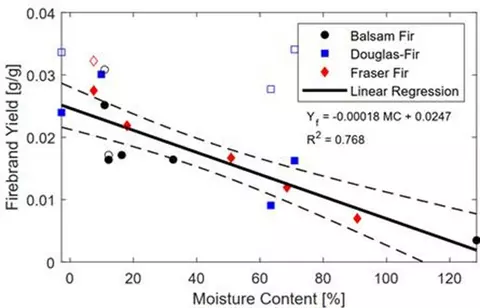
Figure 1. Measured firebrand yield as a function of initial moisture content, MC. Solid symbols represent 𝑌𝑓𝑖𝑟𝑒𝑏𝑟𝑎𝑛𝑑. Measured dependence of 𝑌𝑓𝑖𝑟𝑒𝑏𝑟𝑎𝑛𝑑 on MC is captured by a linear regression with 95% confidence bands.
Characterization of Vegetative Fuels and Impact of Measured Variations on Fire Modeling
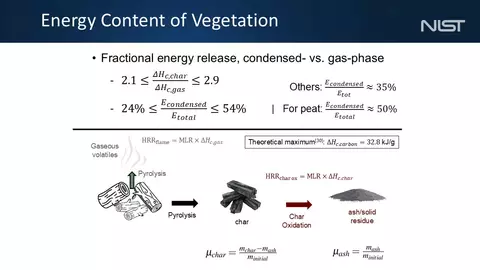
Smoldering and Flaming Heats of Combustion (∆Hc,char and ∆Hc,gas):
Repeated tests were performed using a microscale combustion calorimeter (MCC) to independently measure the heat of combustion of flaming combustion (∆Hc,gas) and the heat of combustion of char oxidation (∆Hc,char) of vegetative fuels: (a) sticks, stems, and/or leaves of grasses and trees, (b) peat (commercial and natural samples, obtained from multiple sources), and (c) solid and engineered wood samples (i.e., western red cedar and oriented strand board, OSB).
Initial results demonstrate up to 65 % variations in ∆Hc,gas measured for these fuels (consistent with values reported in the literature) and a factor of 2.1x to 2.9x increase in ∆Hc,char versus ∆Hc,gas for a given fuel. The relative amounts of energy released (per gram initial sample mass) in the gas-phase and the condensed-phase can be calculated based on measured ∆Hc,gas, ∆Hc,char, and residue yields. The fraction of total fuel energy content released in the condensed-phase due to char oxidation varied substantially: between 24 % and 58 % for all fuels tested here.
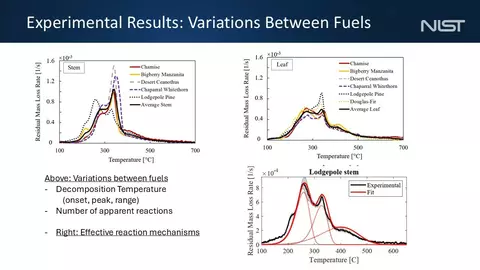
This manuscript presents new measurement data from milligram-scale thermal decomposition experiments conducted on stems and leaves (i.e., needles) of six plant species commonly found across the United States. Between different fuels, distinct differences were measured in the onset temperature of decomposition, the temperature range of decomposition, the number of apparent reactions, and the peak measured mass loss and heat release rates (as well as the temperatures at which they occur).
To analyze the impact of these variations on predictions of wildfire behavior, numerical simulations of wildland fire experiments were repeated using the thermal decomposition mechanisms and heats of combustion determined for each of these fuel species. Model-predicted fire spread rate in these simulations demonstrated a notable dependence (up to a factor of 2x) on measured variations in thermal decomposition mechanism and a second-order dependence on the use of either reaction-step-specific or single (global) heats of combustion.
https://doi.org/10.1016/j.firesaf.2023.103762
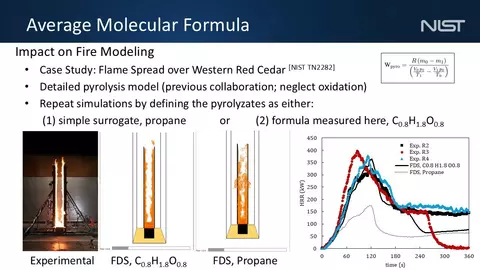
An experimental method is developed to identify the average molecular formula of the gaseous volatiles produced during anaerobic decomposition of combustible solids. This approach uses two test apparatus: an organic elemental analyzer, which determines their average composition, and a heated, non-stirred pressure vessel that determines their average molecular weight. In a preliminary analysis, numerical simulations of upward flame spread were conducted in the Fire Dynamics Simulator, FDS. Simulations of the burning behavior of (and flame spread over) Western Red Cedar panels that used this average formula demonstrated improvement in predicted heat release rate and flame structure compared to cases where propane is the assumed fuel vapor.
Ignitability of structural wood products
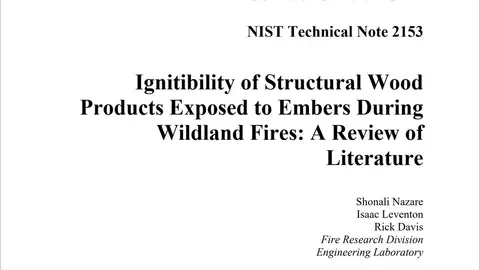
NIST Technical Note 2153, “Ignitibility of Structural Wood Products Exposed to Embers During Wildland Fires”. This report compiles and analyzes past studies to better understand the ignitability of wooden substrates in response to embers/firebrands. Key topics in this review include ignition of structures in WUI fires, measurement of thermal response of solid wood products used in residential structures, controlling mechanisms in ignition and sustained smoldering of wood, measurement of ember properties, real-scale and bench-scale experiments on assessing ember ignitability of structural components, surrogate ignition sources, and existing test methods.