An official website of the United States government
Here’s how you know
Official websites use .gov
A .gov website belongs to an official government organization in the United States.
Secure .gov websites use HTTPS
A lock (
) or https:// means you’ve safely connected to the .gov website. Share sensitive information only on official, secure websites.

Parakh Jain, a senior in the Math, Science, and Computer Science Magnet Program at Poolesville High School and student intern in the Electron Physics Group in
The tolerances on feature size, shape, and placement for next generation computer chips fabricated with extreme ultra-violet (EUV) lithography will range from a
An international research team working with National Institute of Standards and Technology (NIST) scientists at the Hollings Marine Laboratory (HML) in
The quantum computers of tomorrow might use photons, or particles of light, to move around the data they need to make calculations, but photons are tricky to
JILA researchers have developed a laser-based source of terahertz radiation that is unusually efficient and less prone to damage than similar systems. The
Using a new experimental test structure, biophysicists at JILA have unraveled part of a 15-year mystery in the mechanics of DNA—just how the molecule manages to
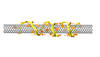
Electronics researchers love graphene. A two-dimensional sheet of carbon one atom thick, graphene is like a superhighway for electrons, which rocket through the
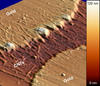
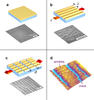
CNST Project Leader Rachel Cannara and collaborators from the United States Naval Academy (USNA) and the University of Pennsylvania have shown that atomic-scale
Electron microscopes are among the most widely used scientific and medical tools for studying and understanding a wide range of materials, from biological
John Unguris, a Project Leader in the CNST Electron Physics Group, has been designated a 2011 Outstanding Referee by the American Physical Society (APS). This
Palo Alto, Calif. – As part of a meeting today with local industry and academic leaders in Silicon Valley, at Stanford University, U.S. Commerce Secretary Gary
Medical researchers who crave a means of exploring the genetic culprits behind a host of neuromuscular disorders may have just had their wish granted by a team
For Web site owners and bloggers, there is a new widget from the National Institute of Standards and Technology (NIST) that will keep your Web pages right on
On Dec. 9, 2010, the National Institute of Standards and Technology (NIST) announced the selection of five finalists in its ongoing competition to select a new
Is the expansion of the universe accelerating for some unknown reason? This is one of the mysteries plaguing astrophysics, and somewhere in distant galaxies are
Two new draft publications from the National Institute of Standards and Technology (NIST) provide the groundwork for a three-tiered risk-management approach
Three scientists at the National Institute of Standards and Technology (NIST) were recently elected as 2010 fellows of the American Physical Society (APS), an
Using the NIST-invented magneto-optical trap ion source (MOTIS), CNST researchers recently took a significant step toward the goal of creating a more versatile
Two new publications from the National Institute of Standards and Technology (NIST) are intended to help developers of software and computer systems for doctors
ENERGY STAR, a program of the Environmental Protection Agency (EPA) and Department of Energy (DOE) to promote energy efficiency, has recognized the National
Once ignited, a dry Fraser fir, one of the most popular Christmas tree choices, bursts into flames in less than 7 seconds, and it will be consumed by fire in
The discoveries of superconductivity, the quantum Hall effect and the fractional quantum Hall effect were all the result of measurements made at increasingly
Paul Haney and Mark Stiles of the CNST have developed a theory of current-induced torques that generalizes the relationship between spin transfer torques, total