

Official websites use .gov
A .gov website belongs to an official government organization in the United States.

Secure .gov websites use HTTPS
A lock (
) or https:// means you’ve safely connected to the .gov website. Share sensitive information only on official, secure websites.


NGD MAGIK

Instrument Purpose
MAGIK is a versatile monochromatic neutron reflectometer designed for structural and magnetic characterization of thin films, interfaces, and layered materials, broadly meeting the measurement needs of the NCNR’s reflectometry users. The instrument supports both horizontal and vertical scattering geometries, enabling studies of a broad range of samples, including solid films, buried interfaces, free liquid surfaces, biological membranes, magnetic multilayers, and electrochemical systems.
The NCNR Advantage
- Versatile and Reconfigurable: MAGIK accommodates a wide range of scientific applications through flexible instrument configurations, multiple detector options, polarized-neutron capabilities, and diverse sample environments.
- Dual-Geometry Operation: The instrument can be configured for both vertical and horizontal scattering geometries, enabling measurements on solid substrates, liquid surfaces, and complex sample environments.
- Precision Polarized Neutrons: MAGIK utilizes high-efficiency Fe/Si supermirrors to provide polarized neutrons, essential for isolating magnetic structure in quantum materials and spintronic devices.
Research Domains
- Magnetic Storage & Spintronics: Characterizing lateral magnetic correlations and domain wall structures in multi-layered storage media.
- Quantum Materials: Probing the interaction between superconductivity and magnetism at complex interfaces.
- Soft Matter & Biotechnology: Investigating the interfacial structure of polymer coatings. Structural biology of proteins and lipids within cell membranes or at technical interfaces relevant to biomedicine and biotechnology.
- Energy Research: In situ investigation of the structure and performance of battery and fuel cell electrode interfaces.
- Liquid Surfaces: Studying the structure of films and coatings at air-liquid interfaces in the horizontal geometry.
What You Can Measure
- Specular Reflectivity: Absolute thickness, density, and roughness of thin-film layers with ±1 Å precision.
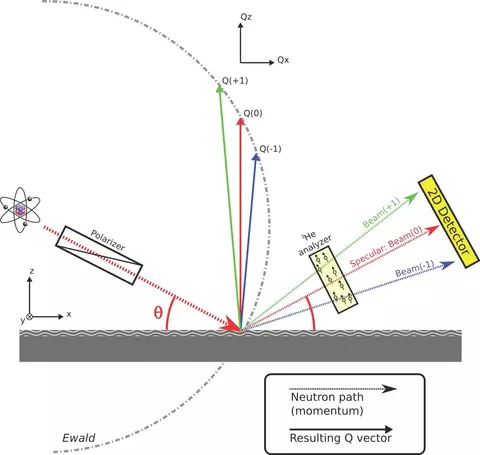
- Off-Specular Scattering: Identification of lateral periodicities, cluster sizes, and magnetic domain structures.
- Magnetic Depth Profiling: Determining the direction and magnitude of interfaces with sub-nanometer depth resolution.
Technical Specifications
| Parameter | Specification |
|---|---|
| Source Type | Cold Neutron Guide (NGD) |
| Monochromator | Highly Oriented Pyrolytic Graphite (PG 002) |
| Wavelength (𝜆) | 5.0 Å (fixed monochromatic) |
| Polarization | Fe/Si Supermirror polarizers and Mezei flippers |
| Detector | 3He pencil detector |
| Accessible Q range | 0.005 Å-1 to 0.15 Å-1 (horizontal) 0.005 Å-1 to >1 Å-1 (vertical) |
| Q-Resolution (Δ Q/Q) | 1 % |
| Sample geometry | Vertical and horizontal |
| Temperature range | 5 K to 315 K |
Specialized Sample Environments
- Electromagnets: Fields up to 0.7 T for probing field-dependent magnetic transitions. A superconducting magnet up to 3 T is also available.
- Electric fields: Capability to apply up to 2 kV across thin-film samples during measurement.
- Advanced Liquid Cells: Purpose-built cells for studying buried interfaces between liquids and solids relevant for soft matter and biotechnology applications.
- Electrochemical Cells: Enable the study of electrode interfaces in energy research, in contact with electrolytes and under an applied electrical potential.
- Air-Water (Langmuir) Troughs: Allow for the study of surface layers at the air-water interface under external control of surface pressure, with the option of in situ surface rheology.
Expertise & Support
- Instrument Scientists: Frank Heinrich and Sushil Satija, experts in biological and soft matter neutron reflectometry (other fields covered by reflectometry team members).
- Experimental Planning: Designing optimal reflectometry experiments, data simulation, and proposal writing support. Support with fabricating surface coatings for reflectometry samples.
- Data Analysis: Support in standard and advanced data analysis techniques in soft matter and biological NR, such as integrative modeling using complementary measurement results (NMR, cryo-EM, crystallography), molecular simulations, and AI methods.