

Official websites use .gov
A .gov website belongs to an official government organization in the United States.

Secure .gov websites use HTTPS
A lock (
) or https:// means you’ve safely connected to the .gov website. Share sensitive information only on official, secure websites.


NGD Cold PGAA

Instrument Purpose
To perform highly sensitive, non-destructive elemental analysis using a high-flux cold neutron beam, specifically optimized for the detection of trace light elements, especially trace H and B, and the characterization of inorganic materials.
The NCNR Advantage
- World-Class Sensitivity: Utilizing neutrons chilled to 20 K, NGD PGAA achieves a sensitivity factor of at least 10 to 20 times higher than most thermal neutron facilities. This enables the detection of hydrogen at levels below 1 microgram and boron at levels below 100 nanograms in some materials.
- Optimized for Inorganics: While NCNR’s thermal PGAA (VT-5) focuses on biological samples, the NGD instrument is the premier tool for certifying inorganic Standard Reference Materials (SRMs), including H and B, in advanced alloys and semiconductors.
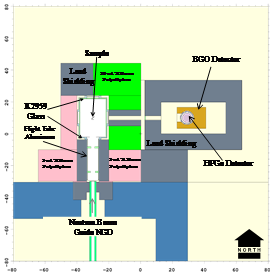
- Ultra-Low Background: The spectrometer features non-hydrogenous shielding (steel shot and lead) and 6Li glass collimators, specifically designed to minimize gamma ray background, optimizing elemental detection limits. Shielding can be optimized to minimize hydrogen background allowing hydrogen measurement at ppm levels, and also for boron measurements at sub-ppm levels.
Research Domains
- Research Domains: Cold neutron PGAA has been in operation at NIST since 1990 (at NG7 until 2015 and at NGD since 2015). In addition to certification of SRMs and research geared toward improvements in measurement science, research and measurements at the PGAA facility are conducted by dozens of users each year in collaboration with NIST scientists.
- Hydrogen Infrastructure: Quantifying hydrogen concentration and movement in storage materials and metal alloys to combat hydrogen embrittlement, as well as certification of reference materials in support of these measurements.
- Semiconductors & Superconductors: Precise stoichiometry of semiconductor and superconducting materials as well as quantification of born as a dopant in silicon and measurement of hydrogen and other trace contaminants in high-tech materials.
- Inorganic Chemistry: Certification of multi-elemental standards for metals, catalysts, and geological minerals.
- High Tech Materials: Measurement of stoichiometry and trace elements in cutting edge materials, including 3D printed materials used in medical research, catalysts, fuel cell membranes, and fullerenes and carbon nanotubes.
- Cultural Heritage: Non-destructive "fingerprinting" of precious artifacts without long-lived radioactivity.
What You Can Measure
- Trace Element Detection: Identifying microgram quantities of H, B, Cd, Sm, and Gd alongside major constituents.
- Multi-elemental Profiling: Simultaneous determination of up to 20+ elements (including H, Li, B, C, N, Si, P, S, Cd, Gd, Sm) in a single measurement.
- Bulk Composition: Measuring the entire volume of a sample (up to 10 g) rather than just the surface.
Technical Specifications
| Parameter | Specification |
|---|---|
| Source Type | Cold Neutrons (NGD Guide, 20 K) |
| Neutron Flux | 6.8 x 10⁹ n/cm2/s (Thermal Equivalent) |
| Detector | High-Purity Germanium (HPGe), 35% to 41% efficiency |
| Energy Resolution | 1.8 keV (FWHM at 1332 keV) |
| Compton Suppression | Bismuth Germanate (BGO) shield for high signal-to-noise |
| Beam Diameter | Variable (typically 20 mm aperture) |
| Measurement Range | 0.01 𝜇g (B, Cd, Sm) to 1000 𝜇g (C, N, F, Pb) |
Specialized Sample Environments
- Evacuable Sample Chamber: Large aluminum box (2.7m high) that can be evacuated or helium-purged to eliminate atmospheric hydrogen and nitrogen and background scattering from air.
- Flexible Mounting: Samples are typically suspended on fine Teflon threads (or occasionally Mylar threads or wires, depending on measurement needs) to ensure the beam interacts only with the sample, minimizing "blind spots" and parasitic signals.
- Sample containment: Double-containment heat-sealed high purity hydrogen free FEP Teflon bags and Teflon vials are used for pressed and unpressed powders, liquids, and solid samples, to minimize contamination from trace elements facilitate low level hydrogen measurements. Alternative packaging includes aluminum foil and Mylar film for measurement of C and F in samples.
- Large Sample Capability: The expanded station allows for mounting of oversized objects or in-situ reaction cells that would not fit in standard thermal beam ports.
SPECIALIZED CAPABILITIES
- Neutron focusing device based on capillary optics: Can focus neutron beam size down to sub-millimeter diameter with increased flux to provide spatial mapping of elements in samples.
- Beam chopper: Allows low level measurement of elements with ultra short-lived isotopes, such as fluorine (20F with an 11 s half-life) by elimination of prompt gamma rays in the spectrum, resulting in measurement of only decay gamma rays from short lived activation products without the need to transfer the sample from the beam.
- In beam neutron activation analysis: Low background counting facility located near the instrument allows determination of Al, Mn, and other elements through counting of short-lived isotopes following irradiation in the neutron beam.
- Second PGAA station for special experiments: Research and development work for cold neutron imaging and prompt gamma imaging, and gamma-gamma coincidence measurement to improve measurement sensitivity for certain nuclear decay schemes. Without sample chamber restriction, it can be configured for large sample scanning.
Expertise & Support
- The Analytical Chemistry Team: NIST radiochemists specialize in the measurement of matrix and trace elements in a vast array of materials, the physics of nuclear activation, and the statistical rigor required for SRM certification. Instrument principles Dr. Rick Paul and Dr. Heather Chen-Mayer, are available to assist users of the NGD PGAA facility in making measurements, and offer support for data analysis, including spectral peak fitting and complex matrix corrections.
- Hardware and Software Suite:
- Lynx Digital Signal Analyzer: High-rate data acquisition for fast, accurate counting.
- CAEN digital electronics: multichannel analyzer for list mode data acquisition and pulse shape discrimination.
- Genie 2000: Industry-standard software for gamma-ray spectral analysis and peak integration and peak fitting.
- PeakEasy (for government use only): A peak integration/fitting program offering simple and rapid integration of peaks.
- Hypermet PC and Hyperlab: Hypermet PC offers robust peak integration and fitting of peaks in complex spectra. Combined with Hyperlab it offers software for determination of element concentrations.
- VRF (Visual Robo-fit) software: a new gamma spectral analysis package, which, instead of fitting each peak individually, fits all peaks as a single, spectrum−wide response function and performs peak matching with the library for identification of elements and quantitative determination. Useful for integration of very low intensity peaks on a very high background, that would be missed by other peak integration software.
- Under development: web-based analysis with automated peak search and k0-method for standard-less elemental analysis based on nuclear data and detector efficiency calibration.
- Dynamic Studies: Support for developing in-situ experiments to track hydrogen absorption/desorption in real-time.
- Complementary Techniques: Users have access to both VT-5 (Thermal) and NGD (Cold) PGAA facilities, allowing for a selection of the optimal neutron energy for specific element sensitivities. Using a combination of thermal and prompt PGAA yields improvement in both detection limit and measurement accuracy. NIST radiochemists also have expertise in instrumental and radiochemical neutron activation analysis which are available for measurement of other trace elements at µg, ng, and sub-ng levels. Between PGAA and NAA techniques it is possible to measure most elements in the periodic table.
Access & Resources
Planning Tools
Live Data
Submit a Proposal
Instrument Contacts
heather.chen-mayer [at] nist.gov (heather[dot]chen-mayer[at]nist[dot]gov)
(301) 975-5595
Created June 25, 2026, Updated August 27, 2026