

Official websites use .gov
A .gov website belongs to an official government organization in the United States.

Secure .gov websites use HTTPS
A lock (
) or https:// means you’ve safely connected to the .gov website. Share sensitive information only on official, secure websites.


NG7 NIOFa

Instrument Purpose
To provide an accessible high-flux monochromatic neutron beamline with high degree of spin control and sample configurations for the study of quantum entanglement and material characteristics using neutron interference.
The NCNR Advantage
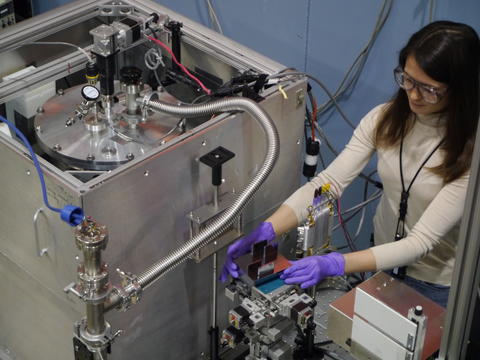
- Support Instrumentation Access: NIOFa’s open layout allows the unique capability of studying interference using cryogenic samples, elimination of air scattering using vacuum components, and greater control of the neutron’s polarization providing a clean 2-qubit system for advancing quantum information.
- Perfect Crystal Interferometry: Utilizing monolithic silicon "perfect crystal" interferometers, NIOFa can split a single neutron's wave function over macroscopically large distances (centimeters), creating a laboratory for testing quantum entanglement and coherence.
- Metrology for Neutron Optics: Serves as the primary testing ground for NIST’s development of novel neutron lenses, prisms, gratings, and other advanced optical elements ensuring the highest standards of accuracy for the international neutron community.
Credit:
NIST
Research Domains
- Fundamental Physics: Testing the equivalence principle, measuring the internal charge structure of the neutron, and searching for Beyond the Standard Model "fifth force" candidates.
- Quantum Information: Probing decoherence mechanisms and demonstrating quantum contextuality using the neutron’s spin, path, and energy degrees of freedom.
- Precision Metrology: Determining absolute neutron-nucleus scattering lengths and the temperature dependent vibrational modes of materials.
- Optical Development: Characterizing the performance of new refractive and diffractive neutron optics, such as Orbital Angular Momentum generating gratings and micro-prism arrays.
What You Can Measure
- Quantum Phase Shifts: Directly observing the effect of external potentials (magnetic, gravitational, or material) on the neutron wave function.
- Quantum Spin Precession: Analysis of the neutron’s spin evolution and its superposition with the neutron’s momentum.
- Structure Factors: Providing the most accurate values for crystal structure factors through phase measurements.
Technical Specifications
| Parameter | Specification |
|---|---|
| Monochromator | High-quality Pyrolytic Graphite (PG 002) |
| Wavelength | 0.44 nm (monochromatic) |
| Interferometer | Monolithic Silicon Perfect Crystal (several geometries) |
| Sample Table | 1.219 m x 1.524 m |
| Beam Size | Typically, 10 mm x 10 mm |
| Detector | 3He proportional counter |
Specialized Sample Environments
- Environment Isolation: The facility utilizes a large volume vacuum chamber to eliminate issues with thermal gradients and air scattering enabling higher precision measurements.
- Magnetic Control: The facility employs several neutron spin polarizers/analyzers, spin flippers, and static magnetic fields to generate, transport, and analyze neutron polarization.
- Cryostat: A custom, vibrationally decoupled cryostat allows the insertion of cryogenic samples.
Expertise & Support
- The Neutron Interferometer Physics Team: Led by Dr. Michael Huber, the team consists of a collaboration with university partners that include U. of Waterloo, Institute of Quantum Computing, University at Buffalo, NC State, Indiana University, Tulane University, University of Nagoya and others.
- Data Analysis Suite:
- NIOF-a: Our specialized, NIST-developed data acquisition and analysis system ensures efficient, high-impact science.
- Collaboration-Driven Access: Due to the extreme sensitivity of the setups, most NIOFa experiments are collaborative efforts with the NIST Neutron Physics Group.
Access & Resources
Live Data
Submit a Proposal
- For submitting proposals, ideas, and questions contact the instrument scientist directly: michael.huber [at] nist.gov (michael[dot]huber[at]nist[dot]gov). Beamtime is awarded based on NIOFa availability, novelty, and scientific impact. Generally, awarded experiments are allowed full use of the NIOFa until such time the experiment is completed.
Instrument Contacts
shannon.hoogerheide [at] nist.gov (shannon[dot]hoogerheide[at]nist[dot]gov)
(301) 975-8582
Created July 2, 2026, Updated August 27, 2026