

Official websites use .gov
A .gov website belongs to an official government organization in the United States.

Secure .gov websites use HTTPS
A lock (
) or https:// means you’ve safely connected to the .gov website. Share sensitive information only on official, secure websites.


BT8

INSTRUMENT PURPOSE
Residual stress is a material property that is critical for safety, durability, and ultimately, the cost of structural components. It is the purpose of this instrument to provide non-destructive, three-dimensional mapping of residual and applied stresses, crystallographic texture, and phase composition in bulk engineering components and advanced structural materials.
The NCNR Advantage
- Unmatched Penetration: Neutrons can penetrate centimeters into common engineering materials (like steel or aluminum), allowing for non-destructive, triaxial stress measurements that are impossible with surface-limited X-rays and even synchrotron X-rays.
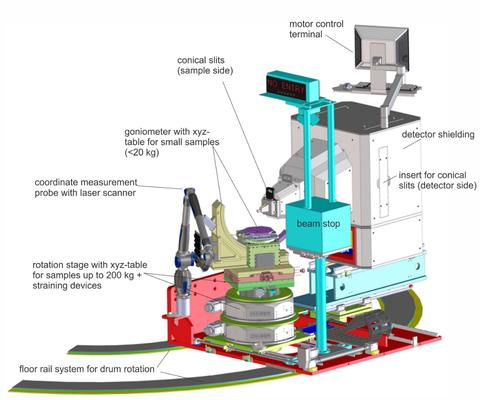
- Large-Scale Capability: Features a high-capacity sample table and a specialized jib crane capable of supporting and positioning industrial components weighing up to 250 kg.
- Multiaxial Testing: Home to the unique "Octo-strain" device, an eight-arm actuator system designed to apply bi-axial stresses along complex, non-proportional strain paths to high-strength materials combining neutron stress measurements with simultaneous macroscopic strain measurements using digital image correlation.
Research Domains
- Additive Manufacturing (AM): Quantifying the high residual stresses inherent in 3D-printed metal parts to optimize build parameters and heat treatments.
- Automotive & Naval Engineering: Biaxial yield functions and strain path dependence. Mapping stresses in weldments, crankshafts, and large AM builds.
- Deformation Physics: The correlation between stress, preferred orientation and phase transformation during the straining of sheet metals.
- Metrology & Standards: Developing measurement protocols for the international engineering community to ensure the safety and reliability of structural components.
What You Can Measure
- 3D Strain/Stress Tensors: Determination of elastic lattice spacing changes in multiple directions to calculate internal stress.
- Pole Figures: High-throughput mapping of crystallographic texture to predict mechanical anisotropy.
- Single crystal elastic constants (SCEC): Anisotropy of lattice strains in response to applied stress is used to determine SCEC in polycrystals.
- Phase Fractions: Identification of volume fractions in multi-phase alloys (e.g., austenite vs. martensite).
Technical Specifications
| Parameter | Specification |
|---|---|
| Wavelength Range (λ) | 0.0937 nm to 0.2836 nm (continuous) |
| Monochromator | Si (various reflections) with variable curvature |
| Detector | Large area 3He PSD (250 mm x 380 mm) @ 10 bar |
| Sample Positioning | XYZ stage + Euler cradle (for smaller samples) |
| Max Sample Weight | 250 kg (Large Table) / 10 kg (Euler Cradle) |
| Spatial Resolution | Typically ~ 1 mm |
| Travel Range (Large Stage) | X, Y: 300 mm; Z: 360 mm; Rotation: 360° |
Specialized Sample Environments
- Octo-strain System: A world-unique 8-arm loading frame for complex, multiaxial deformation studies.
- High-Capacity Load Frames: Mechanically actuated frames for uniaxial tension/compression up to 100 kN.
- Digital Image Correlation (DIC): Integrated optical system for measuring spatially resolved macroscopic surface strain simultaneously with neutron diffraction measurements.
- Shear device with rotation: A rotatable, high-capacity shear device for measuring shear stress and the rotation of the principal stress axes using neutron diffraction.
Expertise & Support
- The Engineering Team: Led by specialists in mechanics of materials and diffraction, providing assistance for complex sample alignment, measurement automation, and data analysis.
- Software & Data Analysis:
- ICP: Instrument control for automated data acquisition.
- Stress Analysis Tools: Dedicated software for converting diffraction peak fit data into stress tensors, pole figures, and elastic constants.
- Sample Alignment: Use of wall scans, coordinate measurement probes and high-resolution cameras to ensure precise positioning of internal features within the neutron beam.
Access & Resources
Live Data
Submit a Proposal
- NCNR IMS
- As a highly specialized engineering tool, BT-8 is accessed via beam time requests. Users are encouraged to contact the instrument scientist directly before submitting a BTR.