

Official websites use .gov
A .gov website belongs to an official government organization in the United States.

Secure .gov websites use HTTPS
A lock (
) or https:// means you’ve safely connected to the .gov website. Share sensitive information only on official, secure websites.


Neutron Spectroscopy (Inelastic Scattering)
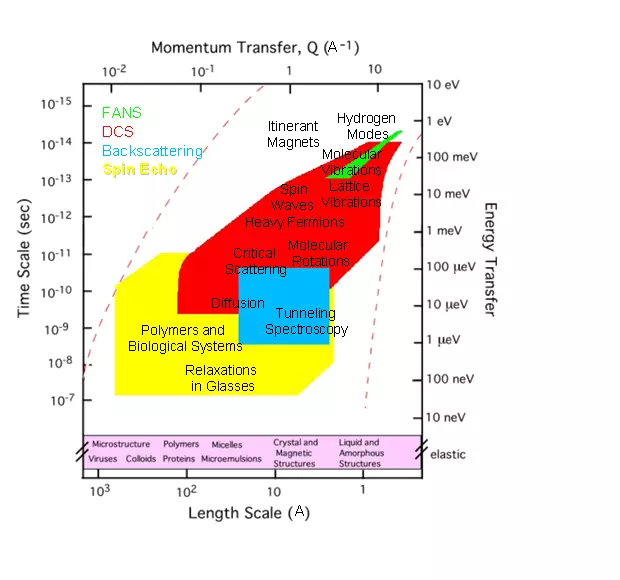
The millielectronvolt (meV) kinetic energy and angstrom wavelength of the neutrons produced at the NCNR makes them ideal probes of the motion of atoms and magnetic excitations in materials. Neutron spectroscopy, including both inelastic and quasielastic scattering, is a high resolution measurement of the space and time dependence of atomic position and magnetism that is unmatched by other spectroscopic probes.
Neutron spectrometers at the NCNR allow researchers to measure dynamical properties over 7 orders of magnitude in energy ranging from ~20 neV to 200 meV, which corresponds to time scales from 100 nanoseconds to ~10 femtoseconds. This allows researchers to study a wide variety of dynamical processes in materials, from the vibrations, rotations, tunneling and diffusive motions of atoms, molecules, and macromolecules, to collective excitations in materials such as phonons and lattice vibrations. Neutrons are also the preferred probe of magnetic excitations, including magnons, crystal field excitations, magnetic correlations, and quantum spin interactions.
Five neutron scattering instruments capable of measuring the dynamics of materials are currently being operated at the NCNR. Three of these instruments belong to the Center for High Resolution Neutron Scattering (CHRNS) which is supported by a grant from the National Science Foundation. The instruments are listed in approximate order of energy scale, from high to low. Corresponding length scales and representative types of excitations can be found in the diagram on this page.
- Thermal Neutron Double-focusing Triple Axis Spectrometer -BT7 (0.05 meV -250 meV)
- DCS - Cold Neutron Disk Chopper Time-of-Flight Spectrometer - NG4 (0.02 meV - 25 meV)
- MACS- Cold Neutron Triple Axis Spectrometer - BT9 (CHRNS) (0.05 meV -15 meV)
- HFBS- Cold Neutron Backscattering Spectrometer - NG2 (CHRNS) 0.001 meV - 0.1 meV)
- NSE- Cold Neutron Spin Echo Spectrometer - NGA (CHRNS) (50 nV - 0.1 meV)
Contacts
-
(301) 975-5134