U.S. flag

An official website of the United States government

Official websites use .gov
A .gov website belongs to an official government organization in the United States.

Secure .gov websites use HTTPS
A lock ( ) or https:// means you’ve safely connected to the .gov website. Share sensitive information only on official, secure websites.

Projects/Programs

Topic Area
Displaying 1426 - 1450 of 1661

Spectrophotometry

Ongoing
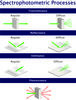
NIST uses spectrophotometric techniques to measure the optical properties of materials for dissemination of national measurement scales to its stakeholders and advancing the development of standards, measurement methods, and modeling capabilities. The beneficiaries of these activities include the

Spectroradiometry of sources

Ongoing
The spectral radiance sources in the form of tungsten-strip lamps and integrating-sphere sources are calibrated in the Facility for Spectroradiometric Calibrations (FASCAL). The measurements are performed by the use of a prism-grating double monochromator whose spectral radiance responsivity is

Spectroscopy and Application of Solid-State Quantum Centers

Ongoing
Quantum color centers in wide-bandgap semiconductors have spin and optical degrees of freedom, which can be leveraged for applications such as sensing and single-photon generation. In materials like diamond and silicon carbide, long spin lifetimes and quantum coherence times enable sensitive

Spectrum Coexistence Metrology

Ongoing
The overarching goal of the Coexistence Project is to support the development, evaluation, and optimization of spectrum sharing techniques. These techniques include methods to model, simulate, and physically measure the ability of wireless communications systems to maintain their functional

Spectrum Sensing and Noise

Ongoing
Reports in the NIST Technical Notes series were extensive measurements of radiated noise. Researchers also made key early contributions to standardizing guided-wave noise measurements in microwave systems. These contributions continue to underpin our ongoing work, but basic applications and hardware

Spectrum Sharing & Sensing

Ongoing
The presence of large numbers of licensed and unlicensed spectrum users has already increased the environmental noise floor well above conventional thermal noise levels. Nevertheless, a quantitative assessment of the existing noise floor in today’s communication world is not yet available. As a

Spectrum Tracking in Power Grid Systems

Completed
The increasing deployment of residential renewables and an extensive use of nonlinear devices in the distribution system can produce undesirable harmonic distortions. Such distortions can severely impact phase/frequency estimation in power systems, especially distributed grid systems. For grid

Speech Analytics

Ongoing
Current speech analytics work: OpenSAT is a new speech analytic evaluation series designed to include developers from multiple speech analytic technologies where common datasets are used in NIST evaluations. The goal is to bring together developers focused on different speech analytic tasks to

Spinor Condensates and Ultracold Collisions

Ongoing
A Bose-Einstein condensate (BEC) collapses the wavefunctions of many particles in to a single quantum state. In a spinor BEC the atoms can be in a superposition of internal quantum states. Thus, a BEC of spin-1 particles, like the F = 1 ground state of Na atoms, can be thought of as being a single

Spin-orbit interaction in devices and quantum materials

Ongoing
The spin degree of freedom can provide a basis for next-generation electronic devices. Spintronic devices typically include materials with magnetic ordering, such as ferromagnets or antiferromagnets. The state of the magnetization influences charge and spin current through an effect known as

Spintronics for Neuromorphic Computing

Ongoing
Magnetic tunnel junctions (see Fig. 1) consist of two thin films of ferromagnetic material separated by a few atomic layers of an insulating material. The insulator is so thin that electrons can tunnel quantum mechanically through it. The rate at which the electrons tunnel is affected by the

Springback

Ongoing
Springback, or the elastic change in shape when a part is released from the manufacturing process, has been a problem for decades and accounts for a significant fraction of the expense that the US auto industry spends each year trying out die sets for new body designs. The inability to predict the

Standard Platinum Resistance Thermometer Calibration Laboratory (SPRTCL)

Ongoing
The SPRTCL provides an extensive list of calibration services that cover the whole temperature range for which long-stem SPRTs, including high-temperature SPRTs, are the ITS-90 interpolation artifacts. This range spans from the triple point of argon (-189.3442 °C) to the freezing point of silver

Standard Reference Materials for Hexavalent Chromium in Contaminated Soil

Completed
During the last century, chromate and dichromate chemical production facilities processed considerable amounts of chromite ore for industrial manufacturing purposes. The waste material from these operations called chromite ore processing residue (COPR) was disposed of in waste sites across the

Standard Reference Materials: Standardization of 232U (SRM 4324c)

Ongoing
The certified massic activity for 232U was obtained by 4παβ LS spectrometry with two commercial LS counters. The beta detection efficiencies for the 232U daughters were calculated using the MICELLE2 code for the CIEMAT/NIST efficiency tracing (CNET) method with composition-matched LS cocktails of a

Standard Reference Materials: Standardization of 243Am (SRM 4332f)

Ongoing
The certified massic activity for 243Am was obtained by 4παβ LS spectrometry with two commercial LS counters. The beta detection efficiencies for the 243Am daughter ( 239Np) were calculated using the CN2003 code for the CIEMAT/NIST efficiency tracing (CNET) method with composition-matched LS

Standard Reference Materials: Standardization of 239Pu (SRM 4330d)

Ongoing
The certified massic activity for 239Pu was obtained by 4πα liquid scintillation (LS) spectrometry with two commercial LS counters. Confirmatory measurements were performed by LS counting comparative measurements against SRM 4330d, which was also standardized in 2009 by 4pa liquid scintillation (LS)

Standard Reference Measurements

Ongoing
State-of-the art property measurements have been the hallmark of the Fluid Properties Group for more than four decades. Many of these measurements have been carried out on one-of-a-kind instruments developed at NIST. In some cases the older instruments are still among the very best of their kind

Standard Solution SRMs Provide Traceability for Millions of Measurements

Ongoing
Literally millions of measurements of elemental composition are performed each year worldwide. The vast majority of these measurements depend upon reference materials for establishing traceability of results to the SI. Leveraged through commercial CRM producers, the NIST SRM 3100 series provides an

Standards

Ongoing
Standards for Optical Based Standoff Detection NIST is researching methods for creating explosive threat materials standards relevant to optical detection technologies (e.g. that result in samples with particle morphologies similar to those found in explosive threat devices). This includes both

Standards Development to Ensure Reliable Breath Analysis in the Field

Ongoing
Numerous volatile organic compounds (VOCs) have been identified in human breath. These compounds can be produced by the body or by organisms in the body (e.g., bacteria or viruses) and provide a non-invasive window into human health. Inexpensive point-of-care devices are being developed to diagnose

Standards for Metagenomics

Ongoing
Metagenomics is a powerful technology combining high-throughput (a.k.a. “next-generation”) sequencing with advanced bioinformatics to identify and quantify mixtures of organisms in a sample. Metagenomics workflows consist of 4 main steps: Sample collection: location, amount, storage, etc. Extraction

Standards to Support Biological Detection in the Field

Ongoing
NIST is working in partnership with the Department of Homeland Security Science and Technology Directorate (DHS S&T) to develop methods, guidance, standards, and reference materials to support and improve our Nation's ability to detect and respond to suspected biothreat incidents. Specific
Was this page helpful?