An official website of the United States government
Here’s how you know
Official websites use .gov
A .gov website belongs to an official government organization in the United States.
Secure .gov websites use HTTPS
A lock (
) or https:// means you’ve safely connected to the .gov website. Share sensitive information only on official, secure websites.

After enactment of the CPSIA, a collaboration was established between the Consumer Product Safety Commission (CPSC) and NIST for the purpose of developing tools
The Chemical Sciences Division is involved in development of standards and reference materials for restricted hazardous substances through participation in
NIST maintains an active role in these two CCQM working groups, participating in international key comparisons and pilot studies, organizing new studies, and
Straw detectors are a new concept in position-sensitive neutron detectors recently developed by Proportion Technology Inc. The detectors are especially valuable
For the past 40 years NIST has developed SRMs for the determination of inorganic and organic contaminants in environmental matrices such as sediments/soils
Analysis of soils for metals and other elements is essential in assessing environmental compliance and the impacts of potentially toxic elements on human
Biomarkers play an increasingly important role in disease detection and treatment. As one of the Biomarker Reference Laboratories (BRLs) in the Early Detection
Significant environmental remediation efforts are being conducted to address the hazards posed by the long-term terrestrial disposal of hexavalent chromium in
Both comprehensive two-dimensional gas chromatography (GCxGC) and comprehensive two-dimensional liquid chromatography (LCxLC) have emerged as powerful tools
For decades, NIST has provided the SRM 3100 series single-element standard solutions. The certified values are traceable to the International System of Units
NIST assigns assay values for a suite of high-purity reagents using two techniques: coulometry and titrimetry. Coulometry is based on Faraday's Laws of
The pH metrology program supports traceability for pH measurements. This traceability rests on primary pH measurements in an ideal electrochemical cell (Harned
Using high-performance inductively coupled plasma optical emission spectrometry (HP‑ICP-OES), relative expanded uncertainties on the order of 0.2 % can be
Microbeam X-ray fluorescence (µXRF) has been used nondestructively to investigate elemental heterogeneity by constructing two-dimensional maps of elemental
The accurate mass determination of DNA and other nucleic acids is of critical importance in many clinical diagnoses and in forensic and molecular biological
While exploring the properties of polymer formation, a team of scientists at the National Institute for Standards and Technology (NIST) has made a fundamental
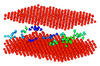
Researchers at the National Institute of Standards and Technology (NIST) have discovered that a carefully built magnetic sandwich that interleaves layers of a
Nanotubes, the tiny honeycomb cylinders of carbon atoms only a few nanometers wide, are perhaps the signature material of modern engineering research, but
The Gas Sensing Metrology Group in the Chemical Sciences Division is tasked with providing traceability in gas analysis for the U.S. This group works with
Our goal is to develop measurements that quantify the shape, size, orientation, and fidelity of nanoscale patterns as a platform to quantitatively evaluate
The American Industry/Government Emissions Research (AIGER) Consortium is working to facilitate the automobile industry meeting more stringent 2003 Federal Tier
Two NIST programs provide calibration gas standards with NIST analyses and concentration value assignment: the Standard Reference Material (SRM) program and the
EPA Protocol gas mixture calibration standards are obtained by users to measure emissions of regulated gaseous species and ensure that they comply with US
The presence of volatile organic compounds (VOCs), which include hydrocarbons, monoterpenes and oxygenates, in the atmosphere has become important to climate
The NIST Standard Reference Photometer (SRP), developed jointly with the U.S. Environmental Protection Agency (USEPA), has provided an infrastructure for the
The Gas Metrology Group periodically participates in bilateral and multi-laboratory international comparisons. During the past two years comparisons have taken
NIST's Chemical Sciences Division Gas Sensing Metrology Group has participated in over 40 Consultative Committee for Amount of Substance-Metrology in Chemistry
NIST's Chemical Sciences Division has participated in over 50 Consultative Committee for Amount of Substance - Metrology in Chemistry (CCQM) Organic Analysis