

Official websites use .gov
A .gov website belongs to an official government organization in the United States.

Secure .gov websites use HTTPS
A lock (
) or https:// means you’ve safely connected to the .gov website. Share sensitive information only on official, secure websites.


Summary
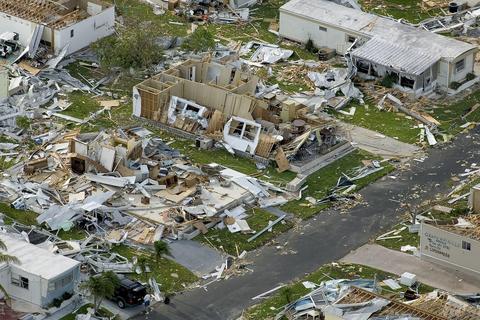
The project addresses the critical need to protect American communities from extreme wind hazards, including those resulting from hurricanes, thunderstorms, and tornadoes. The project’s scope encompasses the comprehensive characterization of these powerful wind events and the development of advanced methodologies for simulating wind-induced loads, analyzing the ensuing structural response, and evaluating potential impacts on life safety and other performance objectives such as serviceability. This foundational research is essential for fostering the design of resilient and economically efficient structures and communities nationwide for extreme winds.
Description
Objective
To significantly reduce the loss of life and property caused by extreme wind events and to enhance the resilience of American communities through improved characterization of extreme windstorms and tornadoes, development of performance-based design methods for extreme winds, and advancement of codes, standards, and practices for tornado hazard mitigation.
Technical Idea
To address critical deficiencies in hazard characterization and structural design against extreme wind events, this section outlines the technical ideas and strategic approaches for extreme windstorms and tornadoes.
Track 1) Extreme Windstorms: Hazard Characterization and Performance-Based Design
The technical idea includes (1) advancement of analysis and design methods for Performance-Based Wind Design, specifically addressing non-synoptic wind loads, wind-induced nonlinear material behaviors, and cyclic testing protocols to evaluate the performance of structural components and assemblies subjected to extreme windstorms; (2) development of physics-informed numerical techniques for CWE simulations; and (3) development of comprehensive approaches for quantifying uncertainties in both experimental and simulation results. Reliable uncertainty estimation in CWE simulations requires well-planned wind tunnel test protocols and data of sufficient accuracy and precision to provide the primary reference for validation. NIST will actively contribute to the development and improvement of guidelines, pre-standards, and standards for PBWD and CWE, along with the establishment of benchmark cases for validation of CWE simulations.
Track 2) Design for Tornadoes
Significant progress has been made on the implementation of recommendations from the Joplin Tornado investigation final report. The project focuses on addressing the following recommendations: (1) standardization and improvement of the Enhanced Fujita (EF) Scale method for estimating tornado wind speeds, (2) development of tornado-resistant design guidance for residential and other building types, (3) development of tools to help support the adoption of the 2024 International Building Code (IBC) tornado load requirements by local authorities having jurisdiction, and (4) development of guidelines for selection of best available tornado refuge areas in existing buildings; and development of guidelines that enable communities to create safe and effective public sheltering strategies. NIST also actively participates as a coordinator, convener, facilitator, or committee member to ensure that necessary work/code change proposals are completed for standard and code development.
For the tornado research, two sets of measurements are needed: 1) in-situ wind speed measurement of full-scale tornadoes and 2) pressure measurement on model buildings in a tornado simulator. The wind speed measurements will be collected through a UAV-mounted wind sensor, and the pressure measurements will be obtained through the tornado simulator experiments conducted at TTU through NIST’s membership in the Wind Hazard and Infrastructure Performance Center (WHIP-C).
Research Plan
A strategic outline for achieving the overarching goals of the project is detailed below. It specifies technical objectives and methodologies across the two critical project areas:
Track 1) Extreme Windstorms: Hazard Characterization and Performance-Based Design
- Performance-Based Wind Design: (1) Develop design procedures based on diverse performance objectives for buildings, incorporating nonlinear behaviors of structural elements under extreme wind loads, (2) develop design methods for estimating structural performance of a building under non-synoptic, transient wind storms, such as downbursts, and (3) establish design procedures for estimating overall structural performance of a building under diverse wind hazards, including extratropical storms, hurricanes, and thunderstorm downbursts at a site.
- Computational Wind Engineering: Develop CWE as a science-based, validated numerical approach, enabling its acceptance and use as a standalone design tool within the ASCE 7 Standard. To achieve this goal, CWE methodologies, modules, and procedures will be developed for (a) simulating diverse approach wind flows including straight synoptic winds, hurricanes, thunderstorms, and tornadoes, (b) modeling complex turbulent flow fields around bluff-body structures, (c) accurately resolving or modeling the flow near structures, and (d) establishing a standard for CWE procedures in building design in coordination with the industry.
- Uncertainty Quantification (UQ): (a) Develop systematic verification, validation, and UQ approach for quantifying both individual and total uncertainties in simulation results, (b) establish quality assurance acceptance criteria for wind loads estimated from CWE simulations, specifically for structural design within the ASCE 7 Standard framework, (c) complete a round-robin study on comparison of variations in approach flows, their effects on pressures on a building model and its structural responses measured across multiple wind tunnel laboratories, and (d) establish benchmark cases using reliable experimental datasets essential for validating CWE simulations.
Track 2) Design for Tornadoes
- Tornado Hazard Characterization: (a) Improve the EF Scale methodology by establishing a more scientific and quantifiable approach to developing Degree of Damage (DoD) wind speed estimates for existing and new Damage Indicators (DIs) (this methodology will be incorporated into a new standard for Wind Speed Estimation in Tornadoes and Other Windstorms currently under development) and (b) advance in-situ measurements of wind speed of tornadoes (and other windstorms) through development, calibration, and publication of the UAV-mounted omnidirectional wind velocity sensor.
- Structural Design for Tornadoes: (a) Develop additional guidance for tornado-resistant design of residential construction and other building types (e.g., warehouses), in collaboration with the NIST Office of Applied Economics and FEMA, incorporating lessons from post-tornado damage assessments and benefit-cost analyses. (b) evaluate the current ASCE 7 tornado pressure coefficients and proposals for modifications to ASCE 7-28, as warranted, and (c) develop a national database and map with a user-friendly web interface of tornado strikes on critical facilities, accurately documenting tornado impacts relevant to the authorities having jurisdiction, to provide support for federal, state, and local adoption of the tornado load requirements.
- Tornado Sheltering Strategies: (a) guidelines for identification of best available tornado refuge areas within existing buildings, developed in collaboration with FEMA, by adapting and expanding the damage modeling to create a fragility-based methodology and tool, and (b) series of workshops to identify opportunities, challenges, and best practices associated with the design, and operation of public tornado shelters in collaboration with FEMA, NOAA, and other stakeholders.
The products from this project are essential for the structural engineering community’s efforts to achieve accurate characterization of wind hazards, including tornado hazards, and to implement practical and effective design tools. External stakeholders, including designers, code officials, building product manufacturers, risk analysts, and others, are working to incorporate wind hazards and wind-resistant design into modern building codes, standards, and guidelines. Additional stakeholders include meteorologists and emergency managers who provide preparedness and operational guidance for response to extreme wind events. The societal impact of this research will be recognized through widespread improvements in the performance of buildings and communities, leading to reduced economic losses and accelerated recovery for the American public following hazard events.
References
NIST (2014a). Final Report, National Institute of Standards and Technology (NIST) Technical Investigation of the May 22, 2011, Tornado in Joplin, Missouri, NCSTAR 3. http://www.nist.gov/manuscript-publication-search.cfm?pub_id=915628
NIST (2014b). Measurement Science R&D Roadmap for Windstorm and Coastal Inundation Impact Reduction, NIST GCR - 14-973-13, prepared by the NEHRP Consultants Joint Venture for National Institute of Standards and Technology, Gaithersburg, MD.
NIST (2023a) Advancements in Performance-Based Wind Design: Workshop Report, NIST GCR 23-045, prepared by ASCE/SEI for National Institute of Standards and Technology, Gaithersburg, MD. (https://doi.org/10.6028/NIST.GCR.23-045-upd1)
NIST (2023b) Advancements in Computational Wind Engineering: Workshop Report, NIST GCR 23-047, prepared by ASCE/SEI for National Institute of Standards and Technology, Gaithersburg, MD. (https://doi.org/10.6028/NIST.GCR.23-047)