

Official websites use .gov
A .gov website belongs to an official government organization in the United States.

Secure .gov websites use HTTPS
A lock (
) or https:// means you’ve safely connected to the .gov website. Share sensitive information only on official, secure websites.


Firewood Piles
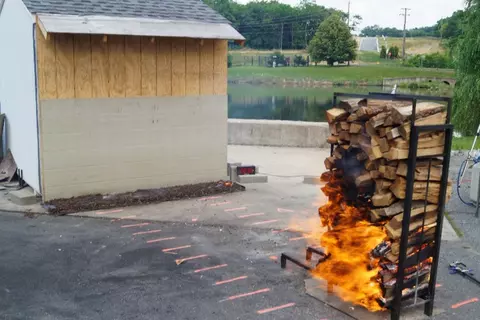
A series of field experiments was conducted to examine the effects of burning firewood piles on fire spread toward a structure under conditions that may be encountered during a WUI fire. The fire behavior of a variety of firewood species in multiple configurations was studied under various wind conditions. The 62 experiments conducted included long range firebrand travel and fire spread mitigation experiments. Wood species included kiln-dried maple, oak [dried and not dried (“green”)] and eastern white pine. Configuration variations included woodpile height, orientation, and elevation on a rack. A wind machine provided a mean wind speed between a nominal 6 m/s and 14 m/s (13 mi/h to 31 mi/h). The woodpiles were ignited by a propane burner on the ground at the end farthest from a small structure located between 0.91 m and 7.32 m (3 ft to 24 ft) downwind of the woodpile. A target mulch bed at the base of the structure evaluated the ability of firebrands produced by the burning woodpile to ignite spot fires that could threaten the structure.
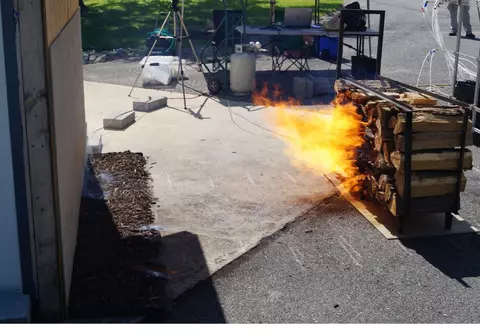
The experiments in this study demonstrated that firewood piles can be rapid sources of spot fire ignitions and can easily spread fire to nearby structures. Rapid fire growth on and substantial flames from the woodpiles were found for all wood species and configurations. Fire behavior was classified as high hazard for igniting spot fires under all wind conditions.
In all cases, spot fire generation was affected by the wind field; the structure created both upward flow (enhanced by buoyancy) and a vortex that deposited firebrands next to the structure. During all experiments, the burning woodpile produced firebrands that ignited spot fires in the target mulch bed. In long range experiments, firebrands from a woodpile caused ignitions over 26 m (85 ft) downwind.
PUBLICATIONS
Johnsson, E., et al. (2023) Wind-Driven Fire Spread to a Structure from Firewood Piles. NIST Technical Note 2251.
https://doi.org/10.6028/NIST.TN.2251
Contacts
-
(301) 975-3083