

Official websites use .gov
A .gov website belongs to an official government organization in the United States.

Secure .gov websites use HTTPS
A lock (
) or https:// means you’ve safely connected to the .gov website. Share sensitive information only on official, secure websites.


Eave and Vent Experiments (EaVEs)
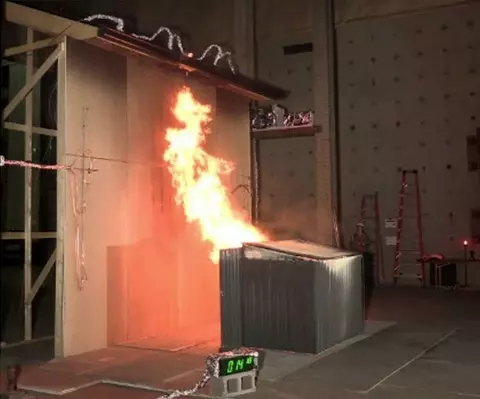
The NIST Eave and Vent Experiments (EaVEs) were conducted to characterize the performance of select wildland-urban interface (WUI) eave vents exposed to fire from noncombustible steel sheds of different sizes and fuel loads (wood cribs) and varying structure separation distances (SSDs) from the target structure. The target structure included an assembly of an exterior residential wall, a roof, and an eave vent. Experiments recorded a range of measurements including heat release rate (HRR), heat flux, temperature, gas flow velocity, and gas species concentration using open-path absorption spectroscopy. The experimental series assessed the performance of three commercially available fire-resistant eave vents subjected to much larger fire exposures (1.5 MW to 2.5 MW) compared to the fire exposure (300 kW) specified in the existing ASTM test methods.
PUBLICATIONS
Brown CU, et al. (2024) NIST Eave and Vent Experiments (EaVE) EaVEs Phase A: Test Plan. (National Institute of Standards and Technology, Gaithersburg, MD), NIST Technical Note (TN) NIST TN 2288. https://doi.org/10.6028/NIST.TN.2288
Brown CU, et al. (2025) Eave and Vent Experiments (EaVE): Phase A. (National Institute of Standards and Technology, Gaithersburg, MD), NIST Technical Note (TN) NIST TN 2341. https://doi.org/10.6028/NIST.TN.2341