

Official websites use .gov
A .gov website belongs to an official government organization in the United States.

Secure .gov websites use HTTPS
A lock (
) or https:// means you’ve safely connected to the .gov website. Share sensitive information only on official, secure websites.


Parcel Combustibles
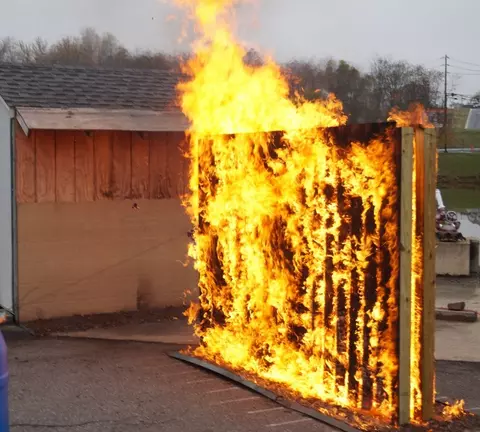
Field observations show that combustible landscaping features are a common pathway leading fire spread directly to homes during wildland-urban interface (WUI) fires. NIST is studying how these features around a home burn to better understand their levels of hazard and potential roles in spreading WUI fires. Three series of field experiments, focused on fences and mulch, firewood piles, and landscape timbers, were conducted to examine how fire spread toward a structure (a small shed) under conditions that may be encountered during a WUI fire. The results of these studies are intended to better inform standards and codes regarding placement of landscape features around homes that are at risk of exposure to wildland-urban interface fires.
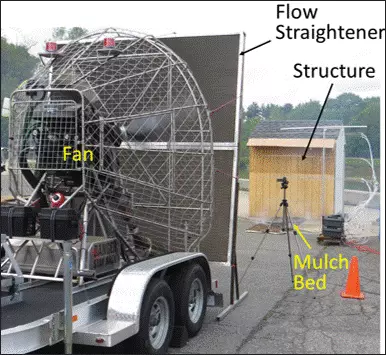
In these experiments, an airboat-style wind machine was used to generate a wind field at three speeds to determine wind’s effect on fire spread via flames and firebrands. For most experiments, a target mulch bed at the base of the structure evaluated the ability of firebrands produced by the burning objects to ignite spot fires that could threaten the structure.
PUBLICATIONS
Butler, K. and Johnsson, E., et al. (2022) Wind-Driven Fire Spread to a Structure from Fences and Mulch. NIST Technical Note 2228.
https://doi.org/10.6028/NIST.TN.2228-upd1
Johnsson, E., et al. (2023) Wind-Driven Fire Spread to a Structure from Firewood Piles. NIST Technical Note 2251.
https://doi.org/10.6028/NIST.TN.2251
Butler, K., et al. (2023) Wind-Driven Fire Spread to a Structure from Composite Fences. NIST Technical Note 2357.
https://doi.org/10.6028/NIST.TN.2357
Johnsson, E., et al. (2025) Wind-Driven Fire Spread to a Structure from Landscape Timbers NIST Technical Note 2307.
https://doi.org/10.6028/NIST.TN.2307
Contacts
-
(301) 975-3083