

Official websites use .gov
A .gov website belongs to an official government organization in the United States.

Secure .gov websites use HTTPS
A lock (
) or https:// means you’ve safely connected to the .gov website. Share sensitive information only on official, secure websites.


Fences and Mulch
A series of field experiments was conducted to examine the effects on fire spread toward a structure for combustible fences and mulch under conditions that may be encountered in a wildland-urban interface (WUI) fire. The fire behavior of a variety of materials, designs, and configurations were studied under various wind conditions. The 187 experiments were split into five categories: mulch only, fence only, fence plus mulch, parallel fences, and long range firebrand experiments. Fence materials included western redcedar, California redwood, pine, vinyl, and wood-plastic composites, and fence styles included privacy, lattice, and good neighbor (board on board). The tested mulch types were shredded hardwood, mini pine bark nuggets, pine straw, rubber, and artificial turf. A wind machine provided a mean wind speed between 6 m/s and 14 m/s (13 mi/h to 31 mi/h). The fence and/or mulch bed was ignited by a propane burner on the ground at the end farthest from the structure. A small structure was located between 0 m and 1.83 m (0 ft to 6 ft) downwind of the fence or mulch bed as a target for flames and firebrands. A target mulch bed at the base of the structure tested the ability of firebrands produced by the burning fence and mulch bed to ignite spot fires that threatened the structure.
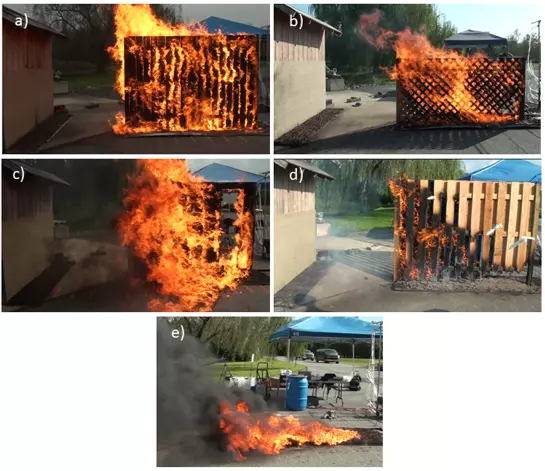
The experiments in this study demonstrated that combustible fences can be rapid conduits for fire and can potentially spread fire to attached or adjacent structures. Combinations of combustible items were found to increase the fire hazard disproportionately. Fire behavior was classified as very high, high, medium, and low hazard. Rapid fire growth and large flames were found for parallel fences and one type of wood-plastic composite fence. Good neighbor fences carried flames from the ground to the top of the fence. Combustible fences with mulch at their base were found to be high hazard, transporting fire through the community and providing a steady source of firebrands. Fire spread continuously over mulch beds, with progress sometimes enhanced by the ignition of spot fires downwind. Medium fire hazard was found for wood fences in the absence of mulch, with slow fire spread dominated by glowing combustion with occasional small flames. Low fire hazard was expected for noncombustible fences, with maintenance required to minimize the accumulation of fine combustible materials along the fence.
In all cases the fire progress was affected by the wind field; the structure created both upward flow (enhanced by buoyancy) and a vortex that both deposited firebrands next to the structure and slowed flame spread on the ground. During most experiments, the burning mulch and fences produced firebrands that ignited spot fires in the target mulch bed. In long range experiments, firebrands from fences and mulch beds caused ignitions over 47 m (155 ft) downwind.
Composite Fences
Following up on an earlier NIST study involving a variety of fences and mulch, full-scale fire experiments and cone calorimeter tests were conducted on two types of wood-plastic composite (WPC) fences and one steel-plastic composite (SPC) fence available to consumers. Full-scale experiments examined the effects on fire spread toward a structure for each type of composite fence, with and without shredded hardwood mulch placed beneath the fence. A wind machine provided a nominal mean wind speed of 6 m/s (13 mi/h). The fence and/or mulch bed were ignited by a propane burner on the ground at the end farthest from the structure. A small structure was located 1.83 m (6 ft) downwind of the fence as a target for flames and firebrands. A target mulch bed at the base of the structure tested the ability of firebrands or flames produced by the burning fence and mulch bed to ignite spot fires that threatened the structure. Cone calorimeter tests were performed on samples from all three composite fences and compared to previous results from western red cedar and vinyl privacy fences. Ignitability and flammability measurements were obtained in horizontal and vertical orientations according to standard cone calorimeter protocols described in ASTM E-1354.
PUBLICATIONS
Butler, K. and Johnsson, E., et al. (2022) Wind-Driven Fire Spread to a Structure from Fences and Mulch. NIST Technical Note 2228.
https://doi.org/10.6028/NIST.TN.2228-upd1
Butler, K., et al. (2023) Wind-Driven Fire Spread to a Structure from Composite Fences. NIST Technical Note 2357.
https://doi.org/10.6028/NIST.TN.2357
Contacts
-
(301) 975-3083