Official websites use .gov
A .gov website belongs to an official government organization in the United States.

Secure .gov websites use HTTPS
A lock (
) or https:// means you’ve safely connected to the .gov website. Share sensitive information only on official, secure websites.


Massively Parallel Reliability Test Platform
Summary
Meeting the ever-growing demand for power consumption is a tall order; meeting this demand reliably is an even more daunting task. Predicting how and when power electronics parts will fail requires, quite literally, predicting the future. The strength in these predictions comes purely from statistics and physical modeling. NIST’s massively parallel reliability test platform provides a unique capability to study the failure behavior of power electronics at a statistical scale never before realized. The project’s current focus deals with extrinsic (early) failures in silicon carbide transistor gate dielectrics.
Description
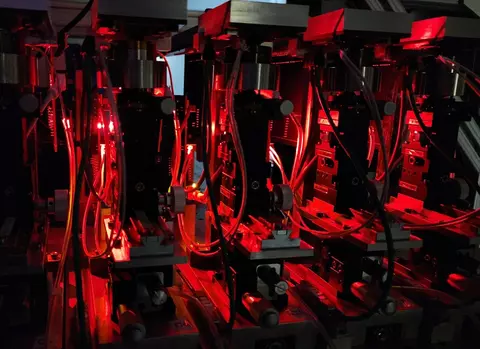
Photograph of a small section of the massively parallel reliability test platform during an active experiment. Several miniature probing stations are visible.
Emerging wide-bandgap semiconductors such as silicon carbide (SiC) physically outperform silicon in the realm of power electronics. High-performance SiC power transistors promise to help enable societal shifts in large-scale datacenter operation, transportation systems, power grid resiliency, manufacturing, and more. As is often the case with new technologies, SiC power transistors present engineers and researchers with new, unique problems- especially when it comes to reliability.
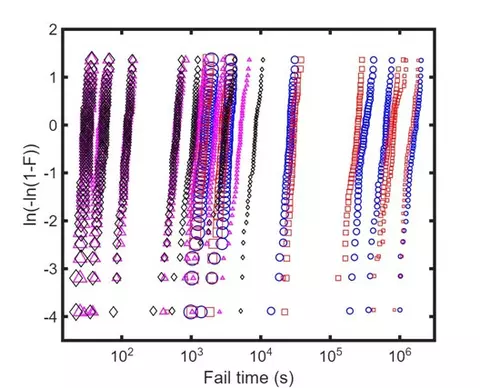
Unlike thin-gate silicon transistors, which wear out and fail on a predictable timescale, SiC power transistors sometimes fail unpredictably due to premature breakdown of the gate oxide layer. Even a small percentage of these “extrinsic failures” can exclude SiC transistors from high-reliability applications like those listed above. Studying these failures is hard for two reasons: 1) the devices under test must be stressed at higher-than-operating voltages and temperatures in order to accelerate the failures, and 2) there may be several thousand or more “normal” failures for each extrinsic failure. This means that, in order to gain a fundamental understanding of extrinsic failures, a HUGE number of devices (tens or hundreds of thousands) must be tested to failure under a wide range of conditions. This is an impossible task when using commercially available test equipment.

NIST’s solution to this problem is a custom, massively parallel reliability test platform for studying gate oxide reliability. The system is based on NIST-developed, miniature, die-level probing stations, each capable of providing stress temperatures in excess of 400 °C and gate stress voltages of up to three times typical operating conditions to 50 devices under test simultaneously. The samples are monitored for gate oxide leakage current and gate oxide failure. Any number of miniature probing stations can be run in parallel to scale the system. A custom app for wireless data streaming and databasing was developed and deployed on a server computer.
The massively parallel reliability test platform is already among the largest in the world, and further scaling of the probe station array will allow NIST to generate the largest publicly available datasets of failure statistics in existence within the next several years. Preliminary data is already contributing to progress towards the development of high-performance and high-reliability power electronics.