

Official websites use .gov
A .gov website belongs to an official government organization in the United States.

Secure .gov websites use HTTPS
A lock (
) or https:// means you’ve safely connected to the .gov website. Share sensitive information only on official, secure websites.


America's Time Capsule
- In 2016, Congress passed a law requiring that a time capsule be created and buried underground in 2026.
- The America 250 organization turned to NIST's preservation experts to create the time capsule.
- The capsule will remain buried underground in Philadelphia for 250 years, protected from the elements by the its bespoke design.

As America approached its 250th birthday, NIST’s historic preservation experts took on a hugely challenging task: building a time capsule that could keep papers and treasures safe for the next 250 years of American history, while buried underground.
To put into perspective just how long 250 years is, stainless steel was first used around 1911. So, as of 2026, stainless steel had only existed for 115 years.
Congress passed a law in 2016 mandating the creation of a time capsule for America’s 250th anniversary and setting a 250-year timeframe for its time underground. America250, the organization created by Congress to celebrate the anniversary, asked NIST to build the capsule.
Luckily, our experts have extensive experience in this area, having preserved the Declaration of Independence, Statue of Liberty and more.

Designing and Building the Capsule
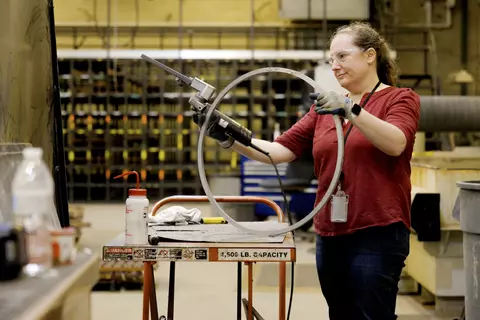
The capsule is actually two pieces. The main capsule is less than a meter in diameter and height and made of stainless steel. It weighs 400 kilograms (or about 900 pounds). NIST team members used a milling machine to carve the metal into a cylinder shape.
The biggest threat to an underground time capsule is water. So, the team designed a bell jar to sit atop the capsule. Why a bell jar? Science!
Before diving suits existed, people went underwater using a bell. A diver would stand beneath the bell and breathe from the pocket of trapped air beneath it.
That same concept — a pocket of air — will protect America’s time capsule from water and other hazards over the next 250 years.
What’s Inside the Capsule
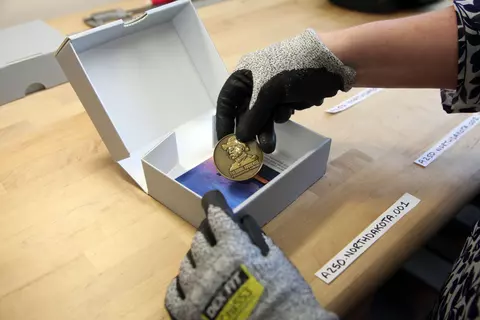
Each item in the time capsule was painstakingly documented and packed by NIST experts and then placed on stackable shelves.
The time capsule contains numerous papers and items to show what life was like in the U.S. in 2026 — such as a crystal from the New Year’s Eve ball drop in Times Square, books, a message in a bottle, a coin-toss coin from an NFL game, an Olympic medal and more.
Additionally, each state or territory provided papers and small items to represent the local area. A few examples of the state/territory contributions include:
- Qubit chip (California)
- Petoskey stone (Michigan)
- Hand-woven necklace (Northern Mariana Islands)
- Route 66 Centennial Coin (Oklahoma)
See the complete list of time capsule contents.
Burying the Capsule
The capsule was buried at Independence National Historical Park on July 4, 2026, and will remain there for the next 250 years, thanks to NIST’s experts and our partners.