

Official websites use .gov
A .gov website belongs to an official government organization in the United States.

Secure .gov websites use HTTPS
A lock (
) or https:// means you’ve safely connected to the .gov website. Share sensitive information only on official, secure websites.


Taking Measure
Just a Standard Blog
The International System of Units: A Never-Ending Quest for the Perfect Measurement System
This is part one in a two-part series. Read part two.
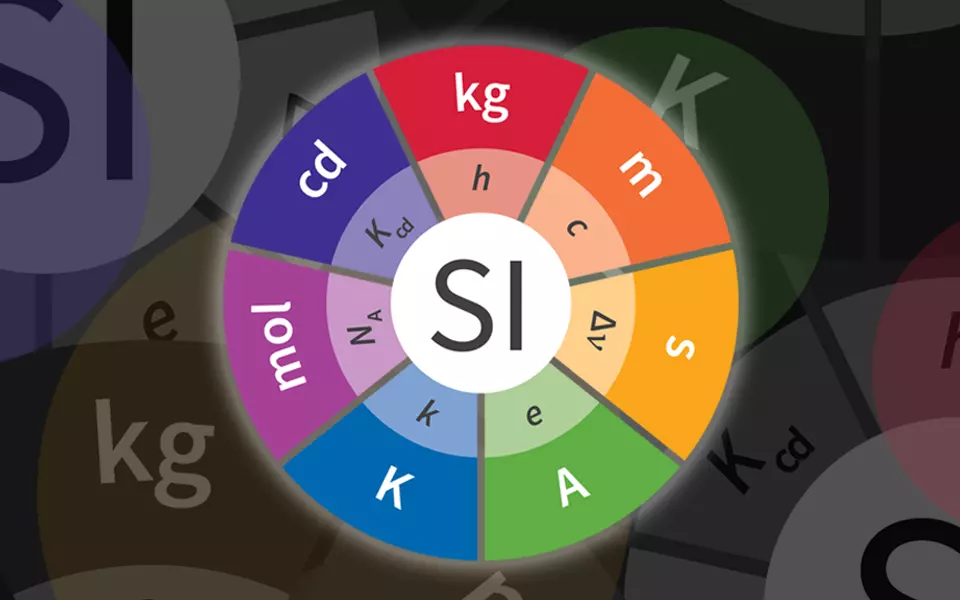
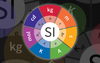
In 2018, 60 nations came together for something historic and profound. They voted to change the international system of units — also known as the SI or metric system — to rest solely on seven constants of nature.
No longer would scientists need to fly metal cylinders to France and compare them with another cylinder to measure mass. No longer would electric current be defined by an experiment that is impossible to carry out. Finally, the world had a measurement system “for all times, for all people” — the fulfillment of a dream first articulated during the French Revolution, more than 200 years ago.
“It was,” NIST wrote at the time, “a turning point for humanity.”
A casual observer might have concluded that the SI was now complete, perfected and engraved in stone for all time. But the reality is very different.
With the 2019 redefinition, scientists did away with the last artifact — the international prototype kilogram, kept in a secure vault in France. And they created a rational and, in principle, universal basis for measurement that should make sense even to an advanced civilization from another planet.
But in doing so, scientists took on a new set of challenges. Researchers now need to develop advanced methods to turn the abstract definitions of several units into a practical reality in the lab — a process experts call “realizing” the units.
And behind the scenes, a debate simmers over whether the current set of seven base units is the optimal foundation for a measurement system. Each unit is important to specific fields of science and industry. But some scientists believe that up to three of the seven belong in a separate category — and that a truly fundamental measurement system would rest on as few as four fundamental constants. The units themselves would serve mainly as a useful and familiar link to history and tradition.
The existence of these challenges and debates is in no way a knock on the SI. To the contrary, they exist because the SI has been so successful that both science and the global economy have come to rely on it — and these two important spheres often have different priorities and interests. Rather than being the last word, the 2019 SI redefinition opened a new and exciting chapter in the quest to create a universal and accessible measurement system.
New Definitions Create Measurement Challenges
Before 2019, measuring the kilogram was logistically complicated but technically simple. Provided you could safely transport your kilogram to Paris, you could simply weigh it on a balance with the International Prototype Kilogram — also known as le grand K — and see how far yours was “off.”
Unfortunately, after enough people did this, it became increasingly clear that le grand K itself was changing.
The redefinition ended this situation. It defined mass in terms of the Planck constant, a number that arises from quantum physics — the description of nature at its smallest and most fundamental scales. And the redefinition fixed the value of the Planck constant for all time.
It also created a new challenge: ensuring that nations around the world can repeatedly and reliably produce mass measurements that agree with each other.
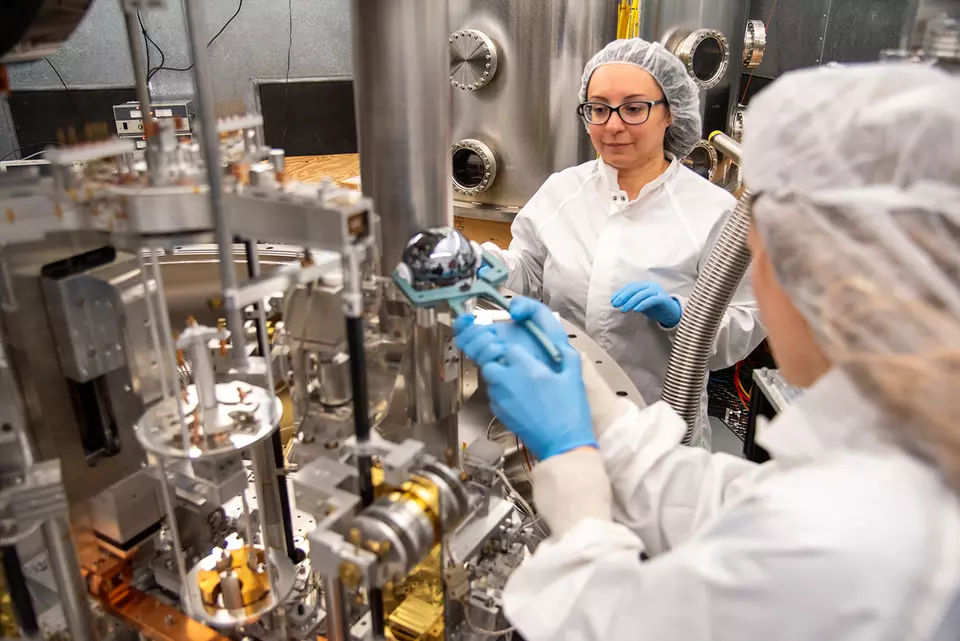
The International Bureau of Weights and Measures (BIPM; the acronym is based on the organization’s name in French), which oversees the SI, specifies two methods for realizing the kilogram. One involves a device called the Kibble balance, which balances mechanical force against electric force. The other method involves weighing a sphere of silicon atoms with near-perfect purity.
While both methods can realize mass very accurately, there was a problem: The world’s Kibble balances and Avogadro spheres produced slightly different values for the mass of a kilogram. Moreover, the measured values were not always as consistent as scientists wanted them to be.
So BIPM developed a staged process for rolling out the new kilogram. Every few years, researchers at national measurement institutes, such as NIST, make precision measurements of the kilogram and send the results to the BIPM. The BIPM averages the results and disseminates a “consensus value” for the kilogram that countries worldwide can use.
Meanwhile, scientists have worked to iron out the kinks and demonstrate that Kibble balances and silicon spheres can produce stable mass measurements that don’t change over time. Once that happens, institutes will be able to calibrate physical mass standards using their in-house primary standards directly.
The kilogram is not the only troublesome unit. Currently, scientists do not have a way to realize the ampere, the fundamental unit of electric current.
Since 2019, the ampere has been defined as a very large number — 6.241509 x 10¹⁸, or 6.241509 billion billion, to be exact — of electrically charged fundamental particles called electrons flowing past a point in one second.
This definition is much more physically meaningful than the one it replaced, which defined the ampere as the current that would produce a specific magnetic force between two infinitely long wires.
But the new definition introduced another problem. Electrons are literally one of the smallest things in the universe. And each electron carries a minuscule amount of charge — around a billionth of a billionth of the current that an ordinary LED bulb draws.
Remarkably, scientists can move individual electrons through a circuit and measure their current using a device called the single-electron transistor. The challenge is measuring enough electrons, fast enough, to reach current levels relevant to everyday devices. Right now, single-electron transistors tap out at around a tenth of a billionth of an ampere.
Scientists have a second, long-established method for realizing the ampere based on quantum standards for voltage and resistance, but it falls short for small currents.
The kelvin — the fundamental unit of temperature — also presents challenges, though perhaps less urgent ones. Historically, the kelvin was defined in terms of what is known as the triple point of water: the combination of temperature and pressure at which water is simultaneously a solid, liquid and gas. While this definition allowed scientists to precisely calibrate thermometers, it created a disconnect between the working definition of temperature and the fundamental quantum-scale movements of atoms and molecules that create temperature.
In 2019, the kelvin was redefined in terms of the Boltzmann constant, which relates the internal energy (and thus motion) of an object to its temperature. To support this redefinition, scientists developed several techniques to measure the Boltzmann constant accurately.
Unfortunately, each of these methods requires scientists to be on hand, tweaking dials for weeks on end. Indeed, most Boltzmann constant experiments were mothballed once they had served their purpose.
Now, scientists are working on another set of primary realizations of temperature that take advantage of new quantum technologies. None of these methods is yet mature, but the hope is that one or more will prove to be both accurate and practical to use.
Meanwhile, for practical purposes, NIST and other labs continue to calibrate thermometers the “old-fashioned” way — by immersing them in cells that produce known temperatures. (Other methods are used for very cold or hot temperatures.)
While this works for the vast majority of needs, it leaves a discrepancy between the official and practical definitions. That’s something you or I might not notice, but that measurement scientists find irksome — and are working to fix.
A fourth unit, the candela, did not get redefined in 2019. But in recent years, it has attracted scrutiny. The candela is unique among the base units in being unabashedly human-centric. It’s defined using a frequency of yellow-green light that scientists consider the color most visible to our eyes in full sunlight, though more recent studies have found substantial variation in how people perceive color. Scientists also developed the candela’s modern definition to align with historical “standard candles.”
But many modern light sources, such as LEDs, put out a spectrum of light quite different from that of the Sun, a candle or an incandescent bulb. That makes the candela ill-equipped for modern lighting, says John Lehman, a physicist at NIST. “It’s a standard for a different era.”
The candela is also the SI base unit that scientists measure with the lowest accuracy. Scientists realize the candela using a laser that can be tuned to particular wavelengths and an instrument called a radiometer that measures the power of the laser. These measurements are accurate to less than one part in a thousand (0.1%) — a measurement uncertainty far greater than that of any other SI base unit.
Some experts would instead like to realize the candela using a quantum-physics-based approach, which could be much more accurate. But scientists would need to make major advances in the detectors needed to count the enormous number of photons — more than a million billion per second — that would be needed to realize a so-called quantum candela.
So for now, the nonquantum candela, with all its quirks and human-centeredness, remains standing.
The Planck constants depend on the gravitational constant G = 6.67… × 10⁻¹¹ SI units.
G does not appear to be a true constant; unreliability sets in after just four significant figures (according to astronomers).
How, then, can the Planck units be trusted?