Official websites use .gov
A .gov website belongs to an official government organization in the United States.

Secure .gov websites use HTTPS
A lock (
) or https:// means you’ve safely connected to the .gov website. Share sensitive information only on official, secure websites.


Taking Measure
Just a Standard Blog
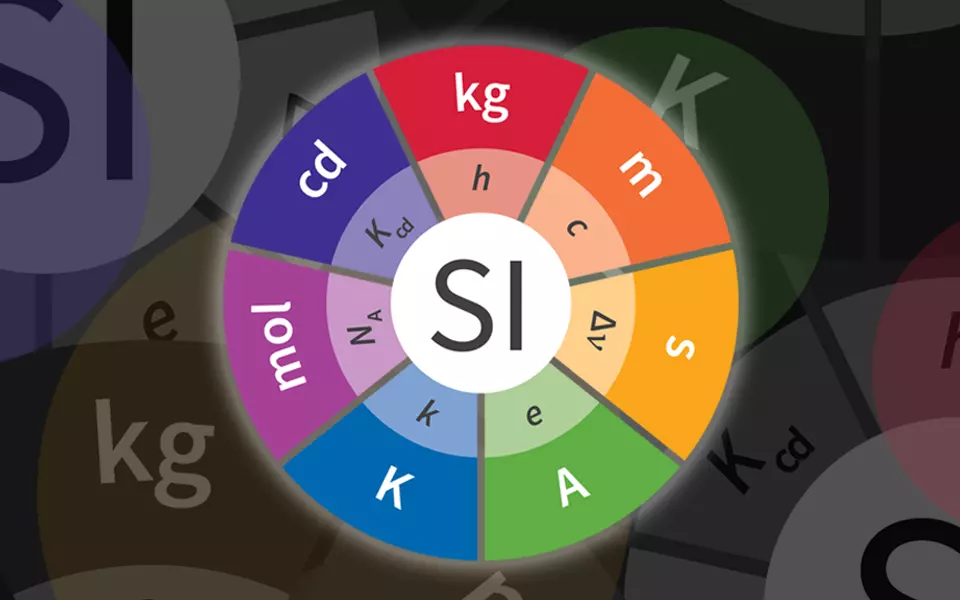
This is the second installment in a two-part series about the SI, or metric system. The first post explored how scientists are developing new ways to measure SI units to high degrees of accuracy. In this post, we delve into a deeper and more philosophical issue: How many base units should the SI have?
When we hear that the SI is based on seven base units, or seven fundamental constants, it gives the impression that there is something obviously unique and special that sets these seven quantities apart.
But when we delve deeper, it turns out that there is nothing special about the number seven. No law of nature tells us how many units (or constants) — or which ones — we should base our measurements on. It is ultimately a human decision.
Indeed, the number of base units has changed over time. The original Metre Convention signed in 1875 included only two units: the meter (as the name suggests) and the kilogram. The current seven-unit system wasn’t formalized until 1970, when the mole was added.
Since then, numerous people have proposed changes, usually by demoting base units. The candela, as a human-centric unit based on how the human eye perceives light, has probably received the most criticism, including from NIST experts.
A visitor from another advanced civilization would very likely agree on defining a length standard using the speed of light and an electric current standard using the charge of the electron. But that visitor would almost certainly not define a standard for visual perception the way we do.
Moreover, the candela, along with the mole and the kelvin, can, in principle, be derived from the other four base units. Recognizing this, a group of physicists recently suggested splitting the units into two categories: four true “base” units (the meter, kilogram, second and ampere) and three “scale-spanning units” (the candela, mole and kelvin) that translate tiny quantum-scale measurements into human-scale quantities. Others have proposed reducing the number of base units to three or even one.
“Some units are more equal than others,” quips John Lehman, a NIST physicist who has also proposed schemes for recategorizing SI units.

But others at NIST and elsewhere support keeping things as they are. The mole, for example, is routinely used in pharmaceutical manufacturing and in medical blood panels, among many other applications. “Why get rid of something that is actually useful?” asks Katrice Lippa, the chief of NIST’s Office of Weights and Measures.
Moreover, others have observed that even if some base units are not truly fundamental, keeping them as base units seems to do no harm. The SI still works, after all.
Some experts have even proposed adding a new base unit: the radian, for angular measurements. NIST physicists Peter Mohr and Bill Phillips have championed this idea, which would, among other benefits, clarify the difference between torque, or rotational force, and work, which is the application of force over a distance. Both are measured in newton-meters.
But adding the radian to the SI would create other complications. It would require a new dimensional unit to convert rotational power into linear power (currently, both are measured in watts). It could also force scientists to rewrite quantum physics textbooks and software. So far, the world's metrologists have not gotten on board.
For more about the idea of adding the radian as an SI base unit, check out my colleague Ben Stein’s recent post.
Do We Even Need Units?
Most radically, some propose doing away with base units altogether and just talking about constants. After all, the meter was just an arbitrary length codified by an artifact; something similar could be said about the kilogram, second and ampere. Now that we have freed ourselves from artifacts, why not do the same with units?
Scientifically speaking, constants alone could establish a basis of measurement. In fact, some experts, such as Mohr and NIST researcher David Newell, say they already do.
“The base units are obsolete,” says Mohr. “The foundation is the fundamental constants.”
The reason to keep the base units around, it seems, stems more from custom, tradition and familiarity. Indeed, the BIPM itself wrote in 2019, “The concept of base and derived units is maintained because it is useful and historically well established.”
Even if constants have displaced base units from their scientific pedestal, the SI has far more stakeholders than just scientists. Global commerce and much more run on the SI. And people around the world are accustomed to measuring fruits and vegetables in kilograms, foot races in meters and musical phrases in seconds. These units operate at the scale at which we live and experience the world.
Some SI constants, by contrast, are based in quantum physics and are very large or very small numbers. For example, the Avogadro constant is a mind-boggling 6.02214076 x 10²³ , or 6.02214076 times 100 thousand billion billion.
The Planck constant, on the other hand, clocks in at 6.626 070 15 x 10-34 joule-seconds — a figure so tiny it's almost impossible to conceive of. Such quantities can be intimidating and unwieldy for everyday use.
What’s most important is that the SI works — not just for scientists, but for everyday people manufacturing and trading goods, delivering healthcare, communicating with each other and living their lives.
The fact that the science underlying the SI has continuously improved while the public has been able to use the system without noticing changes is a testament to a legacy of thoughtful stewardship. It’s a legacy we can all hope will continue for many years to come.