

Official websites use .gov
A .gov website belongs to an official government organization in the United States.

Secure .gov websites use HTTPS
A lock (
) or https:// means you’ve safely connected to the .gov website. Share sensitive information only on official, secure websites.


NOSSE - NIST Outdoor Structure Separation Experiments
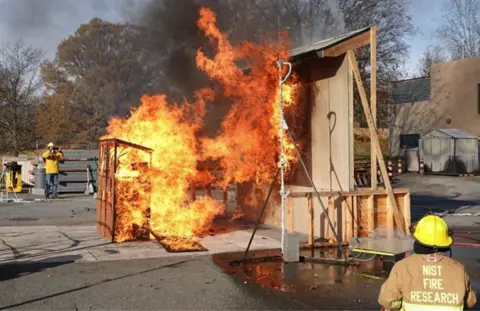
The NIST Outdoor Structure Separation Experiments (NOSSE) aim to quantify the effects of shed sizes, materials, fuel loading, separation distance, and wind speed on the ignition and/or damage of a structure (at IBHS) or a target wall with eaves and a window (at NIST). Experiments were conducted at the National Institute of Standards and Technology (NIST) and the Insurance Institute for Business and Home Safety (IBHS). The NIST experiments are conducted at the National Fire Research Laboratory (NFRL), and the IBHS experiments are conducted just outside of their facility’s wind loading test cell. The opening of the test cell (13.7 m (45 ft) wide) dictates the largest source structure that can be evaluated at IBHS.
PUBLICATIONS
Maranghides, A. , et al. (2023), NIST Outdoor Structure Separation Experiments (NOSSE) with Wind, Technical Note (NIST TN), National Institute of Standards and Technology, Gaithersburg, MD, [online], https://doi.org/10.6028/NIST.TN.2253, https://tsapps.nist.gov/publication/get_pdf.cfm?pub_id=936733 (Accessed July 15, 2026)