

Official websites use .gov
A .gov website belongs to an official government organization in the United States.

Secure .gov websites use HTTPS
A lock (
) or https:// means you’ve safely connected to the .gov website. Share sensitive information only on official, secure websites.


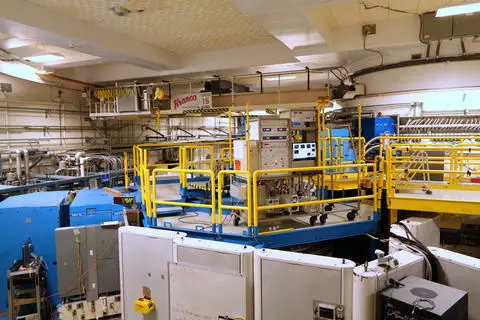
BT9 MACS

Instrument Purpose
To deliver unprecedented sensitivity and speed for mapping dynamic correlations in condensed matter, specifically designed to detect the faint signatures of quantum fluctuations and magnetic excitations.
The NCNR Advantage
- Unrivaled Throughput: MACS provides two order-of-magnitude increase in detection efficiency compared to traditional triple-axis spectrometers by employing 20 independent spectroscopic channels that measure multiple scattering angles simultaneously.
- World-Record Cold Flux: Utilizing a massive, doubly-focusing PG monochromator (1428 cm2), MACS delivers one of the most intense monochromatic cold neutron beams in the world—up to 5 x 10⁸ n/cm2/s.
- Dynamic Resolution Control: Unique instrumentation allows for the near-independent tuning of energy and momentum (Q) resolution, giving researchers the flexibility to "zoom in" on specific quantum phenomena or "zoom out" for broad surveys of reciprocal space.
Research Domains
- Quantum Magnetism: The premier tool for the search for Quantum Spin Liquids and topological excitations.
- Unconventional Superconductivity: Probing the spin-fluctuation in heavy-fermion and high-Tc superconductors.
- Phase Transitions: Rapidly mapping diffuse scattering and critical fluctuations across wide ranges of temperature and pressure.
- Soft Matter Dynamics: Investigating molecular rotations and diffusion in complex liquids and polymers.
What You Can Measure
- Full (Q, E) Maps: Rapidly surveying the entire excitation spectrum of a material in a single experiment.
- Small Sample Dynamics: The high flux enables the measurement of microscopic single crystals (sub-10 mg) that were previously considered "too small" for neutron spectroscopy.
- Spin-Polarized Excitation Spectrum: Using 3He spin filters to differentiate between magnetic and structural (phonon) signals.
- Time-Resolved Inelastic Neutron Scattering: Adding another degree of freedom, time, to the neutron spectroscopy by employing time stamping to the measurement.
Technical Specifications
| Parameter | Specification |
|---|---|
| Source Type | Cold Neutrons (Beam Tube 9) |
| Incident Energy (Ei) | 2.3 meV to 16.5 meV |
| Energy Resolution (ΔE) | 0.05 meV to 1.4 meV (FWHM) |
| Monochromator | 1428 cm2 Doubly-Focusing PG(002) |
| Detection System | 20 independent channels separated by 8˚. Each channel with vertically-focusing doubly-bouncing HOPG analyzers. |
| Solid Angle Coverage | 0.15 sr (Spectroscopic) + 0.15 sr (Diffraction) |
| Flux at Sample | 5 x 10⁸ n/cm2/s (@ 12 meV, open collimation) |
Specialized Sample Environments
- Polarization Analysis: State-of-the-art 3He spin filters for both incident and scattered beams, supported by high-performance Wide-Angle Polarization Analysis (WAPA).
- High-Power Cooling: Fully integrated with NCNR's dilution refrigerators (<50 mK) and 3He inserts.
- High-Field Magnets: Optimized sample table for superconducting magnets up to 10 Tesla, with non-magnetic construction within the sample volume to minimize background.
- Filter Options: Cooled Be, BeO, and PG filters available to eliminate higher-order contamination and optimize signal-to-noise.
Expertise & Support
- Strategic Partnership: MACS is a joint project between NIST, the National Science Foundation (CHRNS), and Johns Hopkins University, bringing together the brightest minds in instrument design and quantum materials.
- Instrument Scientists: Expertise in complex data visualization and magnetic Hamiltonian modeling (Dr. Jose Rodriguez-Rivera and Dr. Yiming Qiu).
- Software Tools:
- DAVE/Mslice: Specialized software for multi-channel data analysis and visualization.
- MACS Simulator: Advanced Monte Carlo raytracing (McStas) tools to plan and optimize experiments before arriving at the beamline.
- ABSCORR. Neutron absorption correction calculations for multiple samples with arbitrary shapes.
Access & Resources
Planning Tools
Live Data
Submit a Proposal
Instrument Contacts
Created June 25, 2026, Updated August 27, 2026