

Official websites use .gov
A .gov website belongs to an official government organization in the United States.

Secure .gov websites use HTTPS
A lock (
) or https:// means you’ve safely connected to the .gov website. Share sensitive information only on official, secure websites.


NCNR Guide Upgrade
The NCNR guide network transports neutrons to the facility’s cold neutron instruments (with the exception of MACS, which has its own dedicated moderator). These guides are conceptually analogous to fiber optics, reflecting neutrons toward their destination using surfaces coated with mirror thin films with a large refractive index, and are a major factor in instrument performance. NCNR is engaged in a multi-year project to upgrade neutron guides NG-5, NG-6, and NG-7, as well as most of the instruments served by those guides.
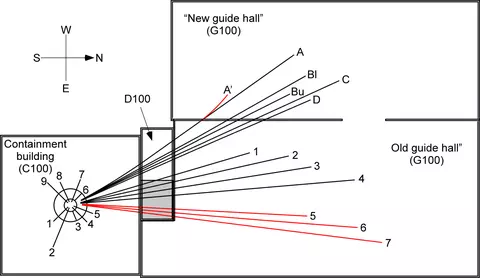
These guides were the oldest in the facility, having been installed as part of construction of the first NCNR guide hall. The reflection coating for those guides was 58Ni, which is no longer state-of-the-art, and the guides suffered radiation damage over more than 30 years of use. The new guides use modern multilayer supermirrors, and they are tailored to optimize performance of the instruments being served. For example, the new NG-6 is curved to prevent line of sight between the source and the cold neutron imaging station at the end of the guide, and the new NG-5 is designed to transport a very large beam onto a double focusing monochromator which will serve the new NG-5 cold 3-axis instrument.
This project started in August 2024, to take advantage of downtime associated with concurrent reactor vessel cleaning. By June 2025, guide installation was complete in the confinement building, and though the wall separating confinement and the guide hall. The new NG-7 is on schedule to be operable by mid-2026, followed by the new NG-6 in 2027, and the new NG-5 near the end of the decade (when construction of the new cold 3-Axis instrument is complete). All told, this project will yield gains of approximately 2-10 in data rate for the nine individual instruments served by these new neutron guides.
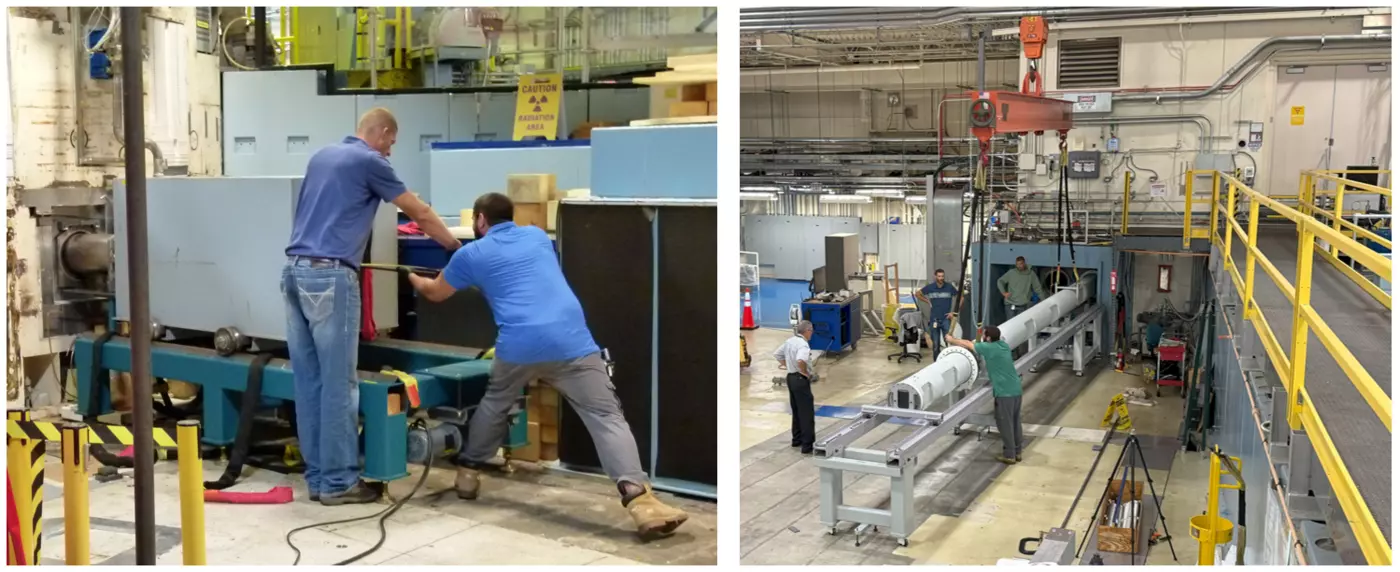
NCNR staff removing in-pile guide sections (left) and installing the NG5 penetration casing (right).
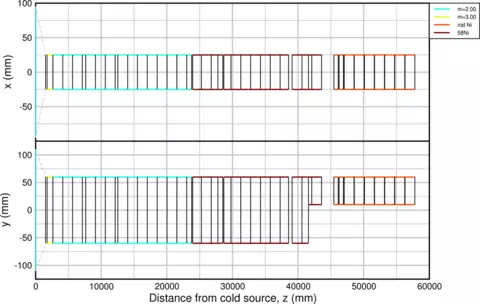
NG-7
The new NG-7 will be a straight 50 mm x 120 mm guide, similar to the previous version. However, the upstream guide components will be coated with m = 2 supermirror rather than 58Ni, which will provide a factor of 2+ improvement in data rate for all instruments on the guide.
Guide work is complete in the confinement building and through the wall penetration. Installation in the guide hall is nearly complete. The new NG-7 will support 5 instruments, the \(\alpha\)-\(\gamma\) high accuracy neutron fluence instrument, 2 neutron interferometry instruments, the PHADES test station, and a 30 m SANS instrument. The relocation of \(\alpha\)-\(\gamma\) (formerly located on NG-6), will increase the data rate on that instrument by a factor of 3, and will facilitate upgrade paths for both that instrument and the NG-6 Cold Neutron Imaging Station.
NG-6
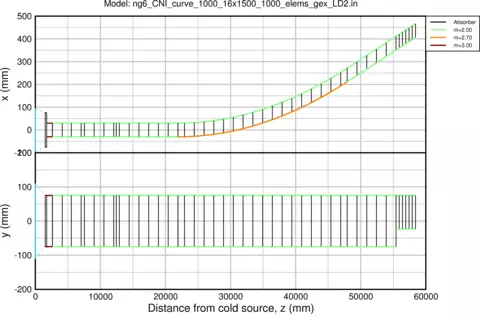
NG-6 is tailored for the Cold Neutron Imaging Instrument (CNII). which will be at the end of the guide, but it will also have guide cuts for two monochromatic test instruments, CANDO, and the 9 Å Beamline. The previous guide was straight, leading to background at CNII from core \(\gamma\)-rays and fast neutrons. The previous NG-6 also had more guide cuts that introduced non-uniformity into the neutron distribution, which is undesirable for an imaging station. Finally, the previous version of CNII was not as long as one might wish. The new NG-6 is designed to address these issues. To eliminate unwanted radiation from the reactor, it will be curved slightly to eliminate line of sight to the core. It is well known that curved guides introduce unwanted beam inhomogeneities. To reduce this problem the guide will use a technique called phase-space tailoring which uses a curved section with a higher m coating on the outer radius followed by a straight section that clips off the unwanted phase space populated by the most highly divergent neutrons. This provides a perfectly uniform spatial distribution for neutrons above a certain wavelength (in this case about 3 Å), which is determined by the chosen m-coatings. Due to this as well as imperfect illumination and non-perfect coatings, there is a very minor deviation from uniformity of perhaps 2%. The capture flux at the end of the guide will be about 6 x 10⁹ n/cm2-s. The diagram at left shows the guide profile. Note the dimensions of the x and y axes are very different distorting the guide shape allowing one to clearly see the curve. Note that the end of the guide is out of the line-of-sight by more than 30 cm. The vertical lines in the figure delineate each segment of the guide, while the color on the edge refers to the guide coating. The side view shows that the bottom section ends upstream of the new imaging station allowing a monochromator to be installed to serve a side position (NG-6a) which will not interfere with the imaging station.
The guide upgrade outage presents a unique opportunity to enhance the capabilities CNII. The most important improvement will be the curved, m=2 supermirror guides from the cold source to the end station. The curved guide will eliminate backgrounds and ease radiation protection measures due to the line of sight fast neutrons and gamma rays. The m=2 supermirror guides will result in a factor of about 3.4 increase in thermal equivalent flux over the present straight 58Ni guides. The use of phase space tailoring ensures that for wavelengths above 3 Å, the phase space is uniformly filled producing a uniform field of view. The new configuration permits lengthening the hutch by about 5 m, so that the maximum flight path is about 15 m. As well, there is space to have a permanently installed double monochromator assembly and velocity selector so that transitioning between polychromatic and monochromatic measurements will not require changing the elevation of the optical axis. These new features will facilitate fine tuning dark field tomography measurements over a broad range of autocorrelations, which is a new method being developed at NIST. The upgraded CNII will offer the first working prototype of this method, which will provide SANS-like measurements in a volume element that is about 50 \(\mu\)m. The additional flight path length provides an opportunity to design a Wolter optics microscope that includes a condenser lens as well as an objective lens. Ray tracing indicates that this neutron version of Hooke’s microscope will produce neutron images with a spatial resolution of about 3 µm with an acquisition time of about 0.1 s. This will bring neutron imaging closer to the performance of coarser synchrotron imaging instruments.
NG-5
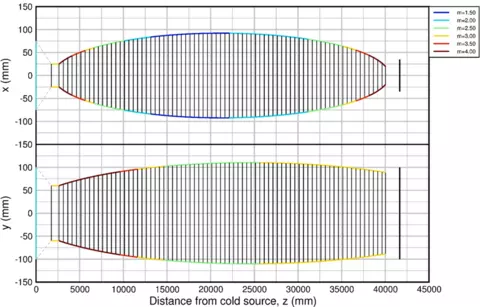
The SPINS cold neutron triple-axis spectrometer was one of the older instruments at NCNR, and was recently decommissioned as part of the guide upgrade project. It will be replaced with a new cold triple-axis instrument with a state-of-the-art beam delivery system. Modern guides for cold-neutron triple-axis instruments are optimized for a double focusing monochromator (DFM). This means that the guide typically provides a virtual source in the horizontal plane while supplying a “parallel” beam in the vertical dimension. The new NG-5 is such a guide, straight in the horizontal and elliptical in the vertical planes, respectively, as shown in the diagram at right.
Note the dimensions of the x and y axes are very different distorting the guide shape. The vertical lines delineate each segment of the guide, while the color on edge refers to the guide coating. Guide installation is complete from confinement through the wall penetration into the guide hall.