Official websites use .gov
A .gov website belongs to an official government organization in the United States.

Secure .gov websites use HTTPS
A lock (
) or https:// means you’ve safely connected to the .gov website. Share sensitive information only on official, secure websites.


Data Integration, Management and Fusion for AM Industrialization
Summary
The maturation of additive manufacturing (AM) into an industrialization (wide-scale production) technology requires an expanded notion of integration of both AM systems and AM data. AM data integration and analytics must also scale up to automate workflows and improve decision-making across the AM value chain.
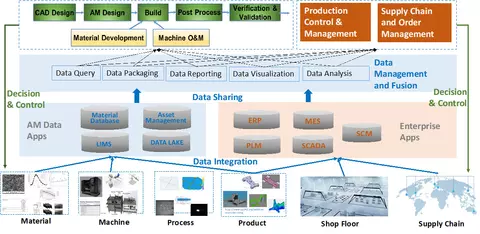
This project focuses on developing innovative methods, models, standards, tools, and a testbed to enable using AM data for industrialization. The proposed work expands the scope of earlier domain-specific efforts on AM information modeling, data registration, and data fusion, including production system and supply chain integration. This new AM data infrastructure will allow 1) automated AM data/metadata flows from the shop floor to the enterprise, 2) seamless integration and management of data in the AM value chain, and 3) streamlined data co-processing to improve AM lifecycle and value chain decision-making. More specifically, this project will address existing measurement science barriers to AM data interoperability, data security, and quality, and develop advanced AM analytics, including data registration, data fusion, and digital twin.
Research will be conducted through close collaborations with the AM community, and the results will provide the foundation for new AM standards development. Use cases in AM industrialization will be identified and analyzed for requirements engineering in AM data integration, management, and fusion. Common data models and data fusion algorithms will be developed for those use cases. Meanwhile, the AM data integration testbed will emulate an AM production environment and evaluate and validate various data models, data integration standards, and data fusion methods. Research data used and generated in this process will be published. In addition, software tools will be provided to the AM community to improve the transferability of the research results and standards adoption.
Description
Objective
Developing methods, models, software tools, open data, and best practices for data integration, management, and fusion in additive manufacturing to accelerate AM Industrialization.
Technical Idea
Our technical idea is to enable an integrated, streamlined, and effective AM development and supply chain with standardized data models and common exchange formats, advanced simulation and data fusion methods, and best practices in data management.
Enhanced common data models, metadata models, and common data exchange formats can enhance cross-domain AM data interoperability required by AM industrialization. We will expand our current effort on AM common data model development to cover the broader integration needs of AM systems with other manufacturing systems and applications for production. In addition, a data model for AM simulation and uncertainty quantification will be developed, tested, and validated using the information from various projects, such as the NIST AM Bench. The technical effort includes the development of the data model for simulations and software, a tool for model validation and repeatability analysis, and standards development.
AM data must always be available in the appropriate quality to maximize its value. The AM data quality will be evaluated toward AM part qualification, including using both in-situ and ex-situ data. ISO 8000 series standards will be the basis for defining quantitative AM data quality metrics. The research also includes the development of a standard procedure to statistically assess the impact of the veracity of the training data on the part quality prediction models or data fusion results, as well as a software tool that validates the methods and enables the standard procedure. This project will address AM security challenges by leading an ASTM standardization activity to apply NIST’s risk-based security frameworks to develop AM security guidelines. Leveraging existing security guidance for information and operational technology systems, this AM security guideline will utilize AM process knowledge, AM attack taxonomies, and how those attacks can result in sabotaged parts, technical data theft, and counterfeiting.
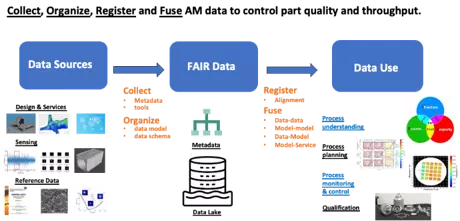
Massive complex data are generated from AM development and deployment, with many modalities and high dimensions, and at various scales and sampling rates. Information acquired from an individual data source exhibits limitations in AM decision-making. Instead, different data modes offer varying amounts of discriminative information that, when fused, play a key role in advancing the understanding of AM processes and drive the engineering decision-making in the lifecycle and value chain. Multi-modal, multi-scale data fusion sets are a requirement for data registration, a process of transforming different data sets into one coordinate system. Data Registration involves aligning those datasets temporally and spatially and recording metadata needed for the data alignment. Data registration standards development consists of a definition of common reference frames, a standard procedure guiding transformations of data between reference frames, and common metadata definitions for data alignment.
Research Plan
The research project will be conducted in 3 thrusts, each including multiple research tasks to deliver intermediate and final products.
Data Integration for AM Industrialization
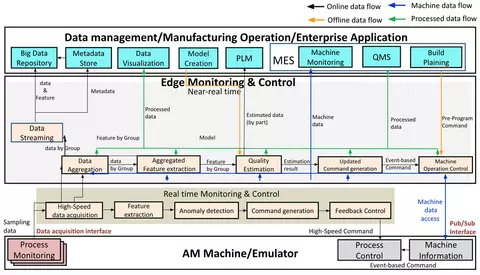
This work package will integrate AM systems with Manufacturing Execution Systems (MES) based AI engineering for scale-up production. In addition, value chain data exchange scenarios will be studied as well. We will take the current version of the AM common data models, ISA 88/95 object models, and APIs provided by AM systems and MES software, and use AI tools to develop new models for integration that support real-time process monitoring and decision making. The AM data integration testbed will benchmark the efficiency of AI-based integration.
Our data integration for AM industrialization will also cover the use of ICME tools and digital twin technology for process control, part quality improvement, and other AM development decision-making. A data model for simulations and uncertainty quantification will be developed, tested, and validated through collaboration with other NIST projects.
The resulting models and tools will be transferred to standard development and deployment. Established manufacturing standards will be heavily leveraged. The key path is collaboration with the AM industry, especially small and medium enterprises (SME).AM Data Registration and Fusion
Data registration is the transformation of datasets from various sensors and inspection instruments into a common reference coordinate system for integral processing, also known as data fusion. Existing efforts include the development of an ISO/ASTM standard on AM data registration. The project team will continue leading the working group for this standard. In addition, we will identify and prioritize additional research needs in data registration based on ISO/ASTM input. The next stage of data registration research will include developing an AM data registration software tool for standards conformance validation and standards adoption.
Our AM data fusion research covers data-driven modeling using machine learning and ICME for AM digital twin, as well as how data and models can be fused to solve AM problems, for example, process anomaly detection, part quality detection, and part certification. We will work with America Makes to target the development of data fusion methods and standards for the application in the AM process/part delta-qualification.- Service-Oriented AM Digital Twin
Digital Twin (DT) is a rapidly growing fit-for-purpose technology to aid in part development and manufacturing process quality improvement, particularly for additive manufacturing (AM). The technology’s flexibility enables it to be adapted based on the needs of all stakeholders. Service-oriented architecture is a promising approach to realizing the DTs ‘plug-and-play capability by modeling them as a service. Given the complex relationships between potential DT services and desired user tasks, matching DT services to a specified task can be challenging to do manually. In this project, we will develop a metadata structuring approach that utilizes ontologies to represent the entities of SOA, enabling semantic queries for DT service discovery for a given task. A framework comprised of two steps using a modified SOA ontology was proposed. The FY26 plan includes developing an ontology that can match general AM digital twin types to accomplish AM activities. The ontology will be validated and demonstrated through use cases, and a harmonization effort will be conducted to adapt the ontology to IOF.
Major Accomplishments
AM Data Standards
- AM Common Data Dictionary (ASTM F3940-21)
- AM Data Registration: ISO-ASTM DIS 52953
- AM Security Guideline: ASTM WK 78322
- AM Common Data Model (CDM) (https://github.com/kaggour/AM-CDM)
- AM dataset Metadata Model (ConnectSpec)
AM Material Database
AM Data Integration Testbed