

Official websites use .gov
A .gov website belongs to an official government organization in the United States.

Secure .gov websites use HTTPS
A lock (
) or https:// means you’ve safely connected to the .gov website. Share sensitive information only on official, secure websites.


VT5 Thermal PGAA

Instrument Purpose
To provide highly accurate, non-destructive elemental analysis of bulk materials through the detection of prompt gamma rays emitted during neutron capture, serving as a primary tool for the certification of NIST Standard Reference Materials (SRMs).
The NCNR Advantage
- The Gold Standard for Metrology: The VT5 PGAA is essential for providing high quality measurements for the certification of NIST Standard Reference Materials that the rest of the world uses to calibrate their own analytical equipment.
- Criticality for Certification of Light Elements: PGAA is critical for the nondestructive measurement of light elements and elements of high neutron cross section that cannot easily be measured by other methods. Because certification of SRMs requires measurement by at least two independent methods, and nuclear methods have few sources of uncertainty in common with non-nuclear techniques such as ICP-MS, PGAA is a vital tool for the certification of these elements.
- Criticality for Evaluation of Natural Matrix Materials: The thermal neutron PGAA instrument at VT-5 is optimized for analyzing biological, agricultural, geological, and organic materials, typically with high hydrogen content, to provide measurements of certification.
- Bulk, Non-Destructive Analysis: Probes the entire volume of a sample (up to several grams) without requiring chemical dissolution, ensuring the chemical form and physical state remain intact for further study.
Research Domains
- Food & Agriculture: Precise determination of nutritional elements and contaminants in NIST biological SRMs.
- Geology: Matrix and trace (B, Cd, Sm, Gd) elements in rock, soils and minerals for SRM certification.
- Environmental Science: Analyzing sulfur and nitrogen content in fuel oils, and multi-elements in coal fly ash and other particulate matter, coal, and sludge for SRM certification.
- Materials Chemistry: Stoichiometric analysis of complex alloys, functional ceramics, carbon nanotubes.
- Cultural Heritage: Determining the bulk composition of rare artifacts that cannot be sampled or destroyed.
What You Can Measure
- Multi-elemental Fingerprinting: Simultaneous detection of light elements (H, B, C, N, Si, P, S) and heavy metals (Cd, Hg, Sm, Gd).
- Trace Detection: Sensitivity down to the microgram level for elements with high neutron capture cross-sections (B, Cd, Sm, Gd).
- Traceability: Results are directly traceable to the International System of Units (SI) through NIST’s rigorous calibration protocols.
Technical Specifications
| Parameter | Specification |
|---|---|
| Source Type | Thermal Neutrons (Beam Tube VT-5) |
| Neutron Fluence Rate | 3.4 x 10⁸ n/cm2/s (Thermal equivalent) |
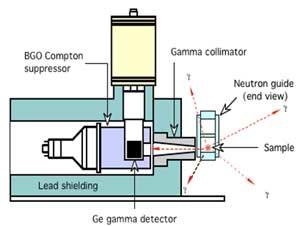
| Detector | High-Purity Germanium (HPGe) with Bismuth Germanate (BGO) Compton Shield |
| Energy Resolution | ~ 1.8 keV (FWHM at 1332 keV) |
| Beam Diameter | Typically 20 mm (Collimated with 6Li glass) |
| Measurement Time | Minutes to hours, depending on target sensitivity |
Specialized Sample Environments
- Sample containment: Samples are typically sealed in hydrogen-free high-purity FEP Teflon bags or vials to eliminate background interference for H and most other elements from the container itself. Alternative packaging includes aluminum foil and Mylar film for measurement of C and F in samples.
- Atmospheric Control: Samples can be measured in air, vacuum, or specialized helium-purged chambers to reduce background from atmospheric nitrogen and hydrogen.
- Large Volume Support: Capable of accommodating unique geometries, ranging from tiny powder aliquots to entire silicon wafers or intact archaeological fragments.
Expertise & Support
- Metrology Experts: The instrument is staffed by skilled NIST radiochemists who specialize in the measurement of matrix and trace elements in a vast array of materials, the physics of nuclear activation, and the statistical rigor required for SRM certification.
- Hardware and Software Suite:
- Lynx Digital Signal Analyzer: High-rate data acquisition for fast, accurate counting.
- Genie 2000: Industry-standard software for gamma-ray spectral analysis and peak integration and peak fitting.
- PeakEasy (for government use only): A peak integration/fitting program offering simple and rapid integration of peaks.
- Hypermet PC and Hyperlab: Hypermet PC offers robust peak integration and fitting of peaks in complex spectra. Combined with Hyperlab it offers software for determination of element concentrations.
- VRF (Visual Robo-fit) software: a new gamma spectral analysis package, which, instead of fitting each peak individually, fits all peaks as a single, spectrum−wide response function and performs peak matching with the library for identification of elements and quantitative determination. Useful for integration of very low intensity peaks on a very high background, that would be missed by other peak integration software.
- Under development: web-based analysis with automated peak search and k0-method for standard-less elemental analysis based on nuclear data and detector efficiency calibration.
- Complementary Techniques: Users have access to both VT-5 (Thermal) and NGD (Cold) PGAA facilities, allowing for a selection of the optimal neutron energy for specific element sensitivities. Using a combination of thermal and prompt PGAA also yields improvement in both detection limit and measurement accuracy. NIST radiochemists also have expertise in instrumental and radiochemical neutron activation analysis which are available for measurement of other trace elements at µg, ng, and sub-ng levels. Between PGAA and NAA techniques it is possible to measure most elements in the periodic table.
Access & Resources
Instrument Contacts
Created June 25, 2026, Updated August 27, 2026