

Official websites use .gov
A .gov website belongs to an official government organization in the United States.

Secure .gov websites use HTTPS
A lock (
) or https:// means you’ve safely connected to the .gov website. Share sensitive information only on official, secure websites.


NG2 HFBS

Instrument Purpose
To explore the "slow" atomic and molecular motions in condensed matter with sub-micro-electron volt precision, bridging the gap between structural and fast dynamics explored by Neutron Spin Echo and Time of Flight.
The NCNR Advantage
- Exceptional Energy Resolution: By utilizing a near-perfect backscattering geometry (𝜃 ≈ 90°), it achieves an energy resolution of < 1 eV, enabling the detection of molecular reorientations and diffusive motions occurring on nanosecond timescales.
- World-Leading Intensity: The HFBS is one of the highest-intensity instruments of its kind globally. It utilizes a unique Phase-Space Transformation (PST) chopper that provides a 4.2x gain in neutron flux, enabling the measurement of small samples or those with a weaker neutron scattering cross-section.
- Unmatched Dynamic Range: Features a high-speed Doppler-driven monochromator that extends the accessible energy transfer to ±50 μeV, more than that of typical reactor-based backscattering spectrometers.
- Low-Background Vacuum Design: Unlike most similar instruments, the entire scattering chamber operates under vacuum, significantly reducing air scattering and improving the signal-to-noise ratio for delicate biological and soft-matter samples.
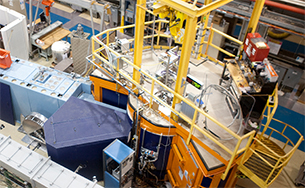
Research Domains
- Liquids: Probing the diffusion, rotations and molecular relaxations in simple and glassy liquids.
- Polymers and Polymer Blends: Investigating segmental and chain dynamics as well as rotations and tunneling of side groups.
- Biological Systems: Internal motions of biomolecules along with the dynamics of surrounding hydration water. In membranes, lipid dynamics is probed, including molecular rotation, lateral diffusion, and thickness fluctuations.
- Chemical Physics: Investigating hydrogen storage materials, molecular tunneling, and the diffusion of water in nanoporous minerals (e.g., zeolites, clays).
- Energy Materials: Tracking ion hopping and diffusion mechanisms in solid-state battery conductors. Organic cation dynamics and proton/ion diffusion in perovskites.
- Magnetic Materials: Probing low-energy magnetic excitations.
What You Can Measure
- Quasielastic Neutron Scattering (QENS): Quantifying both diffusive and localized motions, as well as relaxation times.
- Fixed Window Scans (FWS): Identifying " transitions" as a function of temperature in materials (e.g., finding the onset of molecular dynamics and phase transitions).
- Inelastic Tunneling: Observing the quantum rotational tunneling of small molecules like methane or methyl groups.
Technical Specifications
| Parameter | Specification |
|---|---|
| Source Type | Cold Neutrons (NG-2 Guide) |
| Incident Energy (E0) | 2.08 meV |
| Wavelength (𝜆0) | 6.271 Å |
| Energy Resolution ΔE) | 0.8 𝜇eV to 1.0 𝜇eV (FWHM) |
| Dynamic Range | up to 35 𝜇eV |
| Momentum Transfer (Q) | 0.25 Å-1 to 1.75 Å-1 |
| Detector Array | 16 high-pressure 3He detectors covering 165° |
Specialized Sample Environments
- HFBS-Specific CCR: A dedicated top-loading Closed-Cycle Refrigerator (CCR) optimized for the HFBS geometry (3.4 K to 700 K).
- Cryostats: Liquid Helium "Orange" cryostats for ultra-low temperature studies down to 1.5 K. ICE dilution fridge insert can further lower temperatures down to 60mK.
- High-Temperature Furnaces: Specialized furnace for studying high-temperature diffusion and phase transitions up to 1675 K (requires niobium or titanium sample cans).
- Sample Containers: Standardized aluminum annular cans designed to minimize multiple scattering; flat plate sample holders for powders and films; Titanium cans for materials that react with aluminum; specialized pressure and gas-loading cells are also available.
- Goniometer-mounted sample stick: A motor-driven goniometer can be mounted on a sample stick, allowing measurements to be taken as a function of angle for crystal lattices and magnetic ordering.
Expertise & Support
- CHRNS Partnership: Jointly funded by NIST and the National Science Foundation (NSF), ensuring high-level support for a diverse national user community.
- The HFBS Science Team: Expert staff (e.g., Dr. Madhusudan Tyagi and Dr. Richard Azuah) provide deep expertise in quasi-elastic scattering analysis and molecular dynamics.
- Software & Data Analysis:
- DAVE: The NIST-developed "Data Analysis and Visualization Environment" is the primary suite for HFBS data reduction and fitting. https://www.ncnr.nist.gov/dave/
- NICE: Modern instrument control for automated quasi-elastic (fixed temperature) and fixed-window scans (temperature ramped).
Access & Resources
Planning Tools
Live Data
Submit a Proposal
Instrument Contacts
Created July 2, 2026, Updated August 27, 2026