

Official websites use .gov
A .gov website belongs to an official government organization in the United States.

Secure .gov websites use HTTPS
A lock (
) or https:// means you’ve safely connected to the .gov website. Share sensitive information only on official, secure websites.


BT5 USANS

Instrument Purpose
To extend the structural probing capabilities of neutron scattering to the micrometer scale, bridging the gap between traditional SANS and light microscopy for complex, hierarchical materials.
The NCNR Advantage
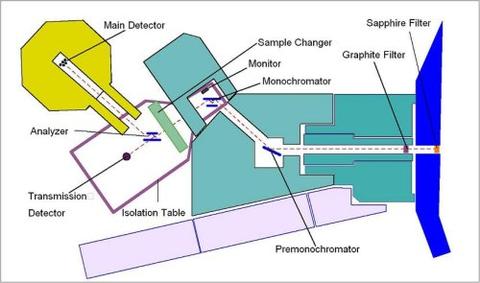
- Unrivaled Length Scales: Utilizes a Perfect Crystal Diffractometer (PCD) design that increases the accessible size of features by nearly two orders of magnitude compared to standard pinhole SANS (probing length scales up to 20 μm).
- High Angular Resolution: Employs triple-bounce Si(220) crystals to achieve an ultra-low Q reaching (3 x 10⁻⁵ Å-1), essential for characterizing large-scale structures like pores in rocks or large colloidal aggregates.
- Seamless Data Integration: Specifically optimized to produce data that can be combined with NCNR’s 30m SANS instruments, providing a continuous structural picture from 1 nm to 20 μm.
Research Domains
- Geosciences: Characterizing the multi-scale porosity of shales and carbon sequestration reservoirs.
- Soft Matter & Food Science: Investigating the hierarchical structure of polymers, gels, and complex food emulsions.
- Biomaterials: Probing large-scale organization in tissues and bone scaffolds.
- Energy Materials: Analyzing the microstructure of electrodes and membranes in fuel cells.
What You Can Measure
- Large Pore Distributions: Quantifying voids and connectivity in porous media.
- Aggregate Morphology: Determining the shape and size of micron-sized clusters.
- In-situ Structural Evolution: Tracking how large-scale features change under stress, temperature, or chemical reaction.
Technical Specifications
Parameter | Value |
|---|---|
Source | Thermal Neutron Beam Port (BT-5) |
Q-Range | 0.0003 nm-1 to ~ 0.03 nm-1 (3 x 10⁻⁵ Å-1 to 3 x 10⁻³ Å-1 ) |
Size Regime | 100 nm to 20,000 nm (20 μm) |
Wavelength (λ) | 2.4 Å (Δλ\λ ≈ 6%) |
Monochromator | Triple-bounce Si(220) (pre-monochromated by PG) |
Analyzer | Triple-bounce Si(220) |
Flux at Sample | < 17,000 n/cm2/s |
Max Sample Size | 50 mm x 50 mm x 10 mm |
Specialized Sample Environments
- Porous Media Cells: High-pressure environments specifically designed for studying fluid flow and gas adsorption in geological samples.
- SANS Compatibility: Fully compatible with most standard NCNR SANS sample environments, including temperature-controlled stages (4◦C to 100◦C) and humidity chambers.
- Large-Area Mounting: The instrument's geometry allows for larger, bulky sample environments compared to traditional pinhole instruments.
Expertise & Support
- The USANS Team: Lead scientists are pioneers in desmearing algorithms and hierarchical structural modeling.
- Software & Data Analysis:
- Data Reduction: Specialized IGOR-based tools for slit-desmearing and combining USANS/SANS datasets.
- Modeling: Direct integration with SasView for advanced fitting of fractal and particulate models.
- Consultation: Expert support for "contrast matching" strategies to isolate specific components within a multi-phase system.
Access & Resources
Live Data
Submit a Proposal
Instrument Contacts
Created March 23, 2026, Updated August 27, 2026