

Official websites use .gov
A .gov website belongs to an official government organization in the United States.

Secure .gov websites use HTTPS
A lock (
) or https:// means you’ve safely connected to the .gov website. Share sensitive information only on official, secure websites.


CHRNS NG2 HFBS - High Flux Backscattering Spectrometer
Instrument Purpose
Explores slow atomic and molecular motions in condensed matter with sub micro electron volt precision, bridging the gap between structural and fast dynamics probed by time-of-flight and spin-echo techniques. HFBS is part of the CHRNS partnership, jointly funded by the National Science Foundation and NIST to provide the scientific community with access to transformative neutron scattering instrumentation.
Instrument Contacts
User Resources
Research Output
Key Capabilities
- Exceptional Energy Resolution: Utilizing a near-perfect backscattering geometry, HFBS achieves an energy resolution of < 1 μeV, enabling the detection of molecular reorientations and diffusive motions occurring on nanosecond timescales.
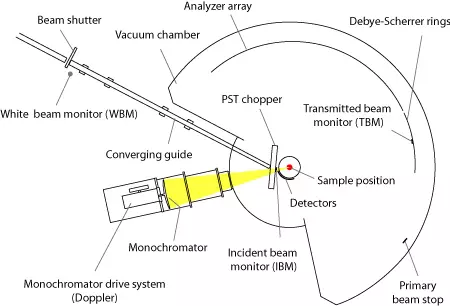
- High Intensity: Utilizes a unique Phase-Space Transformation (PST) chopper that provides a 4.2× gain in neutron flux, enabling the measurement of small samples or those with weak neutron scattering cross-sections.
- Extended Dynamic Range: Features a high-speed Doppler-driven monochromator that extends the accessible energy transfer to ±50 μeV.
- Low-Background Vacuum Design: The entire scattering chamber operates under vacuum, significantly reducing air scattering and improving the signal-to-noise ratio for delicate biological and soft-matter samples.
Research Domains
- Liquids: Probing diffusion, rotations, and molecular relaxations in simple and glassy liquids.
- Polymers & Polymer Blends: Investigating segmental and chain dynamics, as well as rotations and tunneling of side groups.
- Biological Systems: Internal motions of biomolecules along with the dynamics of surrounding hydration water. In membranes, lipid dynamics such as molecular rotation, lateral diffusion, and thickness fluctuations are probed.
- Chemical Physics: Investigating hydrogen storage materials, molecular tunneling, and water diffusion in nanoporous minerals (e.g., zeolites, clays).
- Energy Materials: Tracking ion hopping and diffusion mechanisms in solid-state conductors, organic cation dynamics, and proton/ion diffusion in perovskites.
- Magnetic Materials: Probing low-energy magnetic excitations.
What You Can Measure
- Quasielastic Neutron Scattering (QENS): Quantifying both diffusive and localized motions, as well as relaxation times.
- Fixed Window Scans (FWS): Identifying dynamic transitions as a function of temperature (e.g., onset of molecular dynamics and phase transitions).
- Inelastic Tunneling: Observing the quantum rotational tunneling of small molecules like methane or methyl groups.
Technical Specifications
| Parameter | Specification |
|---|---|
| Source Type | Liquid hydrogen cold source moderator |
| Incident Energy (E0) | 2.08 meV |
| Wavelength (λ0) | 6.271 Å |
| Energy Resolution (ΔE) | 0.8 μeV to 1.0 μeV (FWHM) |
| Dynamic Range | Up to 35 μeV |
| Momentum Transfer (Q) | 0.25 Å-1 to 1.75 Å-1 |
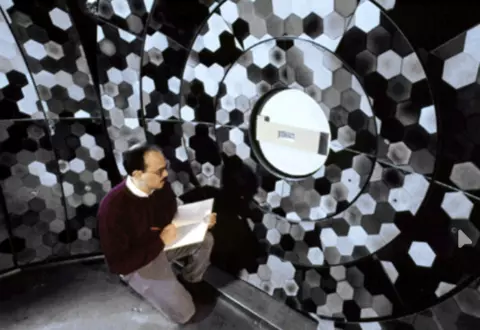
| Detector Array | 16 high-pressure 3He detectors covering 165° |
Specialized Sample Environments
- HFBS-Specific CCR: Dedicated top-loading Closed-Cycle Refrigerator (CCR) optimized for the HFBS geometry (3.4 K to 700 K).
- Cryostats: Liquid helium "Orange" cryostats for ultra-low temperature studies down to 1.5 K; ICE dilution refrigerator insert can further lower temperatures to 60 mK.
- High-Temperature Furnaces: Specialized furnace for studying high-temperature diffusion and phase transitions up to 1675 K (requires niobium or titanium sample cans).
- Sample Containers: Standardized aluminum annular cans designed to minimize multiple scattering; flat plate sample holders for powders and films; titanium cans for materials reactive with aluminum; specialized pressure and gas-loading cells.
- Goniometer-Mounted Sample Stick: Motor-driven goniometer mounted on a sample stick, allowing measurements as a function of angle for crystal lattices and magnetic ordering.
Tools & Links
- Activation & SLD Calculator: Web-based planning tools for estimating sample activation and scattering length density.
- Quasielastic Analysis: Support for dynamic modeling, resolution convolution, and molecular dynamics simulation comparisons.