

Official websites use .gov
A .gov website belongs to an official government organization in the United States.

Secure .gov websites use HTTPS
A lock (
) or https:// means you’ve safely connected to the .gov website. Share sensitive information only on official, secure websites.


Near Infrared Spectra of Origin-defined and Real-world Textiles (NIR-SORT)
NIR-SORT is a spectroscopic and materials characterization dataset for known provenance and post-consumer fabrics. The dataset, with associated data descriptor publication in Scientific Data, contains data on textile specimens for applications including fiber content classification, systems and software development, and validation of textile sorting systems.
Fiber Identification Challenge
Near infrared (NIR) spectroscopy is a rapid, non-invasive technique often used for chemical bond structure identification, making it well suited for feedstock identification and validation for industrial processes involving polymers. It has rapidly gained popularity in the textile industry; however, the availability of high-quality, known provenance NIR data for textile fibers and fabrics is limited. Applying NIR to answer questions such as fiber classification or polymer blend identification typically requires the use of models or algorithms, often using machine learning or artificial intelligence approaches. The underpinning data for these models is typically difficult to access because it is stored in proprietary libraries or self-built databases; thus, benchmarking model performance across the industry is challenging. NIST created NIR-SORT, a curated dataset, to address this challenge.
NIR-SORT 1.0
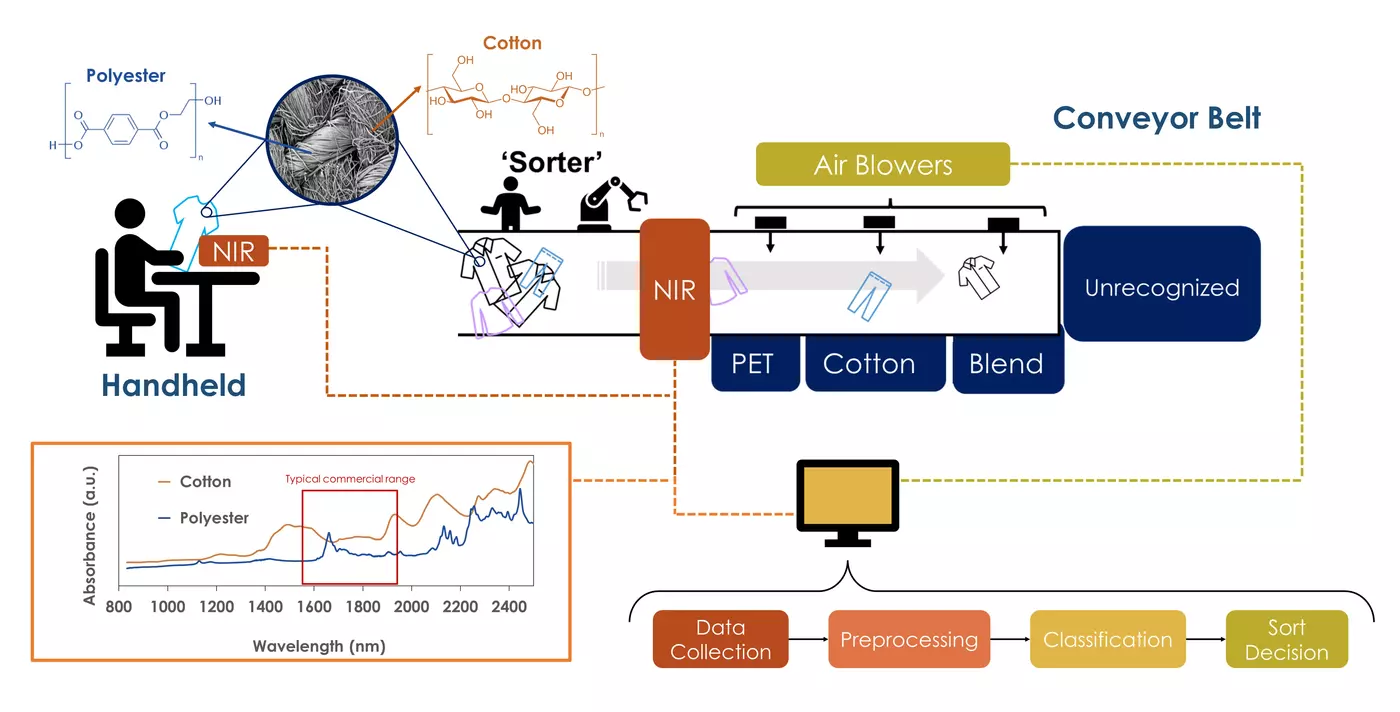
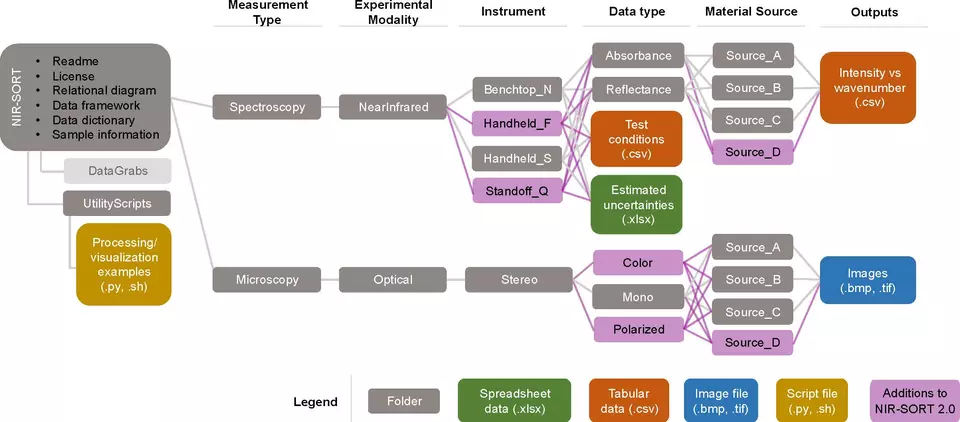
The NIR-SORT dataset is machine-actionable while also being human-readable and contains data on textile specimens for applications including fiber content classification, systems and software development, and validation of textile sorting systems. The data repository includes directories for benchtop NIR spectral data, handheld NIR spectral data, and fabric-scale microscopy images. We welcome inquiries into adding new fabrics, please reach out! Email fibrils [at] nist.gov (fibrils[at]nist[dot]gov).
As of February 2, 2026, NIR-SORT 1.0 has been downloaded 516 times by 395 unique users including researchers and industry stakeholders. Continued interaction with users has provided rich feedback and launched new collaborations. One such interaction led to a Cooperative Research and Development Agreement (CRADA), and three more CRADAs are in process. Please feel free to reach out if you are interested in a CRADA related to NIR-SORT.
Physical fabrics for Research-Grade Test Materials
While NIR-SORT supplies data that can be used for applications such as model validation and training, many industry partners have expressed a need for known composition, physical materials backed with rigorous data validation. To address this need, we are the process of launching a set of Research Grade Test Materials (RGTMs) with an accompanying Interlaboratory Study. We are actively seeking participants for this study. For more information, please visit our RGTM ILS page.
NIR-SORT 2.0 release
Based on feedback received following the initial NIR-SORT release, we are working to expand the dataset to include new fabrics and instruments. The new textile additions include 12 new custom-dyed fabrics, 61 new in-house custom blend specimens, 8 new undyed fabrics with 3 new fiber types, and 12 new pre-consumer fabrics. A new NIR handheld device with associated documentation has also been added. As an upgrade from the grayscale images of NIR-SORT 1.0, color versions of the full sample library are now included. With more fabric and measurement types, NIR-SORT 2.0 is another step towards building a dataset representative of and useful to the textile industry.
Well-characterized samples like the ones in NIR-SORT are time intensive to source, measure, and validate. As we release NIR-SORT 2.0, we are already working on 50+ new fabrics and new validation methods for NIR-SORT 3.0. Looking for a specific fiber or fabric and can’t find it in NIR-SORT 2.0? Reach out to us about including your needs into NIR-SORT 3.0! Email fibrils [at] nist.gov (fibrils[at]nist[dot]gov).

Additions to NIR-SORT 2.0
- 12 new, custom-dyed fabrics
- 61 new, in-house custom blend specimens
- 8 new, undyed fabrics with 3 new fiber types
- 12 new, pre-consumer fabrics
- New handheld NIR device (Handheld_F)
- New benchtop experiment (Standoff_Q)
- 2 new imaging sensors (Color and Polarized)
Explore the rest of the Circular Economy program’s Textiles activities.
Contacts
-
(301) 975-8580
-
(301) 975-5632