

Official websites use .gov
A .gov website belongs to an official government organization in the United States.

Secure .gov websites use HTTPS
A lock (
) or https:// means you’ve safely connected to the .gov website. Share sensitive information only on official, secure websites.


FIBR: Fiber Identification Benchmarking with Research-Grade Test Materials (RGTM 10279)
A new material set from NIST can aid in the evaluation and development of fiber identification methods. We are offering a unit free of charge (plus shipping and handling) until July 1, 2026 in exchange for your feedback by August 1, 2026, which will help us improve and further develop the material.
Questions? Contact fibrils [at] nist.gov (fibrils[at]nist[dot]gov).
Quick Links:

Background
This project is a part of NIST’s Circular Economy Program, whose goal is to leverage expertise in measurement science, standards, and technology to support stakeholders in addressing circular supply chain challenges. This project falls specifically in the textiles focus of the program. Please visit the Circular Economy Textiles page to learn more about our other efforts.
Material recovery systems in the textile industry face significant challenges in rapid and reliable feedstock identification of heterogeneous textile waste streams. Textile sorters are working to integrate Near Infrared (NIR) spectroscopy and other tools into their sorting process to increase their throughput, accuracy, and cost competitiveness. However, the lack of well-characterized, known-provenance materials limits the validation of complex sorting algorithms and hinders the development and deployment of efficient sorting technologies.
The Textiles team at NIST has previously held two workshops: Facilitating a Circular Economy for Textiles in September 2021 and Standards Needs for Circular Textiles in October 2023 in collaboration with ASTM and American Association of Textile Chemists and Colorists (AATCC). These needs were also discussed in a follow-on article from the 2021 workshop. The first workshop laid the groundwork in capturing the current landscape of textile circularity in the U.S., and the second workshop examined the need for documentary standards. Participants identified “Classifications of textile materials to enable advanced sorting” and “Test methods for rapid identification of textile composition (e.g. fiber content, additives, etc.)” as important needs for enabling the scale up of textile sorting.
In addition to the workshops, the Textiles team has sustained continued outreach and engagement with our stakeholders about their measurement needs. To address the need for high quality data to support terxtile sorting system design and validation, we released a dataset of NIR spectra of known-provenance and post-consumer fabrics, called NIR-SORT, in September 2024. The further need for reference materials for NIR spectroscopy measurements has been raised repeatedly by both our industry and academic stakeholders.
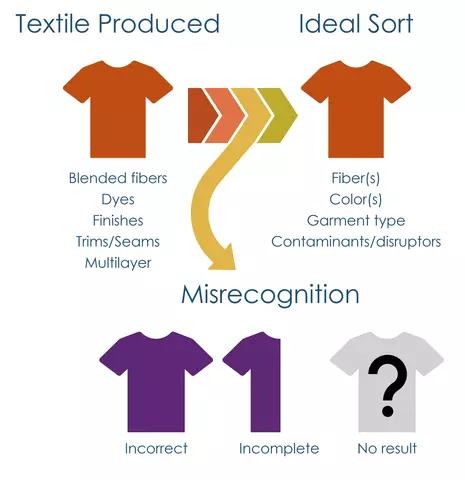
In the figure above, on the left, a textile is produced. Such textiles may include features such as blended fibers, dyes, finishes, trims/seams, or may be comprised of multiple layers. Any of these components can cause misrecognition and misidentification as the textile flows through a sorting system. This can cause the information about the textile to be incorrect, incomplete, or potentially even not provide a result. Accurate sorting is important to enable next use strategies for textile feedstocks, as contamination such as elastane can cause processing issues, such as entanglement in shredding equipment. While NIR-SORT seeks to assist industry in building robust sorting algorithms through ground truth data, not all sorting systems rely upon NIR spectroscopy. In addition, our industrial stakeholders have indicated that they need to be able to test their equipment with known-provenance physical specimens to ensure continued performance.
Fiber Identification Benchmarking with Research Grade Test Materials (FIBR)
The textile industry is not focused on high reproducibility of precise measurements of textiles; therefore, sourcing fabrics with highly repeatable measurements for research or standards purposes has historically been a challenge. Currently, standard test methods will specify textiles to use in their protocol, such as the multifiber strip from Testfabrics, Inc. in AATCC TM61 or ISO 105-F10. However, there is not currently a standard reference material with spectroscopically-validated, known fiber composition available. To address these needs, we are pleased to announce that we have released a set of Research Grade Test Materials (RGTM 10279) to support an Interlaboratory Study (ILS) on textile classification called Fiber Identification Benchmarking with RGTM InterLaboratory Study or FIBRILS.
How to Request a RGTM 10279 Unit and Join FIBRILS
NIST is making this material available free of charge, participants will only need to pay for shipping and handling. Please note- these are not fabrics for personal use. It is for the evaluation of fiber identification methods by textile sorters, researchers, and laboratory professionals through an interlaboratory comparison study.
If you would like a free unit (shipping and handling fee required) of RGTM 10279, visit the NIST Store website. We will ship a unit to you. Please download the guidance sheet (PDF) with details about the material including storage and instructions for use. By requesting a RGTM 10279 unit, you are automatically enrolled in the accompanying comparison study. Please download the fiber identification results template (.xlsx) and complete this form by August 1, 2026 to provide feedback regarding use of this fabric set. Sharing your experience will help us further test, develop, and improve the materials for future development.
Use of Submitted Data
By agreeing to participate in FIBRILS, you agree that your submitted feedback and results can be used in the subsequent comparison analysis. You will be able to designate your choice of participation level in the feedback form. Deliverables from FIBRILS include:
Interlaboratory Comparison Study report
We will analyze the participant feedback and results. If you designate that your data can be shared in aggregate form, your anonymized data will be included in this report, and you will be included as a participant in the report unless you have designated that you would like to remain anonymous.
Co-NIR-SORT dataset
We will curate a dataset of the community-gathered raw or processed data to publish on NIST’s Public Data Repository on data.nist.gov. If you designate that your data can be shared publicly, your anonymized data will be included in this dataset, and you will be included as an author on the dataset unless you have designated that you would like to remain anonymous.
Example of feedback that we request:
- Affiliation
- Description of how the fabrics were measured/analyzed
- Fiber content estimates from qualitative, quantitative, or predictive model methods
- Feedback on the material's impact on your work
Thank you in advance for your participation in the development of this new material from NIST. For questions, concerns, or comments, please contact us at fibrils [at] nist.gov (fibrils[at]nist[dot]gov).
Explore the rest of the Circular Economy program’s Textiles activities.
Contacts
-
(301) 975-8580
-
(301) 975-5632