U.S. flag

An official website of the United States government

Official websites use .gov
A .gov website belongs to an official government organization in the United States.

Secure .gov websites use HTTPS
A lock ( ) or https:// means you’ve safely connected to the .gov website. Share sensitive information only on official, secure websites.

Projects/Programs

Displaying 1 - 25 of 35

Advanced Informatics and Artificial Intelligence for Additive Manufacturing

Ongoing
Objective To develop and deploy the metrics, models, reference data, and best practices for implementing and adopting advanced informatics (including product definition, digital twins, ontology, and machine learning) and artificial intelligence to enhance additive manufacturing design, process...

Advanced Materials Design: Electronic and Functional Applications

Ongoing
Accelerating Materials Discovery using Machine Learning and AI Using machine learning and AI techniques along with high-throughput DFT calculations materials with specific properties are identified to accelerate the discovery process for a variety of applications. Some of the specific materials...

Agility Performance of Robotic Systems

Ongoing
Objective Deliver robot agility performance metrics, test methods, information models, datasets, combined virtual/real testbeds, and planning approaches that will enable manufacturers to more easily and rapidly reconfigure, retask, and redeploy robotic systems. Technical Idea The project is...

AI-Optimized Building Controls

Ongoing
Objective Demonstrate the feasibility of practical AI control techniques for reducing the energy costs of operating HVAC systems in commercial buildings and create a research infrastructure, the Intelligent Building Agents Laboratory (IBAL) and Virtual Cybernetic Building Testbed (VCBT), suitable...

Annual Machine Learning for Materials Research Bootcamp

Ongoing
Four days of lectures and hands-on exercises covering a range of data analysis topics from introduction to python and data pre-processing to advanced machine learning analysis techniques. Example topics include: Identifying important features in complex/high dimensional data Visualizing high...

Augmented Intelligence for Manufacturing Systems (AIMS)

Ongoing
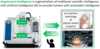
Objective Develop augmented intelligent solutions that combine integrated metrology, physics-based models, and artificial intelligence to monitor and predict the performance of manufacturing machines and their processes in real time for the optimization of production quality and yield. Technical...

Autonomous Formulation Lab

Ongoing
The Autonomous Formulation Laboratory is a joint program between the nMat consortium, NCNR, and NIST's Material Measurement Lab focused on accelerating materials discovery and formulation optimization through artificial intelligence (AI) and machine learning (ML) directed, multimodal scattering...

Biosecurity for Synthetic Nucleic Acid Sequences

Ongoing
Synthetic nucleic acid technologies are fundamental to U.S. biotechnology and biomanufacturing innovation. However, like other transformative technologies, they carry dual-use potential: while they can drive significant progress, they pose risks of unintentional or deliberate misuse to engineer...

AI for Building Systems Innovation (AIBSI) Program

Ongoing
Objective To develop and deploy advances in measurement science that will improve building operations to ensure cyber-secure facilities, system reliability, occupant comfort/safety and lower operating costs through AI-enabled building systems. What is the problem? Buildings are complex systems of...

Data Driven Decision Support for Additive Manufacturing

Completed
Objective To develop and deploy the metrics, models, and best practices for using product definition, advanced analytics, and machine learning methods in additive manufacturing design and process planning to reduce lead times and support first-part-correct goals. Technical Idea Future advancements...

Data Integration and Management for Additive Manufacturing

Completed
Objective Data plays the most critical role in linking AM lifecycle and value chain activities and streamlining the AM development process. While the AM data from a single build is essential for establishing part traceability, when methodically collected, the full processing history of thousands of...

Data-Driven Design for Product Recovery

Ongoing
Objective To develop standards, metrics, and data-driven methods that can be implemented in early product design stages to increase the efficacy of end-of-use product recovery pathways and keep valuable products in the economy and recover valuable materials. Technical Idea The Data-Driven Design for...

Edge AI

Completed
This project: Develops edge learning and edge-enabled collaborative learning algorithms. Develops measurement methods for testing the performance and robustness of edge-learned, and more generally collaboratively learned, AI/ML models. Collaborates with other projects (e.g., 5G/6G Core Network...

Industrial Artificial Intelligence Management and Metrology (IAIMM)

Completed
IAIMM has identified IAI systems for decision making, planning, and control in manufacturing as a prime candidate for better Standard Operating Procedures (SOPs) centered on both use and evaluation. The specific use case of multi-stage manufacturing presents a broad scope of application to...

Intelligent Building Agents

Completed
Objective Demonstrate the feasibility of AI control techniques for reducing the energy costs of HVAC systems in commercial buildings and create a research infrastructure, the Intelligent Building Agents Laboratory (IBAL), suitable for ongoing demonstration, development, and evaluation of advanced AI...

Machine Learning for Internet of Things (IoT)

Ongoing
Resource Allocation in IIoT Systems As with any large an complex system, Industrial Internet of Things (IIoT) deployments require the system operator to efficiently allocate the available bandwidth, computing, and energy resources. This is challenging because IIoT systems, especially large ones, can...

Measurement Science for Automated Vehicles

Ongoing
Objective Develop measurement science for evaluating AI-based decision-making systems in automated vehicles. Technical Idea This project produces measurement methods, reference baselines, test tools, and scenario datasets that solve the measurement gap described above. Current evaluation methods...

Measurement Science for Robotics and Autonomous Systems Program

Ongoing
Objective Develop and deploy measurement science that advances robotic system performance, collaboration, agility, autonomy, safety, and ease of implementation to enhance U.S. innovation and industrial competitiveness. Technical Idea The fundamental idea is to provide the measurement science needed...
Was this page helpful?