

Official websites use .gov
A .gov website belongs to an official government organization in the United States.

Secure .gov websites use HTTPS
A lock (
) or https:// means you’ve safely connected to the .gov website. Share sensitive information only on official, secure websites.


AI for SI Dissemination: Applying Neural Networks to NIST’s Measurement Services
Description
Overview
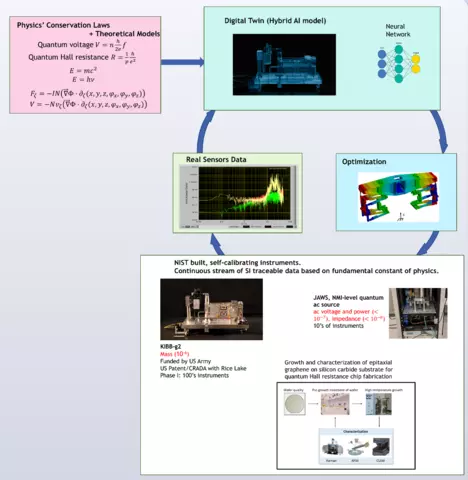
This project uses Artificial Intelligence (AI) to make NIST's most precise measurement tools faster and more accessible. Digital Twins will control the behavior of NIST's quantum-based measurement instruments, using Physics-based AI models to help improve the accuracy and robustness of core measurement services and standards in mass, voltage, and resistance. These AI-powered models allow researchers to test, optimize, and refine measurement procedures continuously on a wider range of sensor data and environmental variables. The result is faster calibrations, simpler procedures, and a path toward making these advanced measurement capabilities available to partners and customers outside NIST.
Background
NIST is one of the world’s leading authorities for precise measurements of fundamental quantities like mass, voltage, and electrical resistance. These measurement services underpin manufacturing quality, scientific research, and international trade. In 2019, the international system of units (SI) was redefined so that all units trace directly back to fundamental constants of nature—rather than to physical objects like the former platinum-iridium kilogram standard kept in a vault in France.
This redefinition opened the door to new, quantum-based measurement methods that are extraordinarily precise. However, these new approaches are complex and time-consuming to operate--for example, they require the use of lasers to make micro-scale measurement of coil movement in the kibble balance, making them difficult for NIST’s routine calibration services and challenging for outside partners to adopt in their own facilities.
Approach
This project combines AI techniques with physics-based constraints to ensure that the computer models respect the physical laws governing each measurement system. Rather than treating the AI as a purely data-driven tool, the team builds in known physical relationships, so the models produce results that are scientifically grounded. This hybrid approach of combining traditional AI methodologies with physics-based models is central to producing trustworthy, accurate results.
The work includes data collection from physical instruments, AI model development, and validation by comparing the models’ outputs against actual hardware performance. To mitigate potential safety concerns with AI, the team is exploring offline models exclusively and incorporating physical constraints into the models.
The project covers three core measurement areas, each with its own challenges:
- Mass (Kibble Balance): NIST has partnered with the Department of Defense and private companies to design and prototype primary mass standards. The AI work here combines data from a wide range of sensors across different prototypes to help correct systematic errors during calibrations.
- Voltage (Josephson Voltage Standards): Current calibration of voltage standards requires laborious, multi-step hardware tuning. AI models aim to move beyond this manual process, speeding up calibrations and simplifying procedures for users outside the NIST campus.
- Resistance (Quantum Hall Effect): Measuring electrical resistance across a very wide range requires high-quality graphene materials grown through carefully optimized processes. AI is being applied to optimize the production of these materials for quantum-based resistance arrays.
Impact
AI-powered models allow virtual evaluation and optimization of measurement processes and instruments, enabling testing and refinement before making changes to physical systems. The knowledge gained from this work can be transferred to interested government agencies and industry partners, accelerating the adoption of quantum-based measurement standards and U.S. manufacturers.
Related Work: Kibble Balance (Completed)
An earlier, completed project demonstrated how AI can improve mass measurements made with the Kibble balance—one of the instruments that realizes the SI kilogram from fundamental constants.
What is Kibble Balance?
A Kibble balance measures mass by balancing the weight of an object against an electromagnetic force. It works in two modes: one that applies electric current to a coil suspended in a magnetic field to counterbalance the object’s weight, and another that moves the coil through the field to generate a voltage. By combining the results from both modes, the balance can determine mass with extraordinary precision—traceable directly to fundamental constants of nature rather than to a physical reference object.
The challenge is that the balance’s magnetic environment is sensitive to small changes in temperature, pressure, and humidity. Correcting for these effects is essential for accurate measurements, especially at facilities that lack NIST’s own reference standards for comparison.
The completed project addressed this by developing a pipeline of AI models that learned the relationship between environmental conditions and the balance’s magnetic behavior. Using data from three NIST reference masses, the team trained neural networks that incorporated physics-based constraints—not just pattern recognition—to predict mass values. A key innovation was using data from one operating mode to improve predictions in the other, a technique called transfer learning. The AI models achieved accuracy on the order of one part in a million, demonstrating that physics-informed AI can substitute for physical calibration steps and potentially enable accurate mass measurements at facilities without NIST reference standards on-site.
This completed work provides the foundation for the broader SI Dissemination project, demonstrating the viability of the digital twin approach for one of NIST’s most demanding measurement services.
Research Context
This project is part of NIST’s SERI program and is distinct from other NIST efforts like the SMART USA Institute and Digital Twins for Advanced Manufacturing, which focus on semiconductor and manufacturing industries. While this project draws on AI and digital twin expertise from across NIST, the systems being modeled feature quantum effects and are fabricated with specialized two-dimensional materials or superconducting electronics—requiring a different set of expertise and approaches.