

Official websites use .gov
A .gov website belongs to an official government organization in the United States.

Secure .gov websites use HTTPS
A lock (
) or https:// means you’ve safely connected to the .gov website. Share sensitive information only on official, secure websites.


LPDT
Laser Processing Diffraction Testbed (LPDT)
The Laser Processing Diffraction Testbed (LPDT) is a custom-built, open-platform system developed by NIST in partnership with the Cornell High Energy Synchrotron Source (CHESS). Designed for high-precision laser processing research, LPDT enables fundamental studies of laser–material interactions, with a focus on—but not limited to—metal additive manufacturing (AM). It combines NIST’s advanced thermal field control technology with real-time, in-situ synchrotron X-ray imaging and diffraction, allowing researchers to investigate how processing parameters influence microstructure, solidification dynamics, and phase evolution under extreme thermal conditions.
Built on the same pointwise laser control architecture as NIST’s Additive Manufacturing Metrology Testbed (AMMT) system, LPDT allows continuous variation of laser power and scan speed. It is currently equipped with a single galvo scanner with dynamic focusing and coaxial imaging, a 400-watt laser, and an inert gas processing chamber outfitted with X-ray–transparent glassy carbon windows. A portable, field-programmable gate array (FPGA)-based controller provides full customization of scan strategies and integrates calibration, process monitoring, and real-time feedback features. LPDT is transportable and regularly deployed to synchrotron facilities, where it enables high-resolution, time-resolved experiments to deepen our understanding of laser-driven processes across a range of materials and manufacturing contexts.
LPDT Research Goals:
- Investigate fundamental material responses under laser-driven thermal fields, using advanced scan strategies and in-situ synchrotron X-ray diagnostics to study microstructure evolution, phase changes, and rapid solidification during additive manufacturing and laser processing.
- Advance real-time monitoring and control techniques to improve AM build quality by linking thermal field control with synchrotron-based observations of processing conditions and resulting material states.
- Study in-situ alloying behavior, including rapid mixing, solidification, and phase formation in high-entropy alloys (HEAs) and functionally graded materials under laser-driven thermal gradients.
- Support broader materials science research beyond AM, enabling precision-controlled studies of rapid solidification, interfacial dynamics, and phase stability in diverse metal systems.
LPDT System Overview
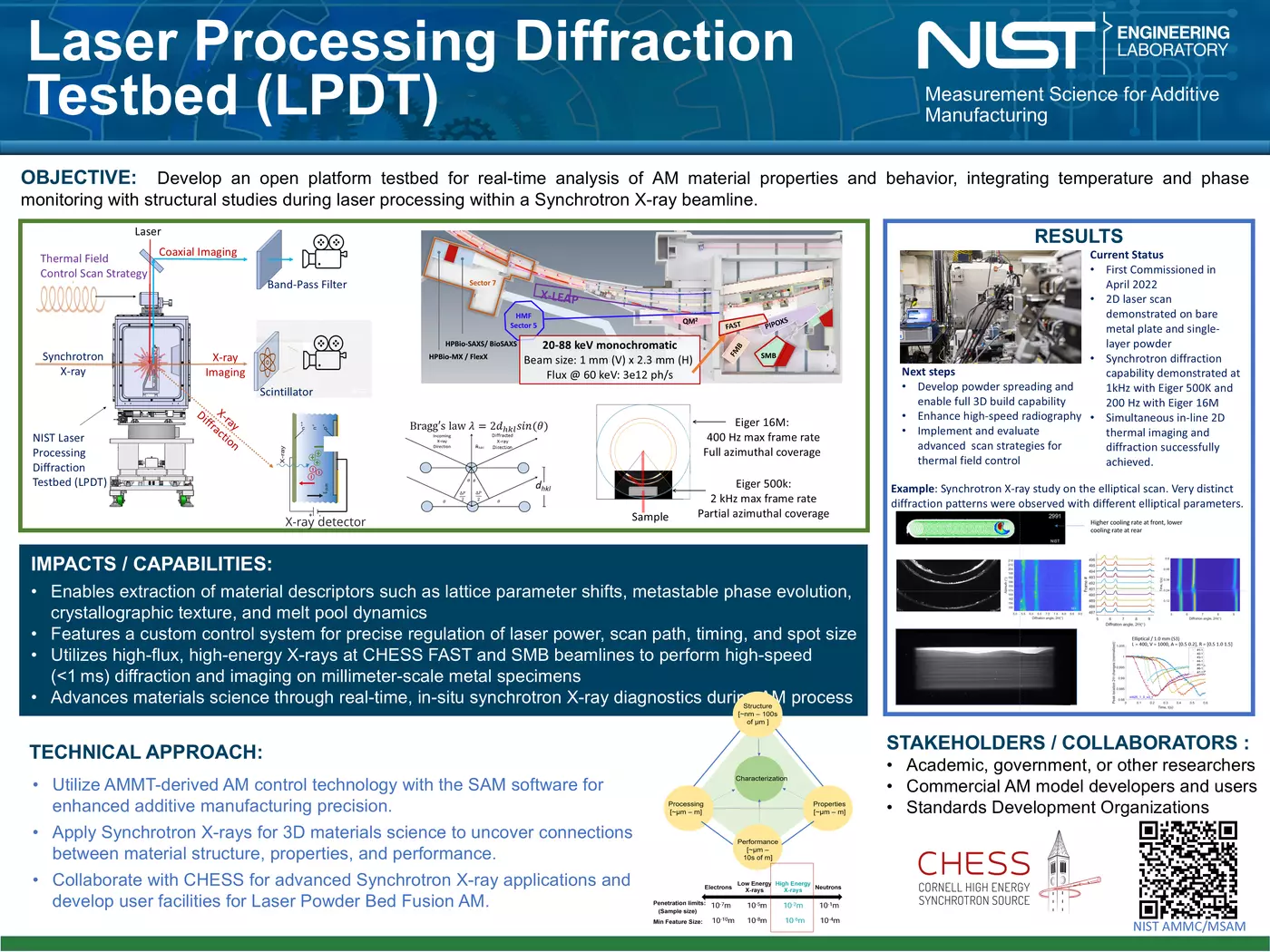
Core Capabilities
Existing
- Pointwise Laser Control: Enables continuous variation of laser power, speed, and path—essential for creating complex thermal fields.
- Thermal Field Control: Implements feedforward, inverse heat placement (IHP), and real-time feedback scan strategies to precisely shape temperature histories for alloy synthesis.
- In-Situ Synchrotron X-ray Measurement: Captures crystallographic structure, phase transformation, and temperature evolution at microsecond resolution.
Under development
- Hybrid Scanning: Super high-speed galvo-piezo hybrid scanning to enhance heat distribution and stirring for improved alloy homogeneity.
- Multi-Material Spreading and Mixing: Enables in-situ alloying and research on high-entropy alloys (HEAs) with >5 constituents.
- Integrated Data & Modeling Framework: Supports machine-learning-based scan strategy optimization and predictive modeling of solidification behavior.
Collaboration
NIST is open to collaborations on projects that can make use of the special capabilities of the LPDT. Unofficial collaborations are preferred, with topics that fall under the research goals of the LPDT and the Measurement Science for Additive Manufacturing Program, and any results can be made public and co-published by NIST. Official collaborations can be conducted through a Cooperative Research and Development Agreement (CRADA).
Want to work with the LPDT? Various opportunities exist for guest researchers, post-doctoral researcher associates, or for Ph.D. students through the NIST Pathways internship program.
NIST Staff and Associates
Contacts
Contacts
-
(301) 975-2786