

Official websites use .gov
A .gov website belongs to an official government organization in the United States.

Secure .gov websites use HTTPS
A lock (
) or https:// means you’ve safely connected to the .gov website. Share sensitive information only on official, secure websites.


Taking Measure
Just a Standard Blog
New Music Captures NIST’s Essence, Measure for Measure

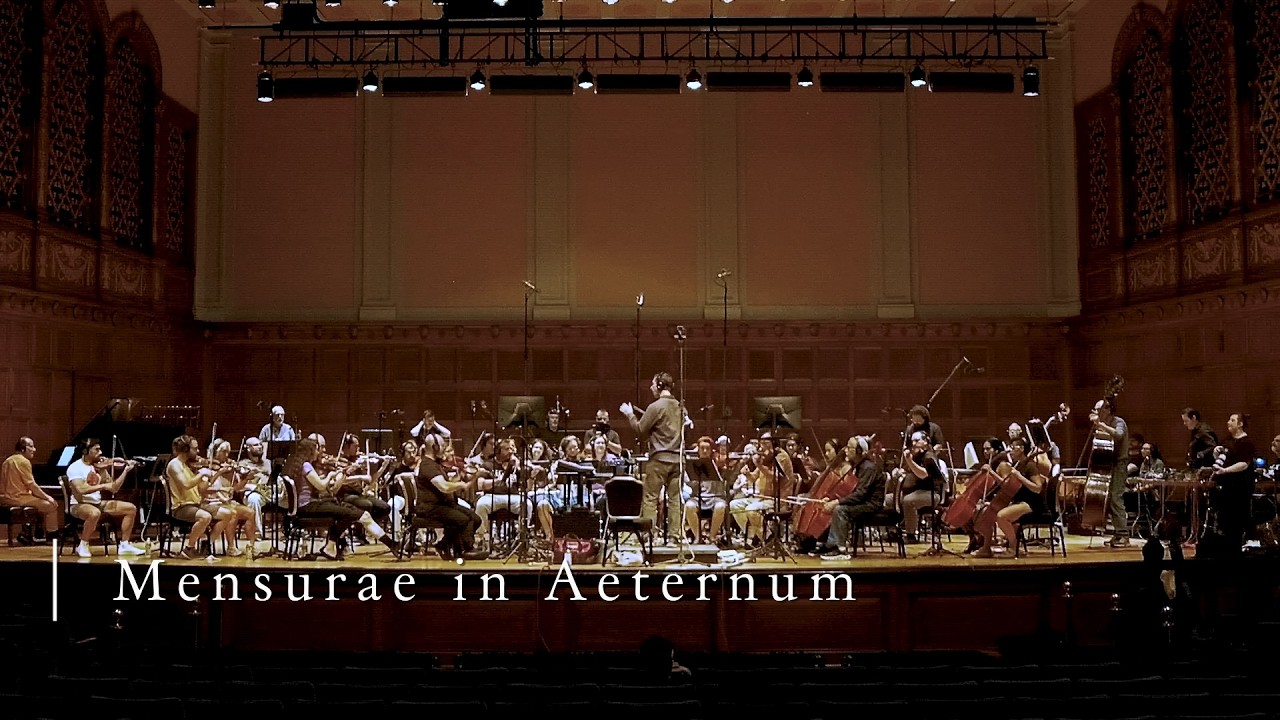
In honor of NIST’s 125th anniversary this year, anonymous donors commissioned a piece of music to honor NIST and its contributions to science and industry. A nonprofit organization paid to have the piece recorded.
This musical gift is an exciting and moving addition to NIST’s 125th anniversary celebration this year.
The resulting piece is titled “Mensurae in Aeternum” (Latin for “Measurements for Eternity”). The seven-minute commemorative work was recorded last year by the Legacy Scoring Orchestra (directed by Todd Maki) and Illuminare Choral Ensemble (directed by Jon Simsic).
Taking Measure spoke with composer Alex Cap to learn about his inspiration and creative process.
Can you tell us about your background and how you became a composer?
I was a classically trained pianist from the age of 5. While attending the College of New Jersey, I developed an interest in writing music for films and video games. I later attended the University of Southern California and got my master’s degree in screen scoring, which is the general term for writing music for films, video games and TV.
While I still play the piano, I’m mainly focused on writing music. I’m grateful for all the projects I’ve had the opportunity to score, including many independent films.
What was your creative process for this commission? Did you know much about NIST before you started?

When you write music for TV or film, you have strict requirements. It’s tied to a particular scene, so I have timing limitations and very specific emotions that I have to convey. My composition has to work with those guidelines.
This commission was very different. I had an abstract idea, and I wasn’t tied down to any particular requirements or timing. It was freeing to be able to write without any restrictions.
I’ve learned a bit about the organization from Albert Rigosi, a NIST employee who is involved with the nonprofit. However, I had to do additional research to learn about NIST's role and its responsibilities.
If you listen to the piece, you’ll hear some of the themes I worked with.
For example, most of the music maintains a steady tempo. That represents what I imagine as a persistent pursuit of the truth, just an unyielding commitment to measurement science. There are some tempo changes, but they are limited. I think this represents NIST’s steadiness throughout its history.
NIST also works in precision measurement. So, I begin the piece with a flurry of sixteenth notes in the strings. It’s an unbroken section of sixteenth notes. For musicians to play this well, they have to play precisely. I incorporated that motif throughout the music.
One concept I wanted to convey is that different individuals have their own areas of expertise, but they collaborate and share information. That’s what NIST does; they partner with government agencies, companies and various organizations toward common goals. I captured that with a common musical technique, but here, it has special significance. The technique involves taking motifs and themes and distributing them to different instruments in the orchestra. The theme passes from one section of the orchestra to the other, but of course, the whole orchestra is working together, just like NIST does.
What do you hope will be the impact of the music?
I hope the piece has a life of its own that continues beyond this presentation. I would love for other orchestras and ensembles to be interested in performing this.
I’d love it if this piece became emblematic of NIST itself. Even for those who aren’t musically inclined, I hope people can listen and enjoy it.
“Mensurae in Aeternum” (“Measurements for Eternity”)
Music and lyrics by Alex Cap
The weight of Truth
The measure’s grace
A foundation built for time
A foundation built for space
In every metric
In every mode
NIST assures a trusted — a trusted code
In every count
In every scale
The Nation’s standards never fail
Related Posts



Comments
This is such a beautiful and creative way to express the spirit of NIST. I really like how the music reflects ideas like precision, collaboration, and the steady pursuit of truth—especially the use of recurring motifs and consistent tempo to symbolize measurement science. It’s inspiring to see science translated into something artistic and emotional, making NIST’s mission feel more human and accessible. Truly a meaningful piece that bridges science and art.
MATHEMTICS, MUSIC PLUSTHE BRAIN EQUALS SPIRITUALITY STORED AS KNOWLEDGE.
HALLELUJAH!
HAPPY BIRTHDAY NIST 125