

Official websites use .gov
A .gov website belongs to an official government organization in the United States.

Secure .gov websites use HTTPS
A lock (
) or https:// means you’ve safely connected to the .gov website. Share sensitive information only on official, secure websites.


New AM Bench Focus on Higher Technology Readiness Level Applications
CM4QC / AM Bench Demonstration Exercise
Introduction
The three completed rounds of the Additive Manufacturing Benchmark Test Series (AM Bench) (2018, 2022, 2025) have demonstrated clearly that the modeling community has made tremendous advances toward developing modeling capabilities for simulating 3D builds using laser powder bed fusion (PBF-LB) of metal alloys. For AM Bench 2018, none of the 10 research groups that submitted modeling predictions for the width, depth, and length of laser melt pools on bare metal plates came close to predicting the measured values [1,2]. Those problems were largely solved by AM Bench 2022 [3], and simulation results published in 2025 demonstrated thermal models of complete AM Bench builds with sub-melt pool resolution [4,5] and microstructure simulations that closely match the measured grain sizes, shapes, and crystallographic texture [6].
The time has come for AM Bench to transition from providing measurement data from small metal AM PBF-LB test specimens to providing measurement data from complex parts reflective of those built by U.S. industry. Our first step in this direction is through a collaboration with another organization that NIST is deeply involved with: the Computational Materials for Qualification and Certification (CM4QC) Steering Group, a tightly focused collaboration of aviation OEMs, research and regulatory government agencies, and universities that has spent five years developing a comprehensive strategy for drastically lowering the barriers for qualification and certification (Q&C) by broadly incorporating computational materials approaches into the aviation AM Q&C processes. The resulting CM4QC Strategy Document was published in early 2026 by the National Aeronautics and Space Administration (NASA) and the Federal Aviation Administration (FAA). Now that this framework has been released, CM4QC is focusing on activities to promote their approach, such as the collaboration with AM Bench on the CM4QC / AM Bench Demonstration Exercise.
CM4QC / AM Bench Demonstration Exercise
The Demonstration Exercise Kickoff and Planning Meeting was held at NIST in Gaithersburg, MD, on January 13, 2026. The meeting included representatives from Pratt and Whitney (P&W), Lockheed Martin (LM), Boeing, General Electric (GE) Aerospace, NASA, the Air Force Research Laboratory (AFRL), Oak Ridge National Laboratory (ORNL), Los Alamos National Laboratory, Johns Hopkins University, the JHU Applied Physics Laboratory, and Cornell. The workshop report will be included as an appendix in the AM Bench 2025 Overview paper that will be published in the Integrating Materials and Manufacturing Innovation AM Bench 2025 collection.
The Demonstration Exercise will be implemented through three sets of highly coordinated benchmarks:
- AMB2028-01 Builds and process monitoring (led by Jordan Weaver)
- AMB2028-02 Post build characterization (led by Lyle Levine)
- AMB2028-03 Mechanical behavior (led by Nik Hrabe)
Teams for these activities have been assembled and the planning and long-lead-time activities for these sets of benchmarks are well underway. Although we are limited in what details we can share at this time, we have agreed to release the following information:
- Build process: PBF-LB
- Material: Nickel alloy 718
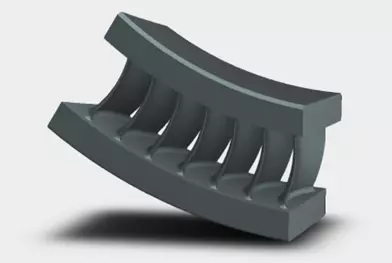
- Component: Stator segment for a jet engine
A rendering of the 7-vane stator segment that will be the focus for the CM4QC/AM Bench Demonstration Exercise is shown below. The approximate dimensions of the stator segment are 16.5 cm (length) x 9 cm (height) x 7.5 cm (thickness).
It is important to recognize that the AM Bench 2028 organizers expect to release many sets of benchmarks in addition to those associated with the Demonstration Exercise. As usual, these will cover a broad range of topics, build methods, and materials. General information about all the AM Bench 2028 benchmarks will be released in September 2027.
The division of responsibilities for the Demonstration Exercise is:
CM4QC – Strategic Direction + Interface to the Aviation Community
CM4QC Demonstration Action Team
- Lyle Levine (NIST), Co-Chair
- David Furrer (P&W), Co-Chair
- Scott Cochran (LM)
- Ed Glaessgen (NASA)
- Michael Gorelik (FAA)
- Manish Kamal (P&W)
- Harry Millwater (UTSA)
- Alex Plotkowski (ORNL)
- Narendran Raghavan (Boeing)
- Tony Rollett (CMU)
- Eddie Schwalbach (AFRL)
- Saikumar Yeratapally (GE Aerospace)
AM Bench – Operational Planning and Execution + Interface to the AM Community
AM Bench Demonstration Exercise Coordinator and Team Leads
- Overall Coordinator – Lyle Levine (NIST)
- Builds and in-process monitoring – Jordan Weaver (NIST)
- Post build characterization – Lyle Levine (NIST)
- Mechanical behavior – Nik Hrabe (NIST)
- Part design – David Furrer and Manish Kamal (P&W)
- Modeling – Alex Plotkowski (ORNL)
References:
- Lane BM, Heigel JC, Ricker R, Zhirnov I, Khromschenko V, Weaver J, Phan TQ, Stoudt MR, Mekhontsev S, Levine LE (2020) Measurements of Melt Pool Geometry and Cooling Rates of Individual Laser Traces on IN625 Bare Plates. Integr Mater Manuf Innov. 9, 16–30 https://doi.org/10.1007/s40192-020-00169-1.
- Levine LE, Lane BM, Heigel JC, Migler KB, Stoudt MR, Phan TQ, Ricker RE, Strantza M, Hill MR, Zhang F, Seppala JE, Garboczi EJ, Bain ED, Cole DP, Allen AJ, Fox J, Campbell CE (2020) Outcomes and Conclusions from the 2018 AM‑Bench Measurements, Challenge Problems, Modeling Submissions, and Conference. Integr Mater Manuf Innov. 9, 1–15 https://doi.org/10.1007/s40192-019-00164-1.
- Levine LE, Lane BM, et al. (2024) Outcomes and Conclusions from the 2022 AM Bench Measurements, Challenge Problems, Modeling Submissions, and Conference, Integr Mater Manuf Innov 13, 598-621 https://link.springer.com/article/10.1007/s40192-024-00372-4.
- Sebastian D. Proell, Peter Munch, Martin Kronbichler, Wolfgang A. Wall, Christoph Meier, A highly efficient computational approach for fast scan-resolved simulations of metal additive manufacturing processes on the scale of real parts, Additive Manufacturing 79, (2024) 103921, https://doi.org/10.1016/j.addma.2023.103921
- S.M. Elahi, J.P. Leonor, R.Y. Wu, G.J. Wagner, Efficient part-scale thermal modeling of laser powder bed fusion via a multilevel finite element framework, Additive Manufacturing 109, (2025) 104897, https://doi.org/10.1016/j.addma.2025.104897.
- Matt Rolchigo, Samuel Temple Reeve, Benjamin Stump, John Coleman, Alex Plotkowski, ExaCA v2.0: A versatile, scalable, and performance portable cellular automata application for additive manufacturing solidification, Computational Materials Science 251, (2025) 113734, https://doi.org/10.1016/j.commatsci.2025.113734.
Contacts
-
(301) 975-6032
-
(301) 975-2265