

Official websites use .gov
A .gov website belongs to an official government organization in the United States.

Secure .gov websites use HTTPS
A lock (
) or https:// means you’ve safely connected to the .gov website. Share sensitive information only on official, secure websites.


Community Resilience Planning Guide Playbook Templates & Additional Resources
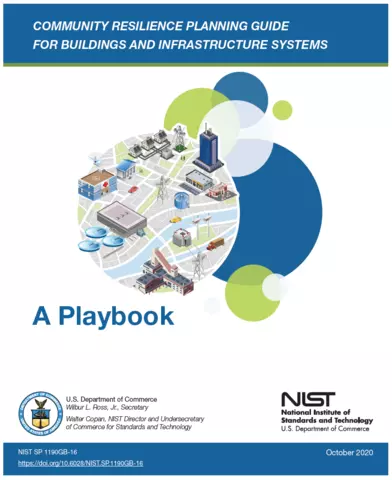
This Playbook is intended to provide a practical, action-oriented aid to help communities follow the Guide’s six-step process. It can assist communities seeking insights into resilience planning issues and help identify the most effective resilience-improvement projects. It can be used without expert assistance but also offers ways to engage experts in the planning and implementation processes. Every community should be able to benefit from the Guide’s planning process.
The following list of templates are supporting materials to complete the steps and actions listed in the NIST Community Resilience Planning Guide Playbook. The Playbook and Community Resilience Planning Guide can be accessed at the following links:
Step 1: Form a Collaborative Planning Team
Templates
- Template 1-1: Forming a Collaborative Planning Team
- Supports Action 1-1 (Playbook pg.9) and Action 1-2 (Playbook pg.10)
- Template 1-2: Stakeholder Engagement Planning
- Supports Actions 1-2 (Playbook pg.10), Action 1-4 (Playbook pg.12); and also Action 5-2 (Playbook pg.46)
Step 2: Understand the Situation
Templates
- Template 2-1: Information Needed to Complete Step 2, Action 2-4
- Supports Action 2-4 (Playbook pg.19) and related information for Action 3-2 (Playbook pg.26), Action 3-4 (Playbook pg.32)
- Template 2-2: Identifying Building Cluster Template
- Supports Action 2-4 (Playbook pg.19)
- Template 2-3: Identifying Infrastructure System Template
- Supports Action 2-4 (Playbook pg.19)
External Resources
- Plan Integration for Resilience Scorecard Guidebook (PIRS) Table 2.1 - Supports Action 2-1
Step 3: Determine Goals and Objectives
Templates
- Template 3-1: Buildings Performance Goals Table
- Supports Action 3-2 (Playbook pg.26), Action 3-4 (Playbook pg.32)
- Template 3-2: Infrastructure System Performance Goal Tables
- Supports Action 3-2 (Playbook pg.26), Action 3-4 (Playbook pg.32)
- Template 3-3: Identifying Community Hazards and Levels
- Supports Action 3-3 (Playbook p.31)
- Template 3-4: Summary Performance Goals Table
- Supports Action 3-5 (Playbook pg.35)
External Resources
- Boulder County Collaborative Resilience Design Performance Standard for Infrastructure and Dependent Facilities (2016) - Supports Action 3-2 (Playbook pg.26), Action 3-4 (Playbook pg.32)
- Threat and Hazard Identification and Risk Assessment (THIRA) and Stakeholder Preparedness Review (SPR) Guide, Comprehensive Preparedness Guide (CPG) 201 (2018) - Supports Action 3-3 (Playbook p.31)
Step 4 - 6: No Templates
Related Federal Disaster Recovery & Mitigation Planning Programs
- FEMA Hazard Mitigation Assistance Grants
- HUD Community Development Block Grant Disaster Recovery
- HUD Community Development Block Grant Mitigation
- EDA Comprehensive Economic Development Strategy (CEDS)
- National Fish & Wildlife Foundation & NOAA National Coastal Resilience Fund
Example Community Resilience Plans
- Boulder County, Colorado: Boulder County Collaborative Resilience Design Performance Standard for Infrastructure and Dependent Facilities (2016)
- Nashua, New Hampshire: Resilient Nashua Initiative (2019)