

Official websites use .gov
A .gov website belongs to an official government organization in the United States.

Secure .gov websites use HTTPS
A lock (
) or https:// means you’ve safely connected to the .gov website. Share sensitive information only on official, secure websites.


Spectral responsivity measurements and spatial spectral power responsivity uniformity measurements
Summary
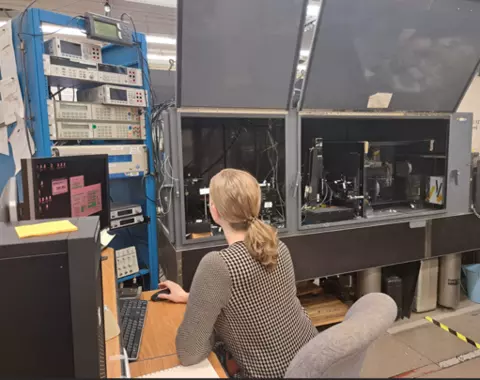
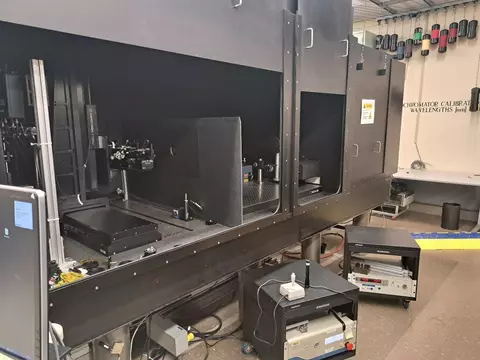
NIST provides calibrations of the spectral power responsivity, spatial spectral power responsivity uniformity, and irradiance of photodetectors and radiometers for use in industrial and government labs. These calibrations are carried out using two monochromator-based Spectral Comparator Facilities (SCFs) covering the spectral range from 200 nm to 1800 nm.
Description
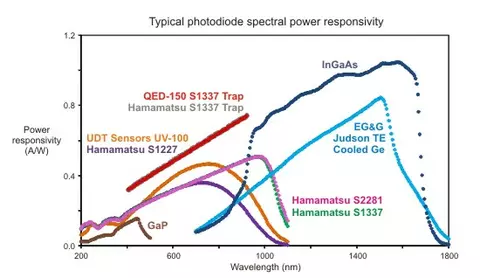
The spectral power responsivity characterizes how sensitive a photodiode is to different wavelengths of light, that is what is the diode’s output current with respect to a known power of illumination. The measurement is given as the output electrical signal in amperes per unit of incoming radiant power in watts [A/W] as a function of wavelength. Below are the spectral responsivities of typical photodiodes that are used in the ultraviolet, visible, and near-infrared, as calibrated by the Spectral Comparator Facilities (SCFs).
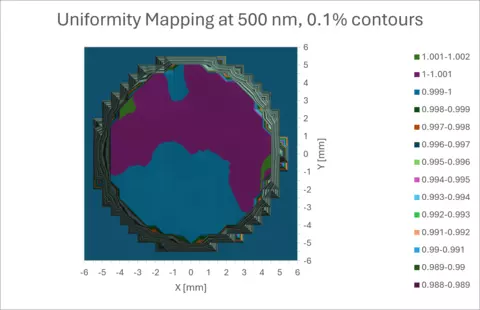
NIST can also raster scan the spectral power responsivity across the surface of the photodiode or radiometer at any requested wavelength between 200 nm and 1700 nm to map the positional spatial spectral power responsivity, i.e. the spatial uniformity of the detector or radiometer.
**Any commercial equipment, instruments, or materials mentioned are identified to foster understanding. Such identification does not imply recommendation or endorsement by the National Institute of Standards and Technology, nor does it imply that the materials or equipment identified are necessarily the best available for the purpose.
For more details about the instruments, see Spectral comparator facilities.