

Official websites use .gov
A .gov website belongs to an official government organization in the United States.

Secure .gov websites use HTTPS
A lock (
) or https:// means you’ve safely connected to the .gov website. Share sensitive information only on official, secure websites.


Metrological Photon Counter and Metrologically Counting Photons at Room Temperature
Published Patent Application Number: PCT/US2025/012217
Problem
Accurately counting photons in few-photon pulses has applications for metrology and quantum computing. The state-of-the-art counter is the Transition Edge Sensor. However, it operates at cryogenic temperatures, requiring $100k compressor systems. Here, we propose a solution that operates near room temperature and thus is potentially scalable and accessible to many more applications.
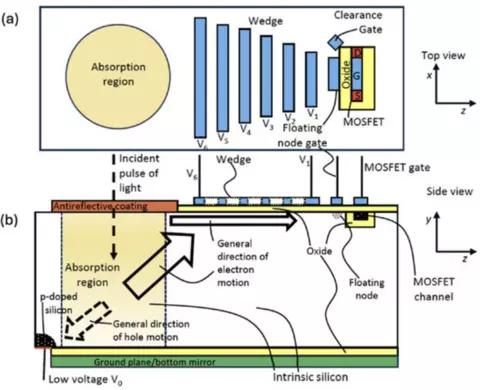
Invention
A gated few-photon pulse enters the device and is converted to electron-hole pairs through photoabsorption. Electric fields lead to the separation of the electron-hole pairs. The electrons are taken to an electronically defined well near a field-effect transistor. (The holes are discarded through a diode.) The current on the field-effect transistor is dependent on the number of electrons. A simulation suggests that by measuring that current, the photon number could be determined with 98% fidelity at a measurement rate of 500 kHz. A full description is given in Z. H. Levine et al., Sensors 25 (17) 5470 (2025) or doi.org/10.3390/s25175470.
Potential Commercial Applications
One application is metrology, where the measurement of weak pulses is important for finding the efficiency of single-photon-sensitive array detectors. A second application is in quantum computing, where the number of photons (up to about 10) in a pulse is needed to determine the quantum state, a key need for almost any quantum computing or quantum communication application. Additionally, a low-cost device operating at the ultimate limit of photon measurements means that many applications are impacted and, in particular, it becomes possible to compare measurements made with different instruments. That allows data to be directly compared between setups, which has obvious benefits especially for clinical instruments.
Competitive Advantage
The proposed detector has a very high efficiency with a small footprint of 1 mm squared or less. The proposed detector also operates near room temperature.
Partnerships
There is a top view and a side view of the device. The absorption region is on the left, with a set of wedge-shaped electrodes that concentrate the electrons from the absorption region to a floating node, which is near a field-effect transistor (FET). The FET is isolated by a trench oxide.