

Official websites use .gov
A .gov website belongs to an official government organization in the United States.

Secure .gov websites use HTTPS
A lock (
) or https:// means you’ve safely connected to the .gov website. Share sensitive information only on official, secure websites.


Taking Measure
Just a Standard Blog
NIST Inventions Are Powering Our World
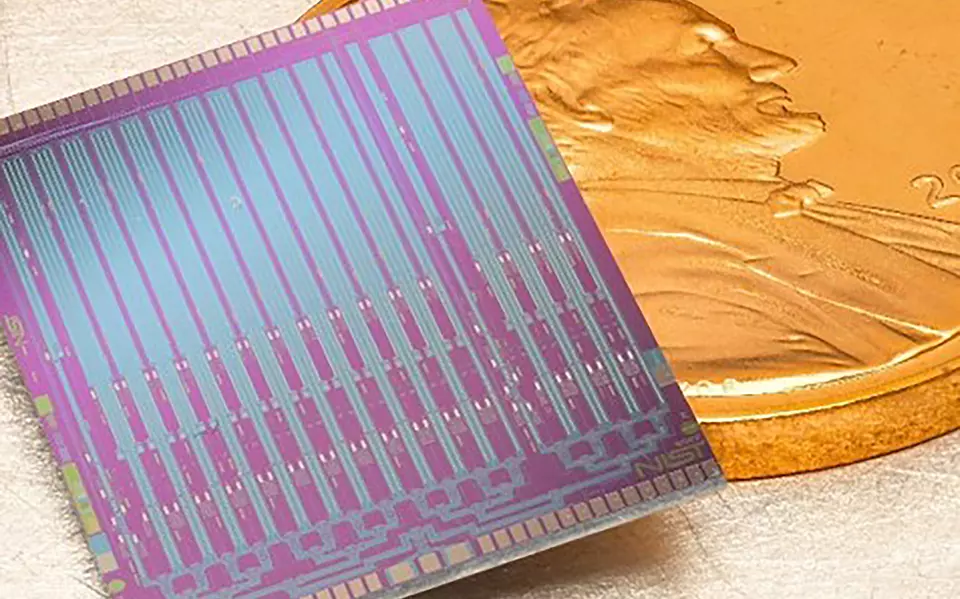
A NIST Josephson voltage chip next to a penny.
In the late 1990s, NIST researcher Jan Hall and his colleagues created a high-tech “ruler” for measuring light, known as a frequency comb.
You may have never heard of a frequency comb, but it’s revolutionized atomic clocks and many other areas of precise measurement. Hall was awarded the Nobel Prize in 2005 for the achievement.
Since then, researchers have continued to improve the frequency comb. One of those advancements was shrinking it to a size small enough to use in more contexts, such as a tiny computer chip.
Thanks to its compact size, the frequency comb is now used for precise measurements, medical diagnostics and more.
Bringing NIST’s Measurements to Industry
This is just one of the many scientific breakthroughs at NIST that have been made into commercial products through NIST on a Chip. This program brings NIST’s highly accurate measurement technologies directly to users in business, medicine and defense.
One example is calibrating torque wrenches used by aircraft mechanics to ensure that bolts and fasteners on planes are correctly tightened, which is critical for safety. These calibrations are performed on large devices in labs, using a costly, time-consuming process.
But NIST experts have created a calibration tool that can be used anywhere — no shipping or waiting required. The researchers partnered with Snap-on Industrial, a tool manufacturer, to build one such device. The U.S. Air Force is currently testing one of the devices, with plans to build and distribute more.
“Our goal is to create a suite of devices where we can take measurements out of our labs and closer to the end user who needs those measurements,” said NIST on a Chip Program Manager Barbara Goldstein. “That could be getting our measurements to an airplane hangar, embedded on a factory floor or on a rocket headed to space.”

The NIST on a Chip team is also working to provide portable technology for calibrating devices that measure voltage, such as voltmeters. Today, accurate voltages are provided by programmable Josephson voltage standards (PJVS), which generate voltage signals linked to quantum physics principles, so they are highly accurate and don’t require calibration.
Access to this level of precision typically requires significant investment and specialized labs.
Large companies that manufacture planes or other instruments, for example, need precise voltage standards as part of their quality control process. Bringing these measurements in-house rather than shipping voltmeters out for calibration helps reduce costs and ensure accurate in-house voltage measurements.
Deputy NIST on a Chip Program Manager Jay Hendricks explained that there are numerous engineering challenges between the invention of a new technology or scientific breakthrough in a lab and turning it into a commercial product that someone can actually buy. This is known as “the valley of death” because there are many opportunities for something to go wrong and derail the invention.
“It’s a long process from the time you get something that works as a prototype in a lab to a product that’s cheap enough or small enough for someone to buy,” Hendricks said. “Those are what we call engineering problems. We hope they can be worked through to achieve NIST on a Chip’s vision, which is that these technologies are out there, in the field, working for people.”


Good