

Official websites use .gov
A .gov website belongs to an official government organization in the United States.

Secure .gov websites use HTTPS
A lock (
) or https:// means you’ve safely connected to the .gov website. Share sensitive information only on official, secure websites.


Optical Entanglement Generation and Measurement
Summary
A collaborative team working to develop optical interconnects between superconducting quantum computers for the first time.
View the Poster
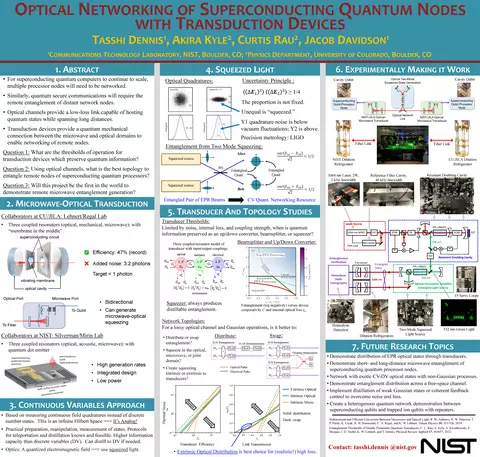
Optical Networking of Superconducting Quantum Computers with Transducer Devices
Description
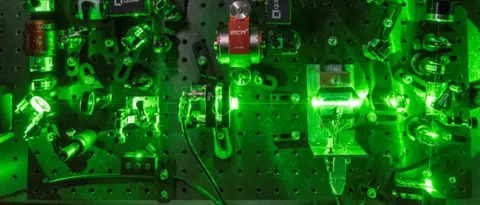
Quantum networks operate by first creating entanglement between the nodes of the network, and then using that resource to transfer quantum information. For the optical networking of superconducting quantum computers, which would allow the computational power of these microwave systems to scale beyond the confines of a single cryostat, a microwave-optical quantum transducer is a critical interconnecting device. Based on the narrow bandwidth of the vibrating membrane transducers we design and operate, this project is generating optical entanglement in the form of two-mode squeezed states.
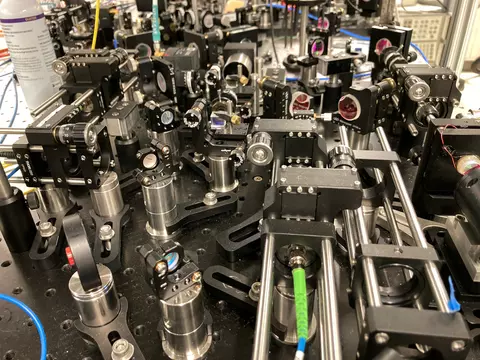
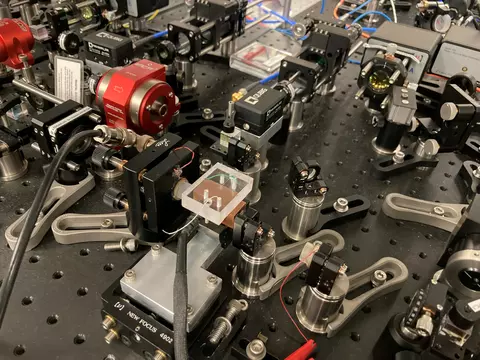
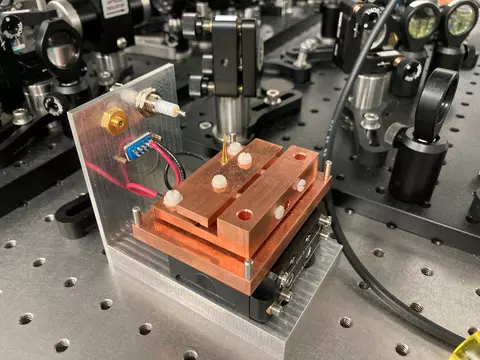
Using a resonant cavity approach, we generate twin beam, two-mode squeezing with a frequency nondegenerate parametric amplifier containing a nonlinear crystal. The nondegeneracy is required by the lack of wavelength tuning of our transducer design and the typical mismatch between any two optical cavities. Optical homodyne tomography is used to quantify the degree of quantum correlations between the two beams. We are also using a resonant approach to generate an optical source of one-mode squeezing to study the fundamental interactions of non-classical light with a membrane-cavity system. Using a non-resonant approach, we generate broadband squeezing from a nonlinear waveguide crystal, where the tight spatial confinement enhances the spontaneous parametric down conversion process. With the broadband squeezing spectrum, quantum correlations exist between upper and lower sideband components, which can be aligned with the cavity resonances of a pair of transducers for conversion to a microwave state.
The delivery of squeezed light to high-finesse optical cavities, maintained in dilution refrigerators at cryogenic temperatures to avoid debilitating thermo-mechanical noise, involves lossy fiber coupling which in turn reduces the degree of squeezing. Efforts to do this efficiently while preserving states of polarization represent difficult engineering challenges. Interacting squeezed light with membrane mechanical resonances at MHz frequencies requires heroic efforts to reduce technical noise. For transducer interactions and down conversion, squeezed light must be accompanied by cavity locking and pump beams to maintain a stable interaction and increase the device operating bandwidth, respectively.
The Optical Entanglement Generation and Measurement Project will:
• Develop resonant, one-mode squeezing to interact with membrane-cavity systems
• Develop resonant, frequency tunable, two-mode squeezing for networking demonstrations
• Develop broadband, non-resonant squeezing for networking demonstrations
• Use homodyne measurement techniques to quantify the quantum correlations of squeezed light
• Interact squeezed light with microwave-to-optical quantum transducers
The Results of this Project will Directly Impact:
• Scalable quantum computing
• Secure quantum communications
• Quantum sensing and metrology
• Quantum transducer technology
• Future quantum networking standards
• US leadership in Quantum 2.0 technologies
• US global competitiveness
• US national security
Literature References
• Entanglement Thresholds of Doubly Parametric Quantum Transducers, Curtis L. Rau, Akira Kyle, Alex Kwiatkowski, Ezad Shojaee, John D. Teufel, Konrad W. Lehnert, and Tasshi Dennis, Phys. Rev. Applied, Vol. 17, 044057, April 2022.
• Optically Distributing Remote Two-Node Microwave Entanglement Using Doubly Parametric Quantum Transducers, Akira Kyle, Curtis L. Rau, William D. Warfield, Alex Kwiatkowski, John D. Teufel, Konrad W. Lehnert, and Tasshi Dennis, Phys. Rev. Applied, Vol. 20, 014055, July 2023.
WANT TO BE INVOLVED?
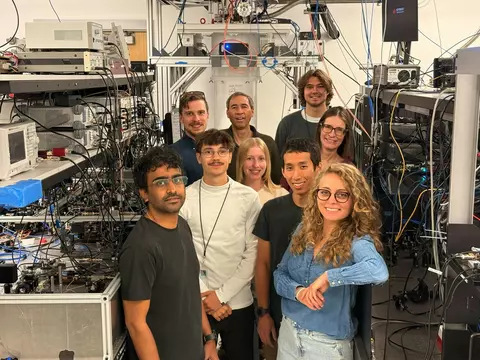
There are numerous ways to contribute to this project team, which benefits from a diversity of expertise and varied levels of prior experience.
The NRC Postdoctoral Program
The NRC Research Associateship Program has opportunities available for research related to this project (eligibility requirements include US Citizenship). Application cycles are in January and August, and it is recommended that you contact us well in advance of this deadline.
The NIST PREP Program
The NIST Professional Research Experience Program (PREP) was created at NIST-Boulder in 1991 and is designed to provide valuable laboratory experience and financial assistance to undergraduates, graduate students, postdocs, and professional researchers. The program is intended to assure the continued growth and progress of a highly skilled science, technology, engineering, and math (STEM) workforce in the United States.
The NIST SURF Program
The NIST-Boulder Summer Undergraduate Research Fellowship (SURF) program provides summer research opportunities for undergraduate researchers during an 11-week program. Students work alongside NIST scientists and will have their own research projects to complete. Student applications are submitted in February.
Research Collaborations
Collaborations are available to US and international citizens as well as various government agencies.
If you are interested or have any questions, please contact the group leader, tasshi.dennis [at] nist.gov (Tasshi Dennis).