

Official websites use .gov
A .gov website belongs to an official government organization in the United States.

Secure .gov websites use HTTPS
A lock (
) or https:// means you’ve safely connected to the .gov website. Share sensitive information only on official, secure websites.


NIST Research Grade Test Material 10268 Lentiviral Vector Integration Copy Number Standard
Description
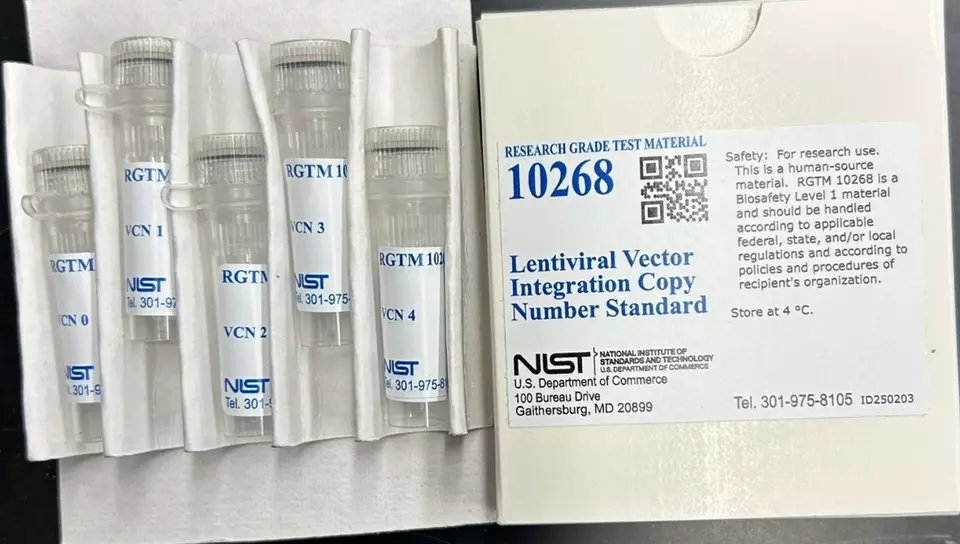
A unit of NIST RGTM 10268 Lentiviral Vector Integration Copy Number Standard. The RGTM is currently available from the NISTstore.
NIST is actively developing and evaluating reference materials for standardizing measurements of integrated lentiviral vector copy number (VCN) and integration insertion sites in cell and gene therapy products, such as CAR-T cells. These materials are designed for use in harmonizing results across laboratories and validating assays used to assess the safety and efficacy of engineered cell and gene therapies.
In collaboration with Lentigen, Inc. (a Miltenyi Biotec company), NIST has developed NIST RGTM 10268 Lentiviral Vector Integration Copy Number Standard. The material is comprised of extracted genomic DNA from clonal Jurkat (clone E6-1) cell lines transduced with lentivirus encoding a jgreen fluorescent protein, such that each clone contains 0, 1, 2, 3 or 4 copies of the integrated provirus. Development and initial characterization of the clonal VCN cell lines are detailed in the publication Reference standards for accurate validation and optimization of assays that determine integrated lentiviral vector copy number in transduced cells. NIST has conducted an interlaboratory intercomparison study of this material, with results described in the publication Interlaboratory assessment of candidate reference materials for lentiviral vector copy number and integration site measurements. The interlaboratory study demonstrated the utility, commutability, and suitability of this material for quality assurance and improved confidence in VCN, integration profile, and integration site measurements.
Purpose
NIST RGTM 10268 is provided on a collaborative basis for evaluation of the material's potential fitness for purpose as a reference material for lentiviral copy number (VCN) and integration site measurements in cell and gene therapy products.
Goals
NIST RGTM 10268 is serving as a "version 1.0" material for VCN measurements. Based on the comments, feedback, and demand for RGTM 10268, NIST intends to collaborate with federal and industrial partners to develop future versions of VCN reference materials. NIST is developing CD19 CAR-T VCN cell lines by transducing jurkat cells, as well as broadly consented T cell lines with a lentivirus expressing an anti-CD19 cassette and eGFP. The clonal cell lines with defined numbers of integrated provirus will be characterized, the protein expression of anti-CD19 CAR, and eGFP will be evaluated, and the functional activity of the cell lines will also be tested in assays such as CAR-T cell cytotoxicity.
References
Barbara S. Paugh, Lajos Baranyi, Andre Roy, Hua‑Jun He, Lindsay Harris, Kenneth D. Cole, Moria Artlip, Caroline Raimund, Patricia S. Langan, Srikanta Jana, Rimas J. Orentas, Sheng Lin‑Gibson, Winfried Krueger, and Boro Dropulić. “Reference standards for accurate validation and optimization of assays that determine integrated lentiviral vector copy number in transduced cells”, Scientific Reports (2021) 11, 389, https://doi.org/10.1038/s41598-020-79698-w
Hua-Jun He, Zhiyong He, Steven P. Lund, Laure Turner, Yongjun Fan, Yu Qiu, David C. Corney, et al. (2025), Interlaboratory Assessment of Candidate Reference Materials for Lentiviral Vector Copy Number and Integration Site Measurements, Molecular Therapy Methods & Clinical Development, https://doi.org/10.1016/j.omtm.2025.101472