

Official websites use .gov
A .gov website belongs to an official government organization in the United States.

Secure .gov websites use HTTPS
A lock (
) or https:// means you’ve safely connected to the .gov website. Share sensitive information only on official, secure websites.


Polyelectrolyte Solutions and Gels
Summary
We engage with leaders in the pharmaceutical, dental, and personal care research sectors that rely on water soluble polymers (polyelectrolytes) to develop new measurement and analysis methods for quantitative data that provide fundamentals for next-generation formulation design and processing technologies of these ion-containing polymeric materials.
Major Accomplishments
Advanced Materials for Biotechnology
Cryogenic Electron Microscopy Characterization of Chain conformation and Topology
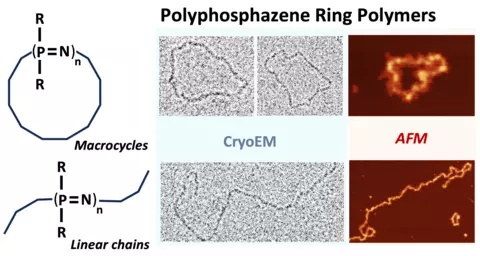
We observed individual macromolecular chains with distinct ring topology when studying cryogenic electron microscopy (Cryo-EM) images of a high molar mass polyorganophosphazene in its vitrified aqueous solution. The presence of monocyclic chains was confirmed by visualizing samples of the same macromolecule in its absorbed form using atomic force microscopy (AFM). The polymer - poly[di(carboxylatophenoxy)phosphazene], PCPP is synthesized via a two-stage process, which includes a ring opening polymerization (ROP) and a subsequent macromolecular substitution transformation. The visualization of macrocycles, which are 20 nm to 60 nm in diameter, provides direct proof of a ring extension polymerization (REP) mechanism occurring in the chain-growth process commonly employed for the synthesis of high molar mass polyphosphazenes. Asymmetric flow field flow fractionation (AF4) analysis shows the presence of a faster-moving fraction, which can be potentially attributed to macrocycles.
Analytical Methods to Characterize Polyelectrolyte-Protein Complexes
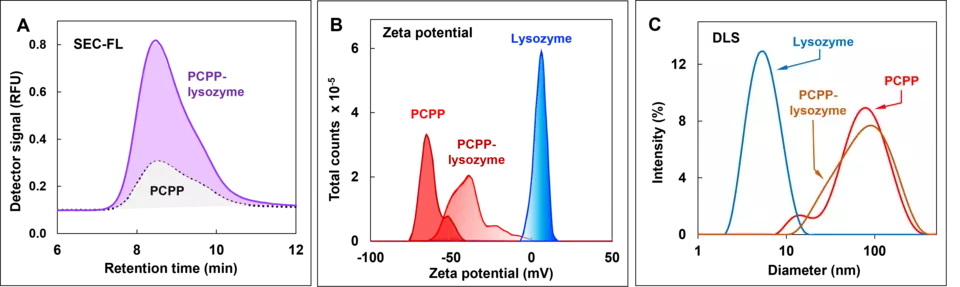
Polyorganophosphazenes are water-soluble macromolecules with potent immunoadjuvant activity that self-assemble with antigenic proteins to enable their biological functionality. Herein, direct imaging by cryogenic electron microscopy uncovers the coil structure of those highly charged high molecular mass hybrid organic-inorganic macromolecules. The successful visualization of individual chains of covalently bound linear synthetic polymers within the vitrified state, which is achieved for the first time in the absence of any additives for contrast enhancement, is attributed to the high mass contrast of inorganic backbone. Upon assembly with antigenic proteins under a controlled stoichiometric ratio, multiple protein copies bind at the single polymer chain level revealing a structural change reminiscent of compact spherical complexes or stiffened coils. The structural outcome depends on protein characteristics and cannot be deduced by commonly used characterization techniques, such as light scattering or circular dichroism, thus revealing direct morphological insights crucial for understanding the in vivo activity. Complementary atomic force microscopy supports the binding morphology outcomes while advanced analytical techniques confirm protein-polymer binding. It is envisioned that the polymer chain visualization methodology, which is based on the use of high mass contrast polyphosphazene systems, can provide indispensable tools for gaining new insights into the processes of supramolecular protein-polymer assembly, as well as into mechanistic aspects of polymer enabled vaccine and drug delivery.
Polyelectrolyte-Protein Complexes as Immunoadjuvant Formulations
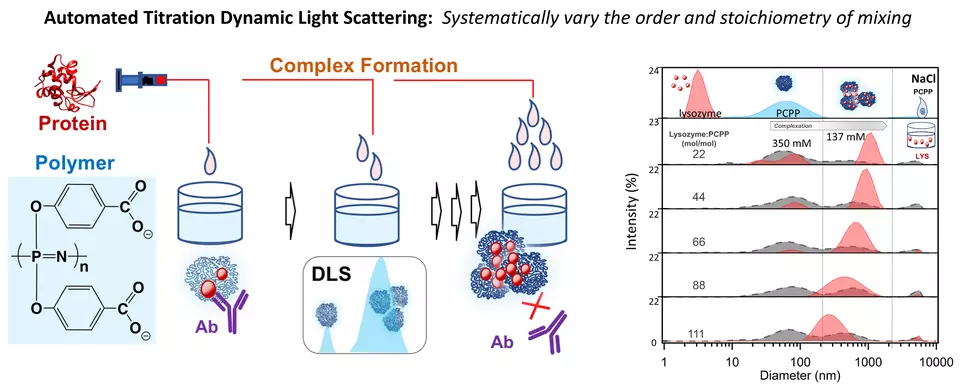
Polyphosphazenes represent a class of intrinsically flexible polyelectrolytes with potent immunoadjuvant activity, which is enabled through non-covalent self-assembly with antigenic proteins by charge complexation. The formation of supramolecular complexes between polyphosphazene adjuvant, poly[di(carboxylatophenoxy)phosphazene (PCPP) and a model vaccine antigen, hen egg lysozyme, was studied under physiological conditions using automated dynamic light scattering titration, asymmetric flow field flow fractionation (AF4), enzyme-linked immunoassay (ELISA), and fluorescent quenching methods. Three regimes of self-assembly were observed covering complexation of PCPP with lysozyme in the nano-scale range, multi-chain complexes, and larger aggregates with complexes characterized by a maximum loading of over six hundred protein molecules per PCPP chain and dissociation constant in the micromolar range. The antigenicity of PCPP bound lysozyme, when compared to equivalent lysozyme solutions, was largely retained for all complexes, but observed a dramatic reduction for heavily aggregated systems.
Associative Phase Separation of Charged Polymers
Phase Diagrams of Mixture of Oppositely-Charged Polyelectrolytes (Coacervates)
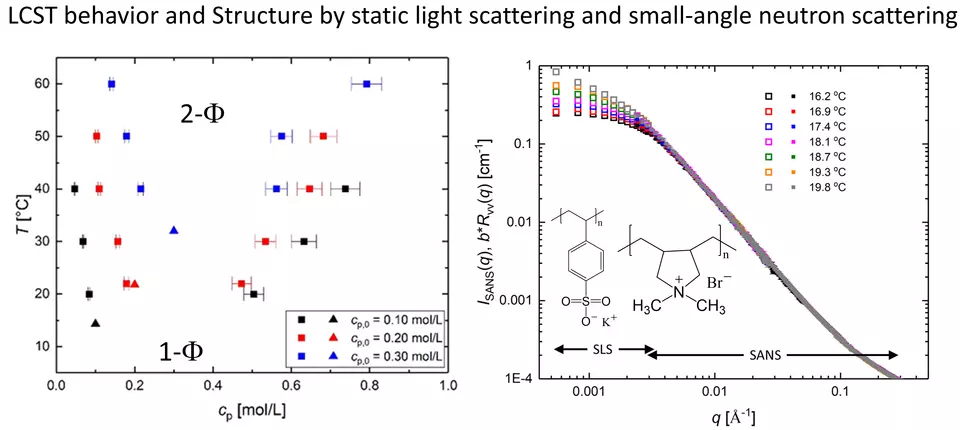
A temperature (T) versus polymer concentration (cp) representation leads to non-overlapping coexistence curves prepared from different initial polymer concentrations along a salt isopleth of aqueous mixtures of charge-stoichiometric, oppositely charged polydisperse polyelectrolytes. This effect was explained by a T-cs-cp phase envelope with phase separation upon heating (LCST). Using a combination of NMR, turbidity, static light scattering and small-angle neutron scattering the structure and stability of the solutions were quantified and illustrated a cross-over from mean-field to fluctuation regime behavior. Further, static light scattering measurements illustrate that concentration fluctuations are enhanced by polyelectrolyte chain association near the lower critical solution temperature, while the dynamics are described by the Generalized Stokes-Einstein equation and mode-mode coupling theory developed by Kawasaki and Ferrell.
Phase Diagrams of Polyzwiterions
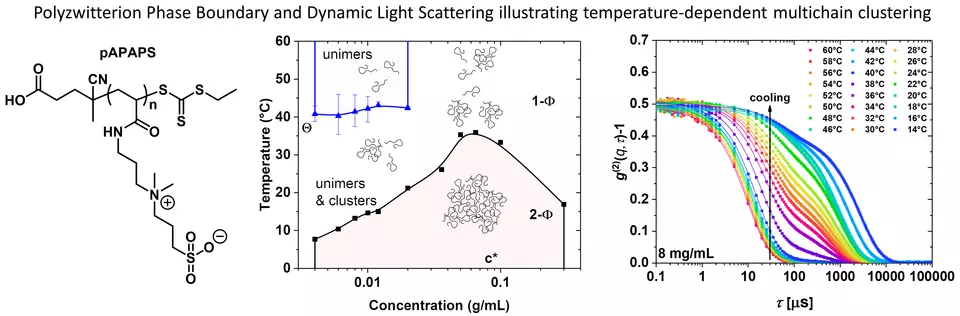
A model zwitterionic polysulfobetaine, poly(3-(acrylamidopropyl-dimethyl-ammonium) propyl-1-sulfonate) (pAPAPS), phase separates upon cooling and exhibits an upper critical solution temperature (UCST) behavior with no added salt in deuterium oxide solutions. Dynamic light scattering measurements indicate the presence of distinct fast and slow diffusive modes, where the fast mode is interpreted as a collective diffusion coefficient and the slow mode is attributed to the diffusion of multi-chain dynamic clusters.
Interfacial Tension in Complex Coacervates
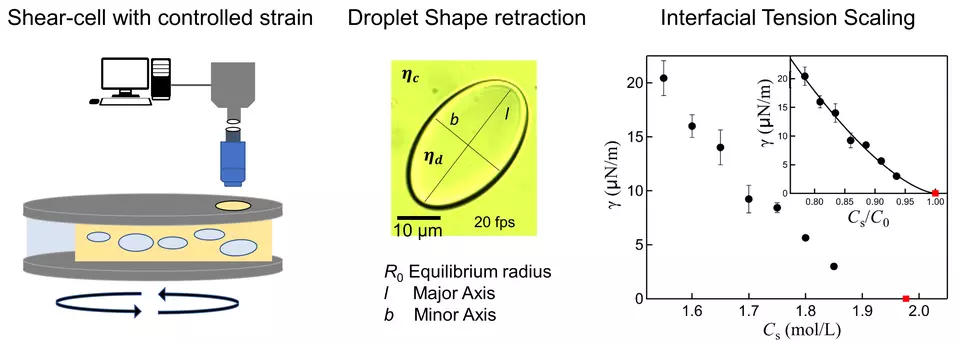
Dilute droplets form upon changing the temperature of a phase separated polyelectrolyte complex coacervate. This provides an in situ approach to measure the interfacial tension between supernatant (dilute droplet) and dense coacervate by the deformed drop retraction (DDR) method. The aqueous coacervate, formed via a model 1:1 by charge stoichiometric polyelectrolyte blend, exhibits ultralow interfacial tension with the coexisting phase. DDR finds the interfacial tension scales as γ=γ0 (1-Cs/Cs,c)μ, with μ = 1.5 ± 0.1, γ0 = 204 ± 36 μN/m, and Cs,c = 1.977 mol/L. The value of μ independently validates the classical exponent of 3/2. The scaling holds between Cs/Cs,c of 0.75 to 0.94, the closest measurements to date near the critical salt concentration (Cs,c).
Microphase Separation of Polyelectrolytes and Polyzwitterions
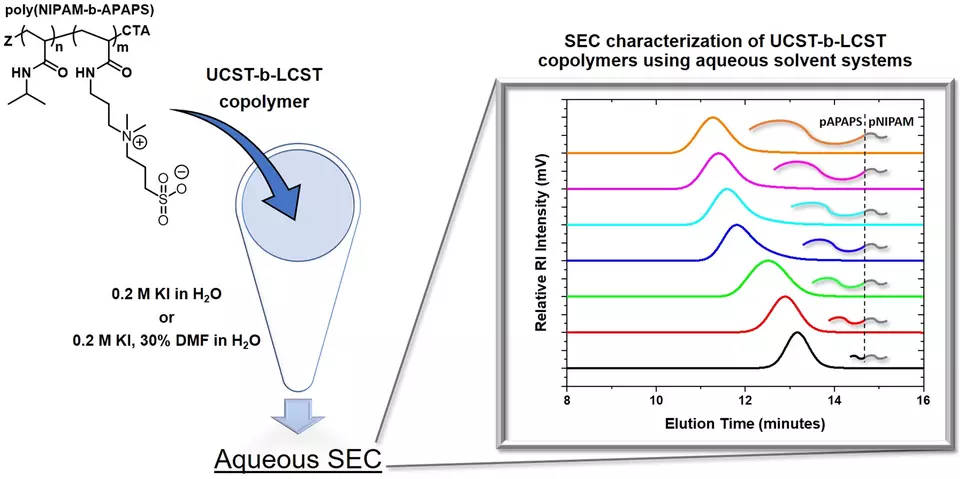
Block copolymers that exhibit both an upper critical solution temperature and a lower critical solution temperature are difficult to characterize due to inherent solubility difference between the two blocks. For example, accurate determination of both the molar mass and molar mass distribution is challenging for polyzwitterion-block-N-isopropyl acrylamide (NIPAM) copolymers in aqueous solutions due to self-assembly. A systematic methodology featuring aqueous SEC is demonstrated using several solvent conditions to enable the elution of polyzwitterion-block-NIPAM copolymers. These aqueous systems can be utilized for the characterization of similar water-soluble block copolymers that are relevant for drug delivery and other biomedical applications.
Kinetics of Associative Phase Separation
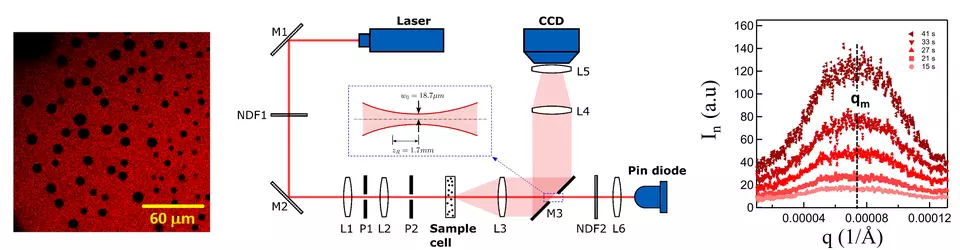
The observed droplet morphology of polyelectrolyte complexes finds many potential applications in materials as well as fundamentals of membranelles organelles. We discovered that common polyelectrolyte systems exhibit phase separation upon heating. This allowed a direct measurement of the temperature-induced phase separation and kinetics without any complications of the rates of mixing. The known spinodal and cloud point temperatures was essential to design such experiments, such that the spinodal wavelength was directly observed by a new small-angle laser light scattering instrument developed.
Additional Technical Details
Samim Ali, Yimin Mao, and Vivek M. Prabhu, Pinhole mirror-based ultra-small angle light scattering setup for simultaneous measurement of scattering and transmission, Rev. Sci. Instrum. 93, 044104 (2022).
Yuanchi Ma, Samim Ali, Vivek M. Prabhu, Enhanced Concentration Fluctuations in Model Polyelectrolyte Coacervate Mixtures along a Salt Isopleth Phase Diagram, Macromolecules 54, 11338-11350 (2021).