

Official websites use .gov
A .gov website belongs to an official government organization in the United States.

Secure .gov websites use HTTPS
A lock (
) or https:// means you’ve safely connected to the .gov website. Share sensitive information only on official, secure websites.


Risk Evaluation and Mitigation
Summary
This project focuses on understanding and reducing the risks that affect buildings and other structures during events like earthquakes. The first step is to figure out how much risk exists—both to the environment and to the structures themselves. Once we understand the risks, we can make smart and cost-effective decisions on how to reduce them. This process includes inspecting structures, testing materials, running computer models, and analyzing results. The findings help us decide when repairs or upgrades are needed to make buildings safer and stronger.
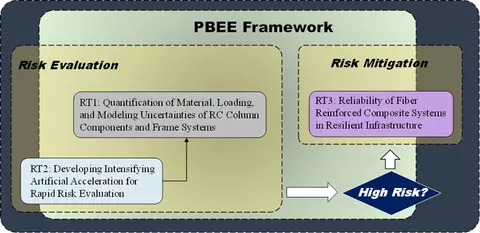
The project has two main research tasks (RT). The first task looks at how different sources of uncertainty—such as how materials behave or how the ground shakes—affect the safety of reinforced concrete structures. The goal is to improve how we measure and account for these uncertainties in earthquake engineering. The second task studies how strong and reliable fiber-reinforced polymers (FRPs) are used to strengthen buildings. These materials are often used to retrofit older structures to help them perform better in disasters. Together, these research efforts aim to improve how we evaluate risks and apply mitigation strategies, making our communities more resilient and better prepared for natural hazards.
Description
Objective
To improve techniques currently used for risk evaluation (including uncertainty quantification) and mitigation (including FRP retrofit) of structural systems and integrate them within the performance based earthquake engineering framework.
Technical Idea
The technical idea for each of the two research tasks are described separately:
RT1- Quantification of Material, Loading, and Modeling Uncertainties of RC Structural Components and Systems:
This research task develops a measurement science framework to quantify the impact of three key sources of uncertainty on the seismic performance of reinforced concrete (RC) structures:
(1) variability in material properties due to construction practices;
(2) uncertainty in analytical modeling assumptions and idealizations; and
(3) record-to-record (RTR) variability in earthquake ground motions.
Currently, the engineering community lacks reliable and quantitative uncertainty bounds for some sources of uncertainty used in seismic risk evaluations. As a result, many existing guidelines (e.g., FEMA) rely on subjective or qualitative assumptions about dispersion values used in the analysis. This project addresses this gap by producing validated, quantitative estimates of uncertainty and dispersion associated with material, modeling, and loading sources—both individually and in combination.
The primary product is a generalizable, systematic framework for incorporating uncertainty into seismic performance evaluations at both the component level (e.g., RC bridge pier) and system level (e.g., RC building frames of different heights). Key outputs will include:
- Statistical dispersion parameters for key engineering demand parameters (e.g., story drift ratio);
- Technical reports and journal publications;
- Guidelines for integrating quantified uncertainty into applications of the performance-based earthquake engineering (PBEE) framework.
By developing data-driven uncertainty bounds and providing practical methods for implementation, this work will enhance confidence in risk evaluations and support more robust design, retrofit, and decision-making strategies.
RT3- Reliability of Fiber Reinforced Polymer (FRP) Composite Systems in Resilient Infrastructure:
FR composites have been used in infrastructure applications to repair, seismically retrofit, and strengthen new and existing structures, as well as build lightweight bridge decks, and provide corrosion-resistant internal reinforcement (i.e. as reinforcing bars) for concrete [Wang et al., 2015; Ma et al., 2017; Ebead et al., 2016; Chandrasekaran and Banerjee, 2015]. It is well known that FR composites can strengthen structures, but durability and performance of retrofitted structures over time is not fully understood. Currently, a general lack of data, test methods, inspection methods, and standards to assess the health and performance of FR composite materials in indoor and outdoor environments is a major barrier to their use [Zaman et al., 2013, Tatar et al., 2021]. An evaluation of performance and health of FR composites in actual systems requires investigation to inform stakeholders and make progress on implementing the necessary method development and testing for this material. Once the performance and health of FR composite systems have been grounded in measurement science, the resilience of FR composite systems to earthquakes and other extreme events can be modeled and evaluated [Wang et al., 2016].
The durability of FR composite retrofits and the systems they are applied to are critical to both the functionality and safety of our nation’s building stock and infrastructure. Factors that affect durability may include freeze/thaw exposure, moisture-induced damage, thermal damage, UV radiation exposure, indoor air quality, and flammability during fire exposure [Ma et al., 2015; Zaman et al., 2013; Barbosa et al., 2017; Kim and Alqurashi, 2017; Lau et al., 2016]. To date, some durability research studies have been conducted and acceptance criteria have been proposed for buildings by the International Code Council (ICC) Evaluation Service, but are somewhat limited in their applicability to FR composites in the field [Barbosa et al., 2017; AC125, 2007; AC343, 2016]. Durability depends on the specific material constituents of the FR composite and conditions during matrix curing [Tumialan and De Luca, 2014]. Since strength retention (e.g., modulus and ultimate strain at rupture) of FR composites alone and when bonded to concrete are key requirements to sustaining the performance of the FR composite system, mechanical measurements in these configurations are important. Furthermore, chemical measurements that provide mechanistic understanding of the changes in FR composite systems can enable broader understanding of performance loss and failure modes [Zaman et al., 2013].
In addition to the gaps in knowledge concerning durability of retrofitted components, the extent of short-term performance improvement of some structural components, such as reinforced concrete shear walls, is less understood. ASCE 41, Seismic Evaluation and Retrofit of Existing Buildings [ASCE/SEI 41, 2023], which is the main U.S. standard for retrofit of existing buildings, currently provides no guidance on simulating the response of retrofitted components. Methods to measure the structural improvement by FR composites applied to existing structural components such as masonry and reinforced concrete walls are also needed.
The products planned for this project intend to address the aforementioned problems related to the furthering the use of FRP in retrofit of reinforced concrete structural systems. Design guidelines will address the research need for design standards related to FRP retrofit. Databases of experiments and tests will inform external stakeholders with valuable information that can inform how they design structures or future experiments. Journal and conference papers will efficiently transfer technology and knowledge from our research to the public. More information about specific planned and delivered products are discussed below.
Research Plan
The research plans for each of the two research tasks are described separately:
RT1: Quantification of Material, Loading, and Modeling Uncertainties of RC Structural Components and Systems:
This research task follows a structured plan to develop and validate a comprehensive uncertainty quantification framework for reinforced concrete (RC) structures, covering both the component and system levels. The objective is to produce a generalizable methodology that supports more accurate risk evaluation and mitigation under the PBEE framework. The research plan includes the following key steps:
Framework Development at Component Level: The project begins with establishing methods to quantify uncertainty at the structural component level (e.g., RC columns). Sources of uncertainty include:
- variability in material properties due to construction practices,
- modeling assumptions and idealizations, and
- ground motion record-to-record variability.
Computational models are developed, validated, and subjected to ground motions to isolate and quantify the effects of individual and combined uncertainty sources. Outcomes include dispersion parameters for key engineering demand measures and validated component-level workflows.
Extension to System-Level Evaluations: Building on the component-level framework, the project will extend the methodology to system-level RC structures (e.g., multi-story RC moment frames).
- Archetype Selection: Representative building configurations will be selected for detailed modeling.
- Literature Review and Gap Identification: A thorough review will guide the inclusion of system-specific uncertainty sources.
- Modeling at Multiple Resolutions: Models will be constructed using varying levels of detail—from lumped plasticity (e.g., plastic hinge) to distributed plasticity (e.g., fiber models) and full finite element models.
- Validation and Sensitivity Analysis: Models will be validated against experimental or historical data (if applicable). Sensitivity studies will identify key influencing parameters.
- Spatial Material Uncertainty: System-level studies will consider spatial variability in material properties across elements.
- Uncertainty Propagation via MSA/IDA: Ground motion ensembles will be used with Multiple Stripe Analysis and/or Incremental Dynamic Analysis to evaluate seismic demand under various uncertainty configurations (single, pairwise, and combined).
- Product Generation: The research will produce statistically derived dispersion parameters for key engineering demand measures (e.g., story drift ratio), along with technical documentation, peer-reviewed publications, and guidance documents for practitioners and researchers using the PBEE framework.
RT 3: Reliability of Fiber Reinforced Polymer (FRP) Composite Systems in Resilient Infrastructure: This project will seek to implement a strategic plan that prioritizes the current research needs for fiber reinforced (FR) composites used in structural systems (NIST SP-1244). The research plan will 1) investigate FR composite use in the field, 2) design durability experiments of FR composite systems from micro to macro level that focus on the critical modes of failure identified, and 3) assess performance of FR composites in structural systems using existing data from laboratory tests and numerical analysis.
RT3-1: Design durability experiments of FR composite systems
The IMG is uniquely equipped to measure the composition and properties of polymeric materials and concrete as they weather under different environmental conditions. Durability studies of stand-alone composites (fibers + resin) and FR composites bonded to small-scale (102 x 102 x 356 mm) notched concrete beams are underway to evaluate degradation of FRP materials and their bond to concrete . Durability studies include outdoor weathering in two climatic zones, hot and humid and cold + freeze/thaw, with several types of glass and carbon FRP materials representative of externally bonded FRP products used nationally. Changes in material properties such as adhesion to concrete and strength retention of FRP composite/concrete assemblies under different environmental loads are being investigated to provide improvement to strength reduction factors for retrofit design [Dai et al. 2005]. Accelerated weathering protocols are also employed using at least two environmental conditions with high potential for causing FRP composite degradation. IMG conducts accelerated weathering experiments using environmental chambers (high temperature, humidity, low temperature, and freeze/thaw) and the NIST SPHERE (UV, temperature, humidity). Degradation modes from accelerated weathering tests will be compared to modes observed in outdoor exposure tests to determine when and if accelerated weathering can realistically determine FRP composite failure at a more accessible time scale than outdoor testing. Metrology that indicates FRP composite performance level will be incorporated into durability studies to measure performance loss due to degradation and potentially predict the point at which FRP composite replacement is necessary. Chemical tests can be used, when needed, to determine mechanistic changes of FRP composites during degradation. Non-invasive metrology, such as ultrasonic techniques and infrared thermography, may be investigated for measuring FRP composite bond adhesion and be related to strength retention depending on identified performance metrics. The applicability and practicality of FRP composite test methods for field inspections will be explored, as improved field inspection procedures are needed to monitor for long-term degradation or performance loss following a seismic event.
RT3-2: Bond quality testing
The quality of the bond between the FRP material and the substrate can be critical to the performance of the FRP retrofit. Oftentimes, the bond can be the limit state of the FRP retrofit. The quality of the bond can be affected by installation practices, environmental degradation, the substrate’s mechanical properties and durability, and hazard events such as earthquakes. Currently, the industry standard for assessing bond quality is the pull-off test, which is a pass/fail test that places direct tension on a disc adhered to the FRP surface and requires a failure in the concrete above a certain threshold strength. Based on input at the NIST stakeholder workshop, variability in the results of this test method leads to difficulty interpreting the actual quality of the bond, and further information is needed to understand the test’s limitations. An ongoing sensitivity analysis is underway to assess variables that may affect the test method’s results. Future work will include determining if there are available alternatives to the pull-off tests for bond quality assessment such as non-destructive testing, peel tests, and shear tests. It is important that new test methods are practical for field inspections of FRP retrofits.
RT3-3: Develop a database of FRP retrofitted shear walls and modeling parameters
All available data on the experimental testing of FRP-retrofitted shear walls will be collected for inclusion in a database. The database will include all relevant information on the tests, including specimen geometric and material data, design of FRP retrofit, test parameters, and experimental results. This database will be published for public use. One of the uses of the database in this project will be the development of modeling parameters of retrofitted shear walls. This is important because there are currently no modeling parameters in the building codes like ASCE/SEI 41 used for design that are directly applicable to retrofitted components. The modeling parameters will be developed using regression analysis of key design parameters of the walls in the database against control points of an idealized backbone curve. Once modeling parameters are determined, we will engage with stakeholders and code committees, such as the ACI 369 Seismic Repair and Rehabilitation committee (which provides concrete-specific content for ASCE 41), to discuss our findings and develop a change proposal to integrate into future versions of the design codes.
RT3-4: Develop a guideline for seismic assessment of FRP-retrofitted concrete structures
This RT is intended to produce design procedures for common high-use seismic retrofit techniques involving FRP materials. Of particular interest for this task is the seismic retrofit of deficient reinforced concrete buildings. The final product is intended to be a standardization-ready document targeted for adoption by ACI 369.1 (Guide for Seismic Rehabilitation of Existing Concrete Frame Buildings and Commentary) and ASCE/SEI 41 (Standards of Seismic Safety for Existing Federally Owned and Leased Buildings) standards, as well as the ACI 440 standard for seismic retrofit of concrete structures using externally applied FRP. The envisioned document would have standard language for ease of adoption in the standards, while also providing a robust background/commentary section. Under this RT, the project team will form a working group of subject matter experts (SMEs) from academia and industry to work with NIST researchers on developing the guideline document.
References:
Ken, H., Leroi, E., Roberds, B. "Quantitative risk assessment: application, myths, future direction." ISRM International Symposium. International Society for Rock Mechanics and Rock Engineering (2000).
Salzano, Ernesto, Iunio Iervolino, and Giovanni Fabbrocino. "Seismic risk of atmospheric storage tanks in the framework of quantitative risk analysis." Journal of Loss Prevention in the Process Industries 16.5 (2003): 403-409.
Sattar, S., Weigand J., Wong, K., 2015, “Quantification of Uncertainties in Component-level Responses under Seismic and Gravity Loads and Investigation of their Influences on the Structural System Response”, Exploratory Proposal submitted to the Engineering Laboratory at NIST.
Vamvatsikos, D., Cornell, C. A., 2002. Incremental dynamic analysis, Earthquake Engineering and Structural Dynamics 31(3), 491–514.
Hariri-Ardebili, M.A., Sattar, S., Estekanchi, H.E. "Performance-based seismic assessment of steel frames using endurance time analysis." Engineering Structures, 69 (2014): 216-234.
Mirzaee, Amin, and Homayoon E. Estekanchi. "Performance-based seismic retrofitting of steel frames by the endurance time method." Earthquake spectra 31.1 (2015): 383-402.
He, Haifeng, et al. "Application of endurance time method to seismic fragility evaluation of highway bridges considering scour effect." Soil Dynamics and Earthquake Engineering 136 (2020): 106243.
ACI, 2014. Building Code Requirements for Structural Concrete (ACI 318), American Concrete Institute, Farmington Hills, MI.
Baradaran Shoraka, M., Elwood, K., 2013. Mechanical model for non-ductile reinforced concrete columns. Journal of Earthquake Engineering. 17(7), 937-957.
Elwood, K.J., 2004. Modeling failures in reinforced concrete columns. Canadian J. Civil Engineering. 31(5), 846–859.
Ghannoum, W.M., Moehle, J.P., 2012. Rotation-based shear failure model for lightly confined reinforced concrete columns, ASCE Journal of Structural Engineering, 138(10), 1267-1278.
LADBS, 2015, Mandatory Earthquake Hazard Reduction in Existing Non-ductile Concrete Buildings, Los Angeles Department of Building and Safety, Los Angeles, CA.
Lehman, D.E., Moehle, J.P., 1998. Seismic performance of well-confined concrete bridge columns, PEER-98/01, Pacific Earthquake Engineering Research Center. University of California, Berkeley, CA.
Sattar, S., 2013. Influence of masonry infill walls and other building characteristics on seismic collapse of concrete frame buildings, Ph.D. dissertation, University of Colorado, Boulder, CO.
Sezen H., and Moehle J.P. 2004. Shear Strength Model for Lightly Reinforced Columns. ASCE Journal of Structural Engineering. 130(11), 1692-1703.
Vecchio, F.J., Collins, M.P., 1986. The modified compression-field theory for reinforced concrete elements subjected to shear. ACI Journal. 83(2), 219–231.
Vamvatsikos, D., and Cornell, C. A., 2002. Incremental dynamic analysis, Earthquake Engineering and Structural Dynamics 31(3), 491–514.
Wang, J.; GangaRao, H.; Liang, R.; Liu, W., Durability and prediction models of FRP composites under environmental conditions. Journal of Reinforced Plastics & Composites 2015, 35 (3), 179-211.
Ma, C.-K.; Apandi, N. M.; Sofrie, C. S. Y.; Ng, J. H.; Lo, W. H.; Awang, A. Z.; Omar, W., Repair and rehabilitation of concrete structures using confinement: A review. Construction and Building Materials 2017, 133, 502-515.
Ebead, U.; Shrestha, K. C.; Afzal, M. S.; El Refai, A.; Nanni, A., Effectiveness of fabric-reinforced cementitious matrix in strengthening reinforced concrete beams. Journal of Composites for Construction 2016, 04016084.
Chandrasekaran, S.; Banerjee, S., Retrofit optimization for resilience enhancement of bridges under multihazard scenario. Journal of Structural Engineering 2015, 142 (8), C4015012.
O’Connor, J.; Frankhauser, W., Advances in FRP Composites in Transportation Infrastructure. Transportation Research Record: Journal of Transportation Research Board 2016, (2592), 56-64.
Zaman, A.; Gutub, S. A.; Wafa, M. A., A review on FRP composites applications and durability concerns in the construction sector. Journal of Reinforced Plastics and Composites 2013, 32 (24), 1966-1988.
Bilotta, A.; Ceroni, F.; Nigro, E.; Pecce, M., Experimental tests on FRCM strengthening systems for tuff masonry elements. Construction and Building Materials 2017, 138, 114-133.
Pino, V. A., Fabric reinforced cementitious matrix (FRCM) composites as a repair system for transportation infrastructure. 2016.
Awani, O.; El-Maaddawy, T.; Ismail, N., Fabric-reinforced cementitious matrix: A promising strengthening technique for concrete structures. Construction and Building Materials 2017, 132, 94-111.
Barbosa, A. P. C.; Fulco, A. P. P.; Guerra, E. S.; Arakaki, F. K.; Tosatto, M.; Costa, M. C. B.; Melo, J. D. D., Accelerated aging effects on carbon fiber/epoxy composites. Composites Part B: Engineering 2017, 110, 298-306.
Kim, Y. J.; Alqurashi, A., Thermomechanical Relaxation of CFRP Sheets Bonded to Concrete Substrate. ACI Structural Journal 2017, 114 (2), 555.
Lau, D.; Qiu, Q.; Zhou, A.; Chow, C. L., Long term performance and fire safety aspect of FRP composites used in building structures. Construction and Building Materials 2016, 126, 573-585.
AC125, I., Acceptance Criteria for Concrete and Reinforced and Unreinforced Masonry Strengthening Using Fiber-Reinforced Polymer (FRP) Composite Systems. 2007.
AC434, I., Proposed acceptance criteria for masonry and concrete strengthening using fiber-reinforced cementitious matrix (FRCM) composite systems. ICC-Evaluation Service, Whittier, CA 2016.
Tumialan, G.; De Luca, A., FRCM Systems. STRUCTURE Magazine; National Council of Structural Engineers Association: Chicago, IL, USA 2014.
Wang, J.; GangaRao, H.; Liang, R.; Liu, W., Durability and prediction models of fiber-reinforced polymer composites under various environmental conditions: A critical review. Journal of Reinforced Plastics and Composites 2016, 35 (3), 179-211.
Dai, J.; Saito, Y.; Ueda, T.; Sato, Y., Static and fatigue bond characteristics of interfaces between CFRP sheets and frost damage experienced concrete, 2005, SP-230—86, 1515-1530.
Ma, G.; Li, H., Acoustic emission monitoring and damage assessment of FRP-strengthened reinforced concrete columns under cyclic loading. Construction and Building Materials 2017, 144, 86-98.