U.S. flag

An official website of the United States government

Official websites use .gov
A .gov website belongs to an official government organization in the United States.

Secure .gov websites use HTTPS
A lock ( ) or https:// means you’ve safely connected to the .gov website. Share sensitive information only on official, secure websites.

Earthquake Engineering Group

Develops, advances, and deploys measurement science for earthquake risk reduction for buildings and infrastructure lifelines in ways that enhance public safety, resilience, and economic security.

Welcome

The Earthquake Engineering Group (EEG) fulfills statutory requirements for the National Earthquake Hazards Reduction Program (NEHRP) to conduct applied research and development (R&D), provide the technical basis for building codes, standards, and practices, and implement improved earthquake-resilient design guidance for new and existing buildings and lifelines. This includes:

  • supporting the development of cost-effective performance-based seismic engineering tools for commercial application
  • improving post-earthquake recovery timelines (“functional recovery”) for buildings and lifelines
  • conducting post-disaster reconnaissance and disaster and failure investigations to support NIST’s responsibilities under the National Construction Safety Team (NCST) Act
  • informing effective practices for the reduction of risk from earthquake hazards
  • closing the research-to-implementation gap and accelerating use of new earthquake risk mitigation technologies

The group produces measurement science research products that advance the reduction of risk from earthquake impacts on buildings, lifelines, and building occupants and users.
Projects and Programs

Earthquake Risk Reduction in Buildings and Infrastructure Program

Ongoing
Objective: The Program’s objective is to develop and advance knowledge which can improve codes, standards, and design guidelines for earthquake risk mitigation of buildings and infrastructure systems with the focus on recovery-based design. These efforts supplement NIST’s role as lead agency for the...

Building-Level Seismic Performance Assessment

Ongoing
Objective This research effort will identify and evaluate methods to enhance the seismic performance of buildings in areas prone to moderate-to-high earthquake shaking through the utilization of new conventional and low-damage seismic design approaches, improved seismic code provisions and design...

Functional Recovery of Buildings and Lifelines

Ongoing
Objective To improve the recovery time of buildings and lifeline infrastructure by strengthening the design of the built environment to withstand future earthquake impacts, considering economic and implementation issues, providing a standard framework for the U.S. construction industry to deliver...

Performance Criteria Development

Ongoing
Objective Advance component-level seismic performance criteria in current design standards by conducting focused experimental tests and analytical studies. Technical Idea In the following, the technical idea for each of the RTs is presented separately: RT1: High-Strength Reinforcement in Earthquake...

Risk Evaluation and Mitigation

Ongoing
Objective To improve techniques currently used for risk evaluation (including uncertainty quantification) and mitigation (including FRP retrofit) of structural systems and integrate them within the performance based earthquake engineering framework. Technical Idea The technical idea for each of the...

NEHRP

The National Earthquake Hazards Reduction Program (NEHRP) was established by Congress in 1977 to reduce risks of life and property from earthquakes. NIST collaborates with federal partners (FEMA, NSF, and USGS), and is also the lead agency of the program.

Awards

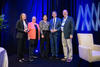
Siamak Sattar Receives the NIBS 2025 Innovator Award

NIST, FEMA, ATC, and STPI were awarded in recognition of their leadership and technical contributions to develop the NIST SP-1254 report to Congress titled “Recommended Options for Improving the Built Environment for Post-Earthquake Re-occupancy and...

Aspasia "Sissy" Nikolaou Receives 2025 Engineer of the Year

Awarded on the basis of her career successes, support to the university, and giving back to her communities. The University of Buffalo School of Engineering and Applied Sciences Alumni Association selected her from among the University of Buffalo's...

Publications

Formulating, Fitting and Fusing Fragility Functions (F5)

Author(s)
Mohammadamin Hariri Ardebili, Siamak Sattar
Fragility functions derived from nonlinear dynamic analysis are a central ingredient in seismic performance assessment and risk analysis of structural systems...

Functional Recovery Performance Targets Workshop Report

Author(s)
Lucy Arendt, Katherine Johnson, Siamak Sattar, Michael Valley, Divya Chandrasekhar, Laurie Johnson, Ryan Kersting
Held in October 2024, the Workshop on Functional Recovery Performance Targets was hosted by the National Institute of Standards and Technology (NIST) and...

News

Blog Posts

Contacts

Group Leader

Was this page helpful?