

Official websites use .gov
A .gov website belongs to an official government organization in the United States.

Secure .gov websites use HTTPS
A lock (
) or https:// means you’ve safely connected to the .gov website. Share sensitive information only on official, secure websites.


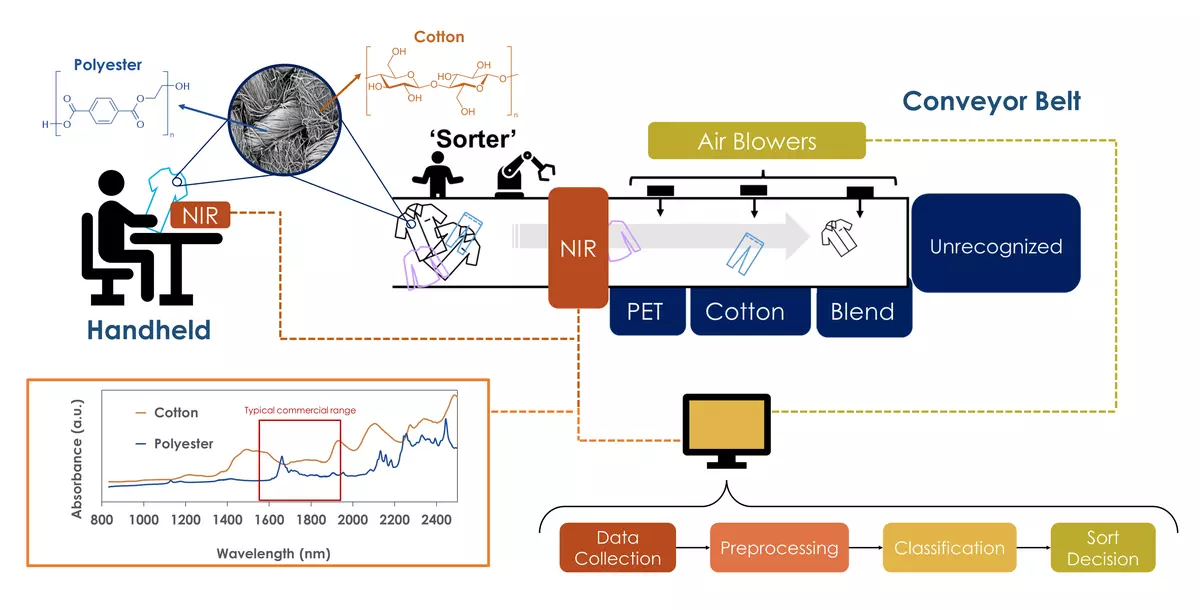
The National Institute of Standards and Technology (NIST) has released NIR-SORT 2.0, a major technical expansion of its spectroscopic fabric characterization dataset. This update provides high-fidelity "molecular fingerprints" essential for the development, benchmarking, and validation of classification models used in automated textile identification systems. Near Infrared Spectra of Origin-defined and Real-world Textiles (NIR-SORT) 2.0 is available for download from the NIST Public Data Repository and also through the Materials Data Framework.
Open-Source, Machine-Readable Data
The identification of fiber content in collected textiles often relies on Near Infrared (NIR) spectroscopy, a rapid and non-invasive technique that detects chemical bond structures. Because NIR spectra are complex, classification models are required to interpret spectral signatures and determine fiber composition.
Validation of these models has historically been limited by the availability of high-quality, open-access reference datasets. Many textiles contain complex or proprietary blends, making it difficult for industry to benchmark the performance of machine learning and artificial intelligence systems used to classify complex fiber compositions.
NIR-SORT 1.0 addressed this by providing a curated, machine-actionable dataset. As of March 2026, the dataset has supported over 400 unique users, including industry stakeholders seeking to refine their sorting algorithms.
Technical Enhancements in NIR-SORT 2.0
Version 2.0 significantly increases the diversity of specimens available for model training and system validation, specifically targeting the challenges of feedstock purity and blend identification.
- Diverse Material Specimens:
- 61 new in-house custom blend specimens, critical for training models to recognize varying fiber ratios.
- 12 new pre-consumer fabrics and 8 undyed fabrics with three previously unrepresented fiber types.
- 12 custom-dyed fabrics to enable analysis of colorant impacts on spectral signatures.
- Expanded Instrumentation Profiles:
- Integration of a new handheld NIR device (Handheld_F).
- Addition of a standoff benchtop experiment (Standoff_Q).
- Introduction of polarized and color imaging microscopy, moving beyond grayscale to provide comprehensive fabric visualization.
Validating the Next Generation of Industrial Sorters
To ensure these models translate from code to the conveyor belt, NIST will soon release Research Grade Test Materials (RGTMs). While the digital dataset supports algorithm development and validation, many partners require physically characterized materials to test integrated hardware and software systems under real-world conditions.
NIST is actively seeking contributors to participate in the comparison study to further validate these materials. This collaborative effort aims to create a standardized framework for identifying textile feedstocks with industrial-level precision.
Get Involved
NIST is already developing NIR-SORT 3.0, which will include more than 50 additional fabrics and enhanced validation methodologies. Feedback from stakeholders is welcome, including suggestions for specific fiber types or fabric compositions.
For inquiries or to participate in the RGTM study, contact the team at fibrils [at] nist.gov (fibrils[at]nist[dot]gov).