

Official websites use .gov
A .gov website belongs to an official government organization in the United States.

Secure .gov websites use HTTPS
A lock (
) or https:// means you’ve safely connected to the .gov website. Share sensitive information only on official, secure websites.


Electronics
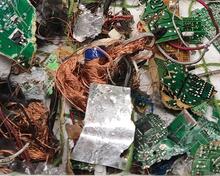
Electronics comprise one of the fastest-growing sectors of the solid waste stream in the U.S., and projections anticipate the stream will continue to grow in the coming decades. Electronics are increasingly complex and contain many valuable materials, including critical minerals and materials, that are lost from the economy if not recovered.
Jump to: Research Activities | Related NIST Workshops | Reference Materials & Reference Data | Tools & Capabilities
Research Activities
Quantitative Elemental Analysis of Electronic Scrap
NIST is investigating the fate of critical minerals in electronics recycling processes to improve their recovery. The activity involves characterizing the elemental compositions of bulk-separated material streams from e-scrap recycling using various analytical methods, including inductively coupled plasma optical emissions spectroscopy (ICP-OES), X-ray fluorescence (XRF), prompt gamma activation analysis, and neutron activation analysis. Understanding how critical minerals are distributed during the initial shredding and sortation process could help identify opportunities for system improvements, such that recyclers can better assess the value of their e-scrap streams and recover more critical minerals. Read more. Contact: Nicholas Sharp.
System and Decision Science for Electronics Recovery
Recovering value from electronic products before they become waste is a growing challenge. NIST research addresses that challenge with investigations into 1) integrated circuit (IC) reuse, and 2) design for circularity. In collaboration with partners, NIST is identifying opportunities and challenges surrounding IC recovery and reuse and developing criteria and a method for determining when IC reuse can be economically viable and environmentally benign. NIST is also partnering to identify attributes that enhance the circularity of consumer electronic products, with a goal of developing a method for applying these attributes in new designs to improve the recoverability of materials and components from future products. Contact: KC Morris.
Related NIST Workshops
Visit the Workshops page to learn about workshops relevant to electronics circularity.
Reference Materials & Reference Data
NIST is exploring the need for new e-scrap reference materials or reference data. Contact: Nicholas Sharp.
Tools & Capabilities
NIST experimental equipment and capabilities relevant to electronics circularity are described on the Tools & Capabilities page.