

Official websites use .gov
A .gov website belongs to an official government organization in the United States.

Secure .gov websites use HTTPS
A lock (
) or https:// means you’ve safely connected to the .gov website. Share sensitive information only on official, secure websites.


Taking Measure
Just a Standard Blog
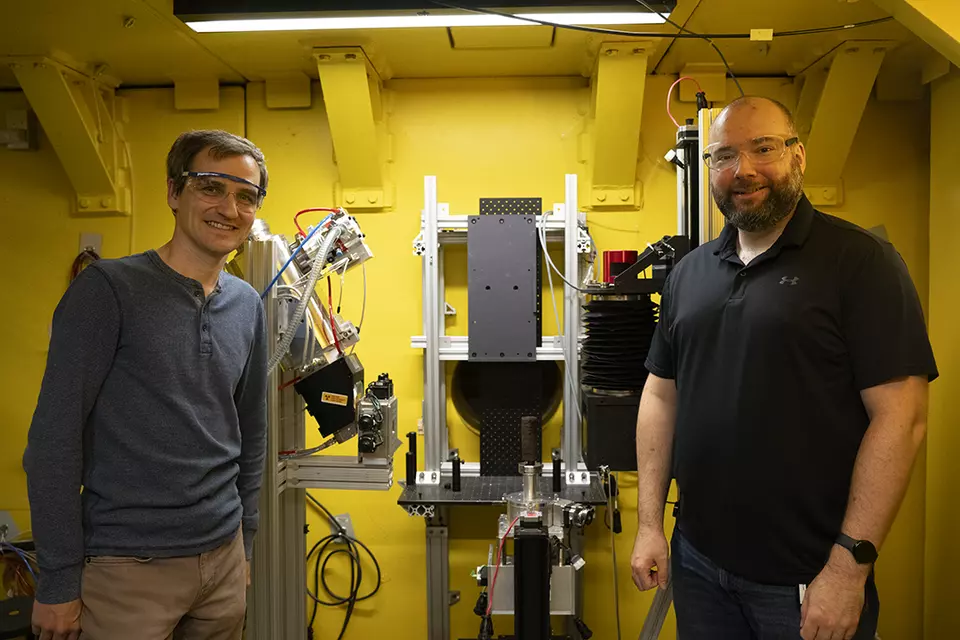
Cyrus Daugherty (left) and Jacob LaManna (right) with the scroll they used to help work toward solving an ancient mystery.
Four years ago, NIST researcher Cyrus Daugherty developed an algorithm to virtually unroll the tightly wrapped layers of a cylindrical lithium-ion battery. Daugherty’s software transformed X-ray images of the battery, taken at different angles, into a CT scan. The scan, a 3D portrait of the battery’s interior, pinpointed hard-to-spot defects and highlighted wear and tear on its electrodes.
This study aims to extend the life of lithium-ion batteries, which power everything from laptops and cellphones to e-bikes and electric cars.
But Daugherty never imagined that his algorithm could serve a very different purpose: helping to decipher a trove of fragile papyrus scrolls. Ancient scholars inscribed these scrolls before the documents were entombed beneath the debris spewed by Mount Vesuvius two millennia ago.
Scrolls Lost, Scrolls Reclaimed
In the fall of 79 C.E., Mount Vesuvius belched a plume of volcanic material thousands of meters into the sky and sent superheated gas clouds, ash and rock racing down its slopes with a force 100,000 times more powerful than an atomic bomb. The eruption obliterated entire towns on the Bay of Naples, including Pompeii and Herculaneum. Residents died gruesome deaths.
But from this singular act of destruction came a remarkable act of preservation.
The superheated volcanic gases and lava sucked the oxygen and moisture from food, furniture, paintings, jewelry, wood and papyrus. Then the volcanic material solidified, burying entire residences —including ancient papyrus scrolls — under cement-like rock. The rock protected these treasures from water seepage, weather and vandalism.
For nearly 1,700 years, these buried time capsules lay undisturbed. But in 1750, workers digging a well discovered the remains of a luxurious villa in Herculaneum, believed to have been owned by Julius Caesar’s father-in-law. The excavation initially revealed dozens of bronze and marble statues, paintings, colorful mosaics and gold jewelry. Two years later, the workers found hundreds of cylinder-shaped lumps of charcoal.
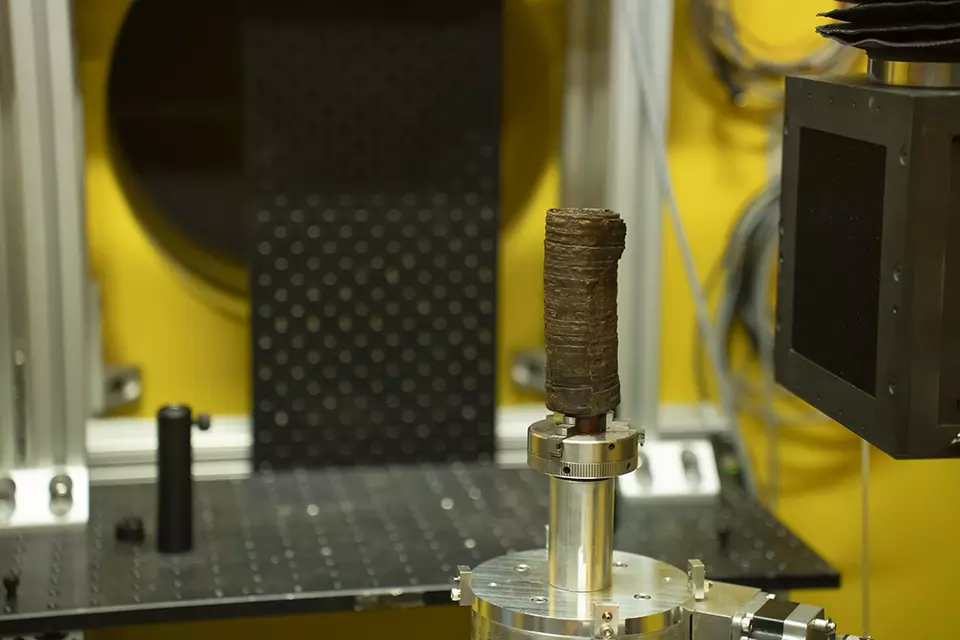
Upon closer inspection, the excavators realized that their latest find was more precious than gold. The lumps were charred papyrus scrolls, the only complete library to have survived from antiquity. Handwritten by Greek scholars and philosophers, the scrolls had remained intact, despite being blackened and turned to brittle charcoal by the eruption of Mount Vesuvius.
Initial attempts to unroll the Herculaneum scrolls proved disastrous. Many of the papyri crumbled to dust. Others were destroyed when they were cut open. Conservators then decided that the remaining scrolls, which had been moved to a library in Naples for safe storage, should be left undisturbed.
Applying Machine Learning to the Scroll Mystery
Fast forward to 2024, when a team of researchers, including computer scientist Brent Seales of the University of Kentucky and his colleagues, X-rayed a few of the inked scrolls. From the X-ray images, the team created CT scans that they used to unroll the scrolls and discern some of the writing, similar to how NIST’s Cyrus Daugherty unrolled the layers of lithium-ion batteries. Also, like Daugherty, Seales developed his own algorithms to decipher the Vesuvius scrolls.

In addition, Seales and his collaborators released the scans to the public as part of the Vesuvius Challenge, an ongoing multimillion-dollar competition to identify and read several inked passages that were not clearly legible. The challenge encourages participants to use machine learning, a form of artificial intelligence in which a computer program improves its accuracy as it processes more data.
So far, competitors have deciphered several passages from one of the Herculaneum scrolls, along with fragments from another.
Going forward, however, efforts to transcribe the writing on many of the scrolls could face a formidable obstacle. Ancient philosophers sometimes used lead-based ink. In other writings, they used carbon-rich ink. Similar to the way dark gray text would be difficult to read on a black background, X-rays cannot easily distinguish the carbon in the ink from the carbon in the charred papyrus.
“You’re basically looking for carbon letters on a carbon scroll, and there’s no contrast between the two,” said NIST researcher Jacob LaManna, who supervised Daugherty’s battery study. Algorithms that seek to identify and read text written in carbon ink must be exceedingly sensitive to succeed.
Replicas to the Rescue
A collaboration between LaManna, Daugherty and research volunteer Douglas Seiler could help address the issue.
Seiler began designing replicas of the ancient scrolls a few years ago using modern Egyptian papyrus. To inscribe the scrolls, he dipped a stylus in carbon-based ink mixed with varying concentrations of lead sulfate. Those mixtures, experts believe, have a composition similar to the ink used in Roman times.
Seiler, along with David Kreimer at the University of California, Berkeley, wanted to mimic the harsh conditions that the Herculaneum scrolls experienced. To do so, they placed each replica scroll into a separate, partially sealed steel container. Then they inserted the containers into a high-temperature furnace with little or no oxygen.
Seiler wondered how easily the replica scrolls could be virtually unrolled and read. A contact at UC Berkeley put him in touch with LaManna. LaManna realized that Daugherty’s algorithm for virtually unrolling the layers of a lithium-ion battery might be adapted for this effort.
Modifying the software wasn’t easy. The layers of a lithium-ion battery are evenly spaced and form a perfect spiral as they wrap around the battery’s core. In contrast, the carbonized papyrus scroll is squashed, with some layers fused.
Attempting to unwind the scroll by treating its wrapped layers as a perfect spiral would result in an unreadable image. It would lead to text from different layers mixing, along with large blank spots.
Nonetheless, in about a week, Daugherty modified his software so that it could examine Seiler’s replicas.
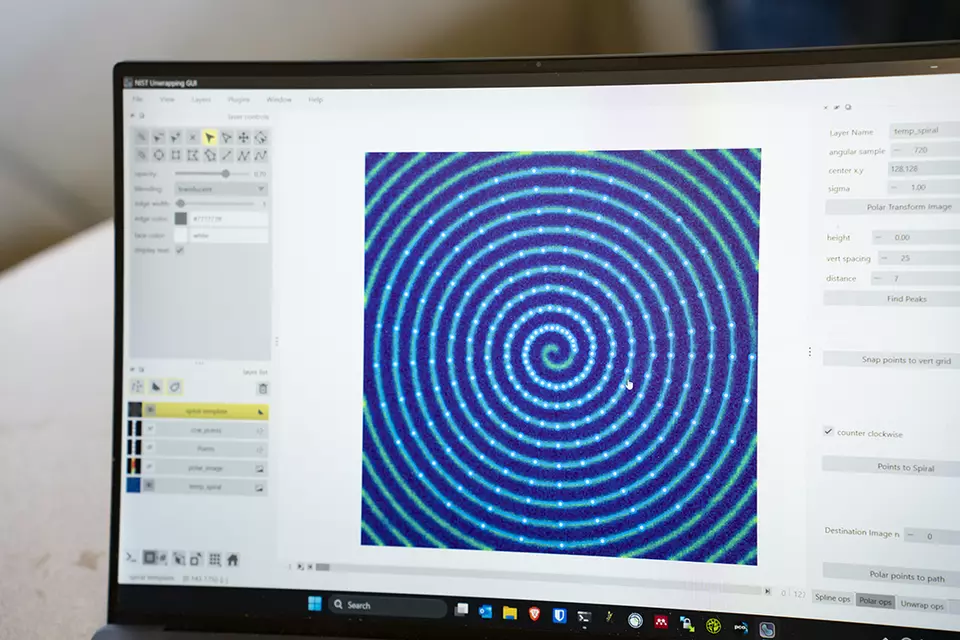
The NIST study had one major advantage over the effort to decipher the ancient scrolls retrieved from Herculaneum. The inscriptions on the replicas were known. Seiler had written them himself but intentionally did not disclose the text to the NIST scientists.
That meant Daugherty’s software could be tested against ground truth. The more accurately the software deciphered the text on the replica scrolls, the more confident the team could be that the software accurately deciphered the text on the ancient scrolls. Daugherty’s algorithm successfully deciphered the text in a matter of days.
The NIST team also realized that the algorithms developed by the Vesuvius Challenge collaboration could be better tested and potentially perfected by applying them to the replica scrolls.
A Fast Way to Select the Most Readable Scrolls
The NIST team made one other contribution, which they report in the Sept. 16 issue of PLOS One. Because lead interacts much more strongly with X-rays than does carbon, LaManna surmised that any of the ancient scrolls inscribed with an ink containing lead salts should be easier to read. That prompted LaManna to wonder: Could he find a rapid, inexpensive and nondestructive way to identify the Herculaneum scrolls written with lead ink?
LaManna found that a common laboratory device, an X-ray spectrometer, met his criteria. The spectrometer shoots X-rays at a material under study. The spectrometer’s X-rays cause every element in the sample to emit its own X-rays in a different, unique pattern. These “fingerprints” allow researchers to rapidly and inexpensively identify elements, including lead, in the material.
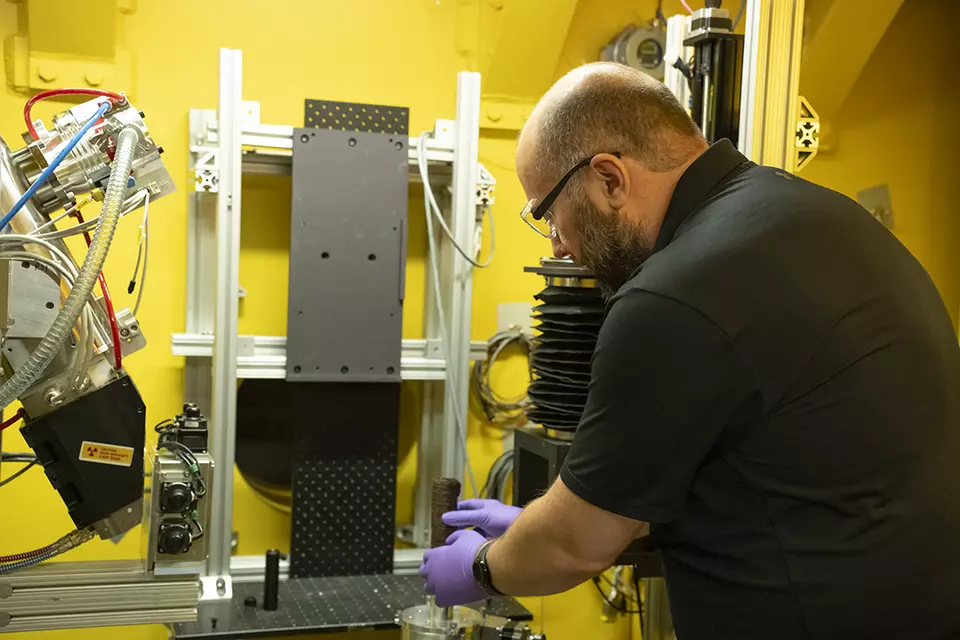
In their paper, LaManna and his colleagues propose a process for deciphering the Herculaneum scrolls using the spectrometer and their team’s algorithm.
Leaders of the Vesuvius Challenge are aware of the NIST study but have not yet decided whether to incorporate its findings into their study of the Herculaneum papyri, LaManna noted.
Modern Technology and Ancient History
In the meantime, Daugherty hopes to continue his study of lithium-ion batteries, probing the cells with subatomic particles called neutrons.
“Although the scrolls are definitely interesting in their own ‘Indiana Jones’ kind of way, I’m an electrochemist, and my primary research interest is batteries,” he said.
Still, LaManna said he hopes ongoing efforts using artificial scrolls will help build better algorithms to read the real ones.
“It’s been fascinating to see how the tools we develop for very specific applications can be applied to unconventional applications, especially in rediscovering ancient history,” he said.



Thanks Ron for a great article. The focus on how re-use of a technology was applied to new problem was great to see an someone who develops solutions and looking at AI driven solutions in the fed as well as open source space. Proud of NIST and your scientists / data scientists.